How to Show Communication Skills on Your Resume | Careerkit
Home/Blog/Guide/How to Show Communication Skills on Your Resume
Guide
How to Show Communication Skills on Your Resume
Communication skills on a resume: the exact skills recruiters look for, where to list them, and resume bullet point examples that prove them with real results.
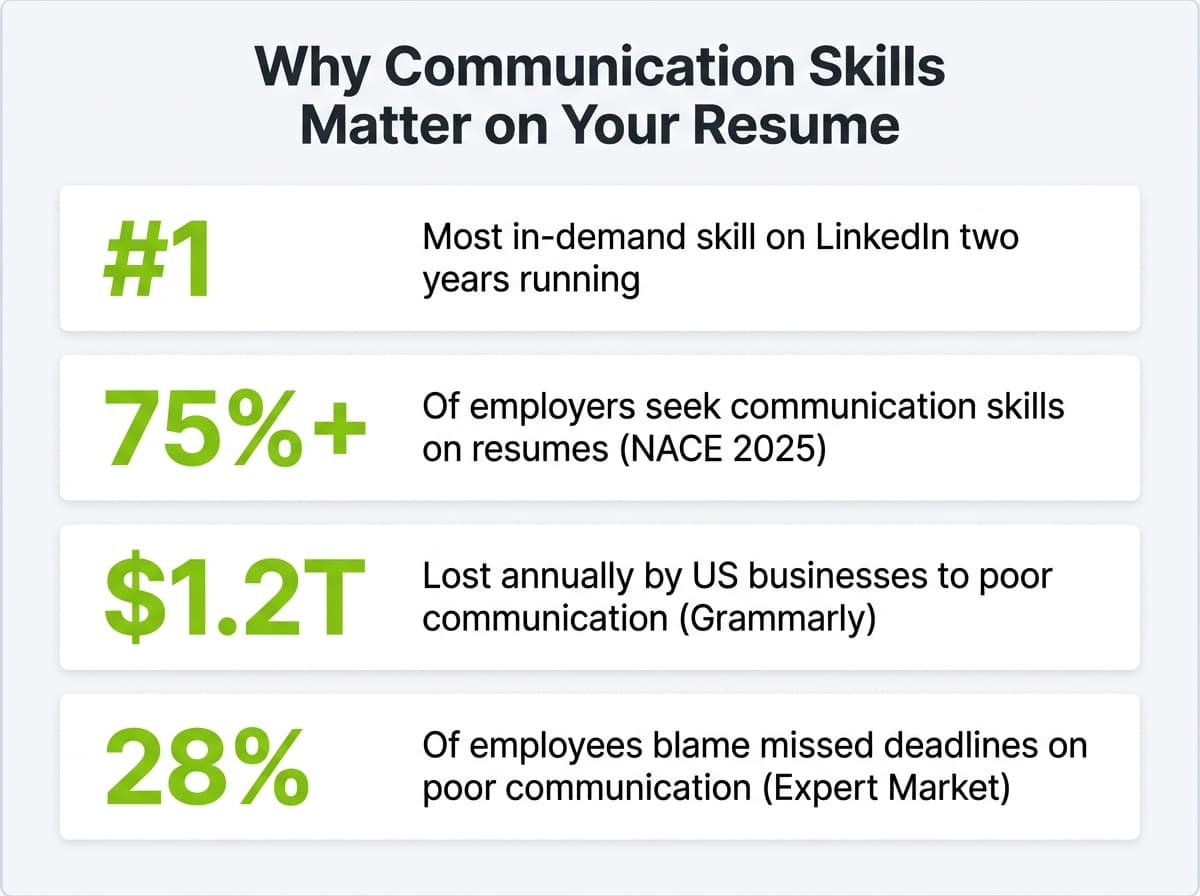
Every resume claims "excellent communication skills," but that phrase alone won't get you an interview. According to LinkedIn's Most In-Demand Skills report, communication has been the number one skill employers look for two years running. And the NACE Job Outlook 2025 survey found that more than 75% of employers specifically seek communication skills on resumes, ranking them alongside problem-solving and teamwork.
The cost of getting communication wrong is staggering. Research from Grammarly and The Harris Poll estimates that US businesses lose $1.2 trillion annually due to ineffective workplace communication, roughly $12,506 per employee each year. That is why hiring managers do not just want to read the word "communicator" on your resume. They want proof.
This guide breaks down the specific communication skills recruiters are looking for in 2026, shows you how to identify your strongest ones, and walks you through exactly how to present them on your resume with real examples and measurable results.
What Are Communication Skills and Why They Matter
Communication skills go far beyond speaking clearly in a meeting. They encompass every way you share and receive information at work, from writing an email to reading body language in a negotiation. Below is a breakdown of what these skills actually include and the hard data behind why employers value them so highly.
Professional success in today's workplace depends on communication skills. These skills help people share information with others in personal and professional settings. Communication skills aren't just one skill - they're a complete set of tools that help convey ideas, information, and emotions clearly.
The National Association of Colleges and Employers (NACE) defines this career readiness competency as knowing how to share information clearly and effectively with people inside and outside of an organization, including ideas, facts, and professional viewpoints. This definition shows these skills go far beyond just speaking well.
Components of Effective Communication
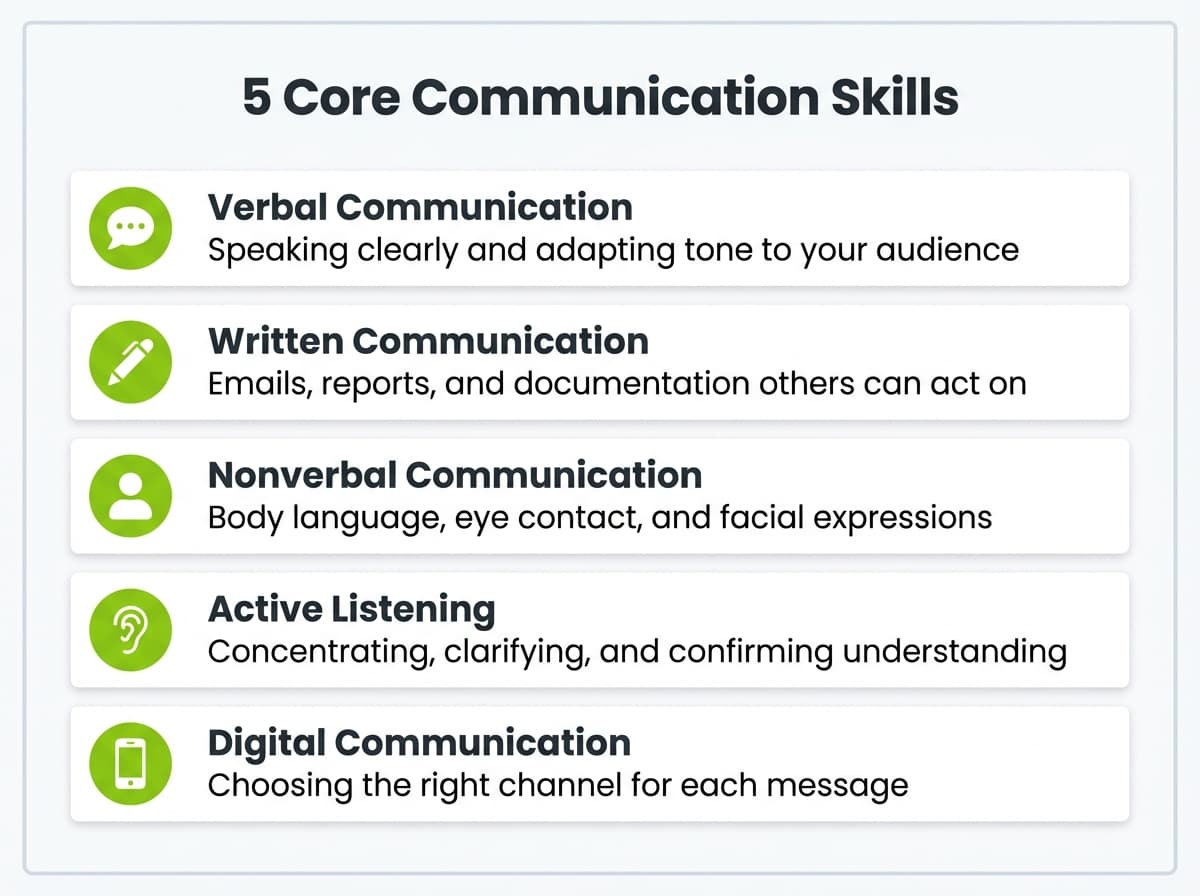
Good communication includes several connected abilities that work together. Verbal communication means speaking clearly and adjusting your tone, pace, and word choice for different audiences, whether you are presenting to executives or explaining a process to a new hire. Written communication covers everything from crafting concise emails to producing detailed reports, proposals, and documentation that others can reference later.
Nonverbal communication plays a supporting role through body language, facial expressions, posture, and eye contact. These cues can reinforce your spoken message or, if misaligned, undermine it entirely. Active listening goes beyond simply hearing words. It requires full concentration, thoughtful responses, and clarifying questions that show the speaker you genuinely understand their point.
Finally, digital communication has become its own distinct category in the modern workplace. Choosing the right channel for the right message, whether a quick Slack note, a formal email, or a video call, is a skill that separates effective communicators from the rest.
Why Communication Skills Matter
These skills mean more than just simple workplace interactions. The NACE Job Outlook 2024 survey found that nearly 90% of employers want problem-solving abilities in candidates, and about 80% look for strong teamwork skills. At least two-thirds of employers also seek candidates with written and verbal communication skills, placing these competencies among the top attributes on every hiring checklist.
Poor communication hurts workplace efficiency. A survey by Expert Market found that 28% of employees cite poor communication as the reason they could not deliver work on time. According to Grammarly's State of Business Communication report, US businesses lose an estimated $1.2 trillion per year due to ineffective communication.
Strong communication creates a ripple effect across every part of your work life. Teams that communicate well collaborate more efficiently because misunderstandings drop and everyone stays aligned on shared goals. On an individual level, clear communication builds trust and genuine connections with colleagues, which creates the kind of positive work environment people want to stay in.
Goal clarity is another direct benefit. When employees understand exactly what is expected of them, they deliver better results, and that clarity boosts both job satisfaction and morale across the team. Your communication style also has a direct impact on career advancement. Whether you are presenting a quarterly report to leadership, negotiating a promotion, or networking at an industry event, how you communicate shapes how others perceive your competence and potential.
Perhaps most importantly, communication drives problem-solving. Active listening helps you understand the root of an issue, and clear articulation of ideas helps you rally a team around a solution. A project manager who can translate a client's vague frustration into a concrete action plan for the engineering team is worth far more than one who simply relays messages.
Here is what this looks like in practice. Imagine two project managers handling a delayed product launch. The first sends a one-line email: "Launch is delayed, new date TBD." The second writes a brief update explaining the reason for the delay, the revised timeline, and the specific next steps each team member should take. The second manager's team knows exactly what to do, stays motivated, and hits the new deadline. The first manager's team spends the next two days asking follow-up questions and losing momentum. Same situation, different communication, completely different outcome.
Job seekers must show these skills, and knowing where each section belongs on your resume is the first step toward doing that effectively. NACE lists communication as one of the main Career Readiness skills that potential employees need during their job search. Being skilled at communication helps others see your value and potential clearly.
Organizations benefit from employees with good communication skills too. Better information sharing leads to improved collaboration. This helps make smarter decisions that help the company's bottom line.
Top Types of Communication Skills for Resume
According to a 2018 eye-tracking study by Ladders, recruiters spend an average of 7.4 seconds on an initial resume scan before deciding whether to keep reading. Those seconds are your window to showcase the right communication skills. Below are the specific types that carry the most weight with hiring managers, along with guidance on how to frame each one using the Careerkit skills generator to match your experience to the role.
Verbal communication
Verbal communication means expressing ideas clearly and confidently through spoken language. This basic skill includes how you express thoughts, present information, and interact verbally with others.
People who excel at verbal communication speak with clarity and precision. They can make complex information accessible to different audiences and adapt their style based on the situation and who is listening. On a resume, this translates into skills like public speaking and presentation delivery, interpersonal communication, persuasion and negotiation, and the confidence to share ideas clearly in high-stakes settings.
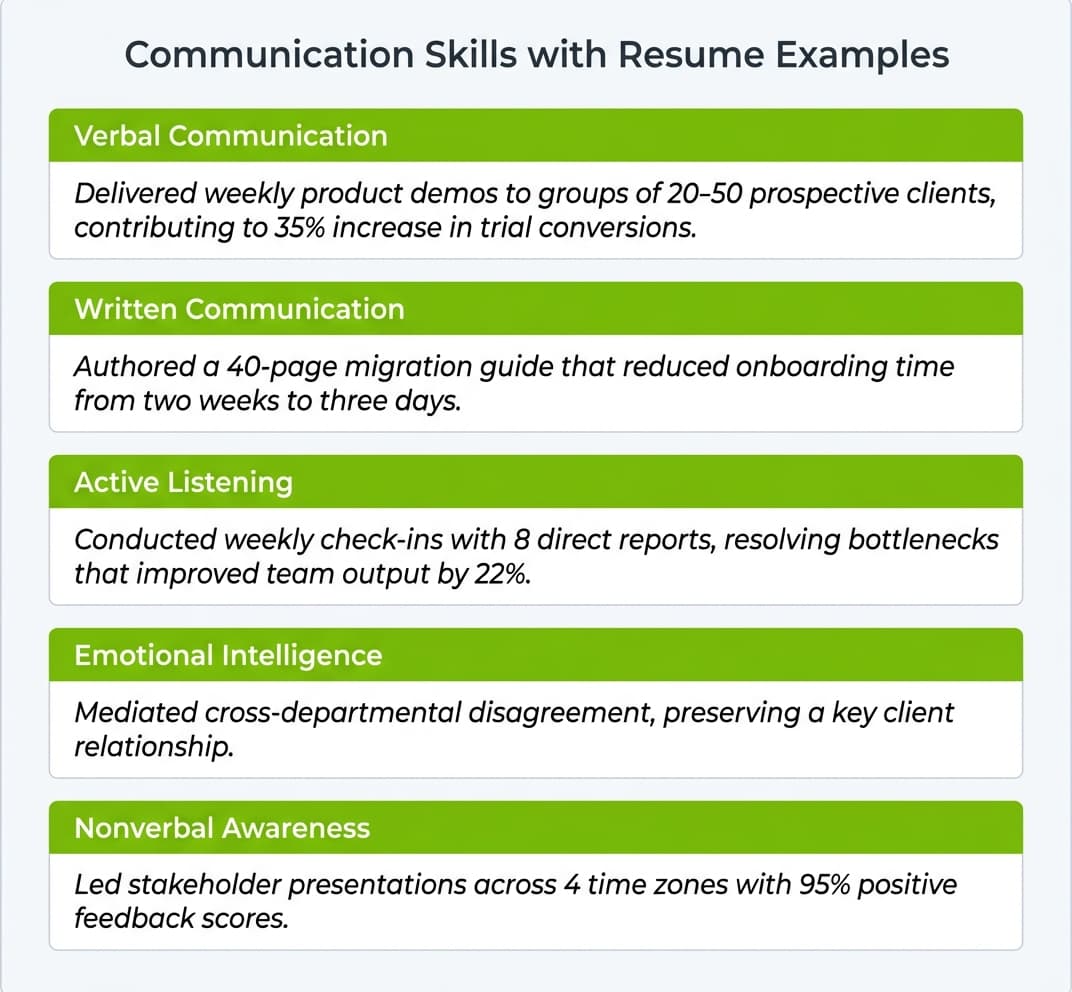
Here is what this looks like as a resume bullet point:
"Delivered weekly product demos to groups of 20 to 50 prospective clients, contributing to a 35% increase in trial-to-paid conversion over six months."
Compare that to simply writing "strong verbal communicator." The first version shows the skill in action with a measurable result.
Written communication
Written skills help you share information through text, from emails and reports to formal presentations. Written communication creates a permanent record that people can refer to later.
Strong written communication on your resume shows you can write clearly and directly, edit and proofread for grammar and clarity, adjust your writing style for different audiences, and create well-structured documents that people actually use. Many professional settings need people who can turn complex technical information into simple language that both technical and non-technical team members can understand.
Here is a strong resume example:
"Authored a 40-page technical migration guide that reduced new developer onboarding time from two weeks to three days."
And here is a weak version of the same experience:
"Wrote documentation for the team."
The difference is specificity. The first tells a hiring manager exactly what you wrote, who it helped, and what changed because of it.
Nonverbal communication
Nonverbal communication plays a significant role in how your message is received. The widely cited claim that "93% of communication is nonverbal" is actually a misinterpretation of Albert Mehrabian's 1967 research, which only applied to situations where spoken words and facial expressions were contradictory. In real workplace conversations, words obviously matter a great deal. But nonverbal cues like posture, eye contact, and tone of voice still shape how colleagues and hiring managers perceive your confidence and credibility.
Nonverbal communication includes body language, facial expressions, eye contact, posture, and gestures. These elements can support or contradict your spoken message, making them vital for effective communication.
The nonverbal skills that matter most in a professional setting include maintaining appropriate eye contact during conversations, using purposeful gestures that reinforce rather than distract from your message, projecting confident posture, reading other people's body language accurately, and being aware of personal space norms across different cultural contexts. While you cannot list "good eye contact" on your resume, you can demonstrate nonverbal awareness through achievements like successful client presentations, stakeholder management, or cross-cultural collaboration.
Active listening
Active listening means more than just hearing words. You need to concentrate fully, understand, respond, and remember what someone says. This skill shows you can connect with others and build trust.
To name just one example, active listening helps you understand customer's concerns, show empathy, and provide targeted solutions. This builds stronger professional relationships and better problem-solving.
The active listening skills worth highlighting include giving full attention without interrupting, asking clarifying questions to confirm understanding, restating and summarizing key points, responding thoughtfully rather than reactively, and picking up on nonverbal signals that accompany spoken messages. On a resume, active listening shows up through results like improved customer satisfaction scores, faster conflict resolution, or better team alignment after meetings you facilitated.
Here is an example:
"Conducted weekly one-on-one check-ins with eight direct reports, identifying and resolving workflow bottlenecks that improved team output by 22%."
Empathy and emotional intelligence
Empathy is the life-blood of emotional intelligence. It means understanding other people's viewpoints and feelings. Empathetic leaders inspire loyalty and motivation by showing genuine care for team members.
Emotional intelligence helps you handle your emotions while recognizing and influencing others' feelings. A Catalyst study of nearly 900 US employees found that 76% of people with highly empathetic senior leaders reported being engaged at work, compared to just 32% of those with less empathetic leaders. Your resume should show emotional intelligence through concrete situations where you understood and respected different viewpoints, handled conflicts constructively, built connections across diverse teams, managed your own emotional responses under pressure, or delivered difficult feedback with care. The key is to frame these as outcomes, not personality traits.
Here is an example:
"Mediated a cross-departmental disagreement over resource allocation, facilitating a compromise that kept both teams on schedule and preserved a key client relationship."
How to Identify Your Strongest Communication Skills
You need honest self-assessment and external validation to identify your best communication skills. Technical abilities can be measured through tests or certifications, but communication strengths show up through experience and feedback. Let me show you some practical ways to spot your communication assets.
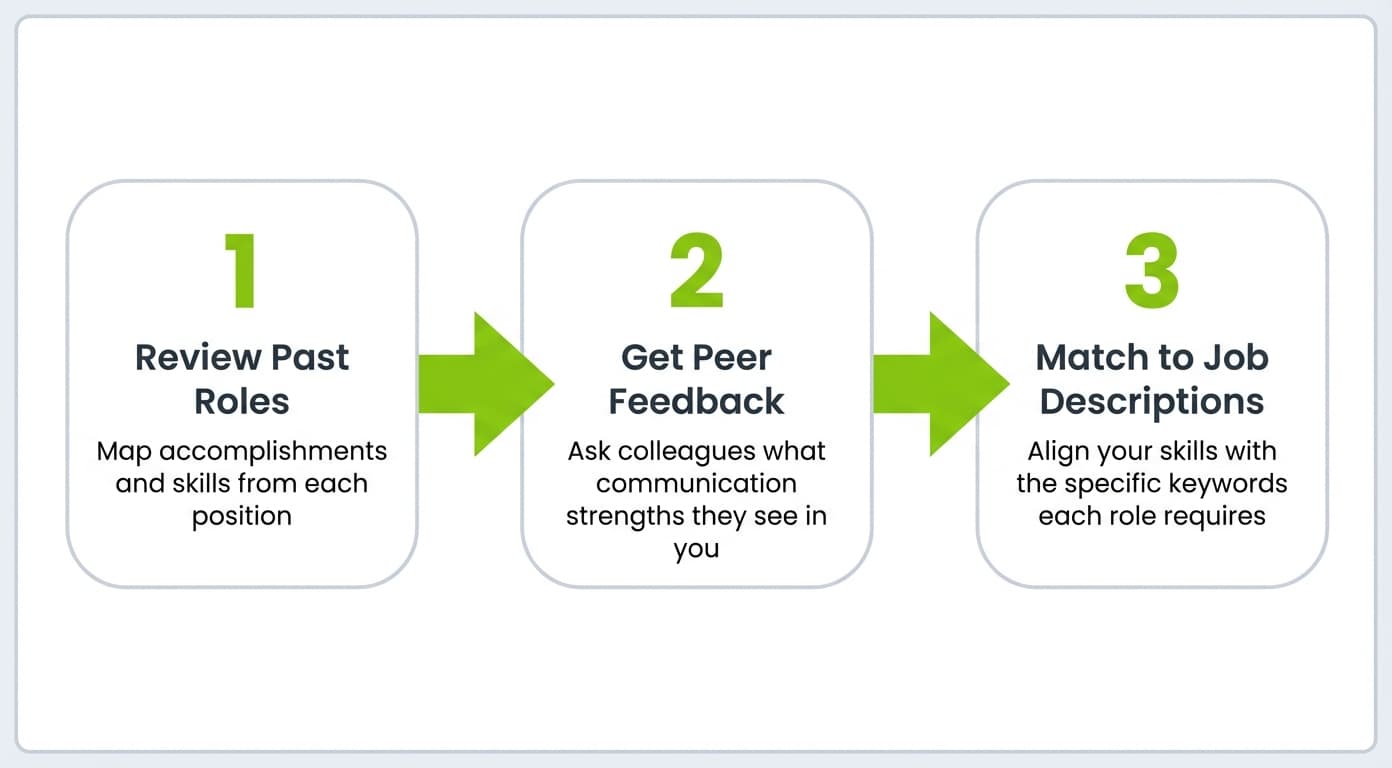
Review past roles and responsibilities
Your professional history reveals a lot about your communication strengths. Start by creating a work timeline that maps key accomplishments across your career, noting the hard and soft skills you used at each milestone. Keep a running work diary where you track daily or weekly tasks and the communication skills each one required. Then look at the different roles you have held, whether as a researcher, team lead, trainer, or client-facing representative, and list the specific communication tasks each position demanded.
Once you have identified your strongest communication skills, a structured template makes it easier to present them. The Careerkit resume builder lets you organize your skills, experience, and summary in a format that is already optimized for ATS scanning. Maybe you explained something complex in a clear way, solved a conflict, or wrote documentation that helped others.
Don't just list tasks - focus on skills. Rather than saying "led team meetings," highlight the skill: "coordinated discussions that boosted team efficiency by 30%". This turns basic descriptions into solid proof of what you can do.
Ask for feedback from peers or managers
Other people often see strengths in us that we miss. Research shows that honest opinions from trusted sources can point out areas where you excel:
Start by requesting honest feedback from people who have seen you communicate in different situations, including long-term clients, meeting colleagues, and family members who know how you handle pressure. Try recording yourself speaking so you can review both your words and your body language. Video is especially helpful because it lets you see your complete communication style from the audience's perspective.
Ready to land your dream job?
Join 50,000+ job seekers who have already transformed their careers with our AI-powered resume builder.
Ask specific questions instead of broad ones about "communication skills." Try questions like: "How well do I explain technical concepts?" or "Are my written instructions clear enough?" You'll get more practical answers this way.
When people give feedback, don't explain or defend yourself. Just say: "Thank you. I'll think about that". This shows respect for their input and gives you time to process it.
Match skills to job descriptions
Job posts show what communication skills employers want most. Reading these descriptions helps you spot where your strengths fit market needs:
Read job listings carefully and look for communication-related keywords beyond generic phrases like "excellent communicator." Pay attention to specific skills the role requires, such as presenting to stakeholders, influencing cross-functional teams, writing technical documentation, or managing client relationships. Then tailor roughly 20% of your resume to match each job's communication requirements while keeping the other 80% consistent across applications.
Employers want more than just "good communication skills." They look for people who work well with colleagues and clients, handle tough conversations, solve conflicts, and fit specific workplace settings—whether in teams, remote work, or formal presentations.
New to the workforce or changing careers? No problem. Your personal projects, academic work, and activities outside work can show strong communication skills. Our guide for writing your first resume walks you through how to connect these experiences to workplace situations, even without years of professional experience.
A clear picture of your communication strengths emerges when you review your experiences, get honest feedback, and match your skills to job requirements. This knowledge helps you present these abilities effectively on your resume.
How to Show Communication Skills on Your Resume
A good resume shows your communication skills to potential employers. Your way of presenting communication abilities can affect hiring decisions. Poor presentation might cost you interview opportunities. Let's look at proven ways to highlight these vital skills.
Use action verbs and measurable results
Strong action verbs grab attention and show your communication prowess without saying it directly. Start each bullet point with powerful verbs that show your communication capabilities:
Strong communication-focused action verbs include addressed, arbitrated, authored, collaborated, corresponded, drafted, facilitated, influenced, interpreted, mediated, negotiated, persuaded, presented, and promoted. Words like "coordinated," "directed," and "negotiated" immediately signal communication ability and carry far more weight than generic phrases like "responsible for" that recruiters see hundreds of times a day.
Words like "coordinated," "directed," and "negotiated" show strong communication abilities. They work better than generic terms like "responsible for" that recruiters see often. These power verbs paint a clear picture of what you can do.
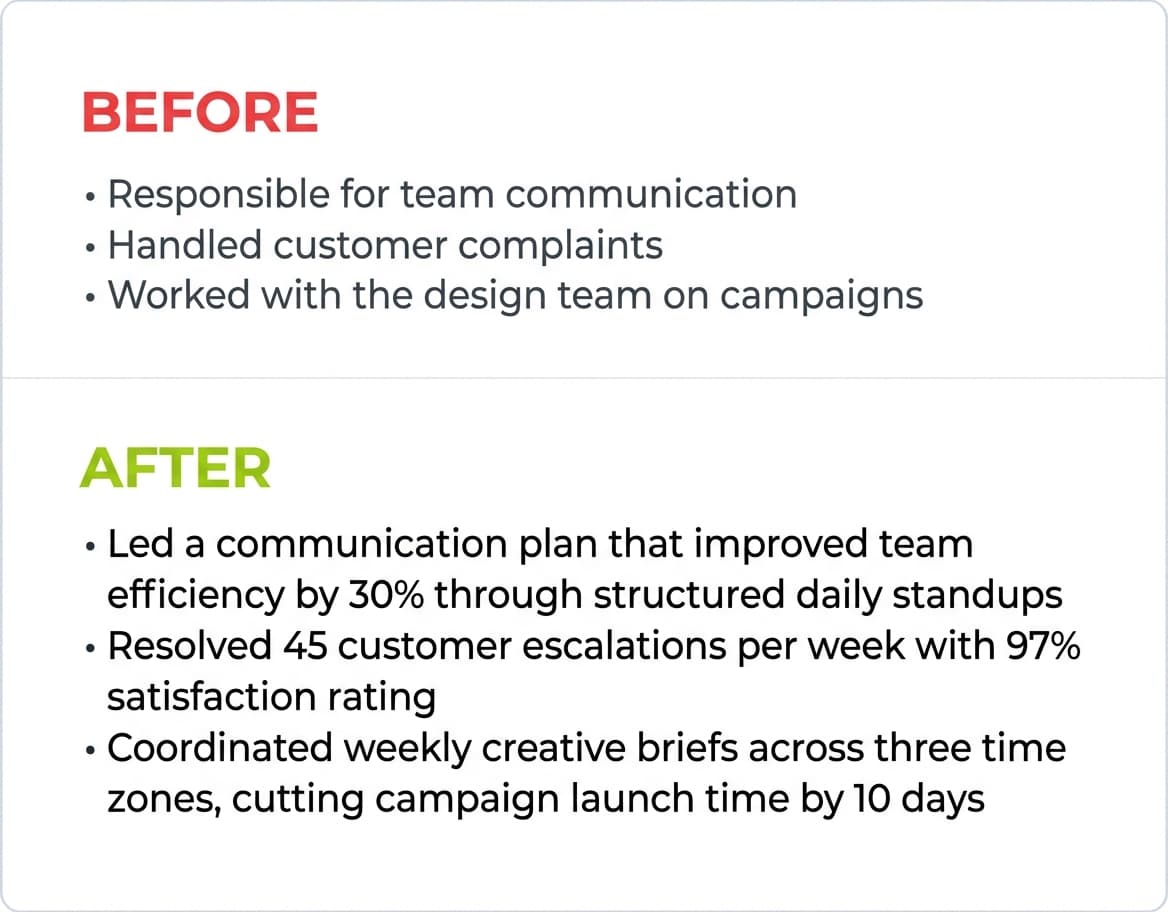
Notwithstanding that, verbs alone won't do the job. Adding numbers to your achievements turns vague statements into solid proof. To name just one example, see this change:
Weak: "Responsible for team communication."Strong: "Led a plan that improved team efficiency by 30% through structured daily standups and weekly status reports."
This shows both how you communicate and what it achieved. Add numbers whenever you can to show scope (audience size, frequency), efficiency (time saved), or quality (satisfaction scores).
Here are two more before/after examples across different roles:
Strong: "Resolved an average of 45 customer escalations per week using active listening and de-escalation techniques, achieving a 97% satisfaction rating on post-call surveys."
Weak (marketing): "Worked with the design team on campaigns."
Strong: "Coordinated weekly creative briefs between the marketing and design teams across three time zones, reducing revision cycles from four rounds to two and cutting campaign launch time by 10 days."
Tailor examples to the job description
Before writing your resume, analyze the job description to find communication-related keywords. Find out which specific communication skills the job needs—presenting, influencing, managing, or writing. Note these requirements and add relevant examples.
Skip generic statements like "excellent communicator." Employers want people who can work well with colleagues and clients, talk about performance, solve conflicts, and communicate in specific work situations.
So highlight experiences that show exactly how you've used these skills:
"Managed international stakeholders in India, the United Kingdom, and Hong Kong through daily standups and weekly status reports."
This example shows you can communicate across different cultures and time zones—valuable for global organizations.
Include both soft and hard communication skills
The right mix of technical expertise and people skills is vital to show you're a well-rounded candidate. Employers look for people who can do specific tasks and work well with others.
Show how you've used hard communication skills in real situations instead of just listing them. Rather than writing "strong written communicator," say: "Wrote technical documentation for the API migration project, reducing new developer onboarding time from two weeks to three days."
Add soft communication skills through achievement descriptions. Instead of writing "team player" or "excellent communicator," show these qualities through accomplishments:
"Negotiated with cross-functional teams to complete a complex client project. We resolved conflicting priorities and delivered two weeks early."
Yes, it is true that your resume itself shows your written communication skills. Keep a professional structure without spelling and grammar errors. If you are building your resume from scratch, use a clean template that lets your content speak clearly. Make each section clear to show you can communicate well and stay organized.
Your communication abilities should link to business results. Note that communication without results is just talking. Even with limited space, each point should connect your communication method to a positive outcome. This shows you know that good communication achieves results, not just shares information.
The best proof of communication skills comes from showing, not claiming them. Use carefully written, achievement-focused bullet points that demonstrate your proven abilities.
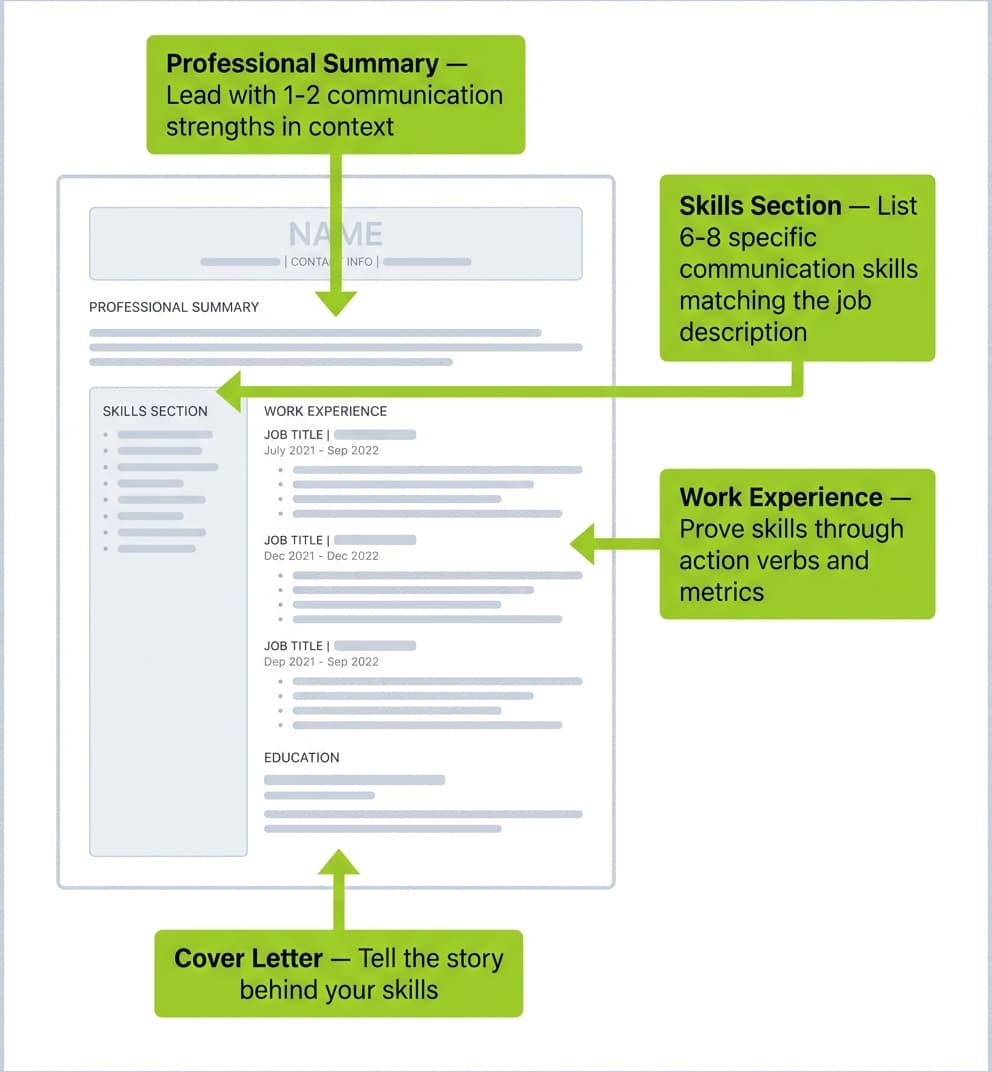
Where to Include Communication Skills in Your Resume
Smart placement of your communication skills throughout your resume boosts your chances of getting past automated screening systems and human recruiters. The right spots to showcase these abilities make the difference between getting noticed or overlooked.
Professional summary
Your professional summary appears at the top of your resume. This prime spot helps highlight your best communication abilities. The section should be brief yet influential—3-4 lines that catch attention right away.
This opening needs 1-2 main communication strengths with quick context instead of generic skills. Rather than writing "excellent communicator," you could write:
"Highly motivated communications specialist with five years of experience in communications and public relations. Tech-savvy professional seeking a rewarding digital communications manager position for a mission-driven organization."
This approach shows your expertise while proving your written communication skills through clear, direct language.
Here is a second example for a non-communications role:
"Senior project manager with seven years of experience leading cross-functional teams of 15 or more across distributed offices. Known for translating complex technical requirements into clear stakeholder updates that keep projects aligned and on schedule."
This works because it does not say "excellent communicator." It demonstrates communication through the specific actions described.
Skills section
The skills section is a great way to get 6-8 relevant communication abilities that match the job description. This section needs to be easy to scan so recruiters can spot your capabilities quickly.
You might include specific communication abilities such as confident public speaking, empathic listening, persuasive writing, stakeholder presentation, negotiation, cross-cultural communication, or technical documentation. The key is to pick six to eight skills that directly match the language in the job description rather than listing generic terms.
The key is to avoid listing "communication skills" without context. Link these abilities to results—did your presentations shape decisions? Did your written communication cut down errors? Did your listening skills boost customer satisfaction?
Work experience section
The work experience section proves your communication expertise through real examples. Each responsibility needs concise statements that start with strong verbs.
Every position should show how you used communication skills. To name just one example, if you worked in customer service, explain how you helped customers understand and meet their needs.
Change vague statements into solid proof with numbers:
"Led weekly team meetings to set project goals, resulting in 95% on-time project completion."
"Resolved customer complaints with 95% satisfaction rate by using active listening techniques."
"Presented quarterly reports to executive leadership and secured approval for three new initiatives."
Your examples should show both written and verbal communication abilities. Add situations where you made business deals or worked with teams to finish projects.
Cover letter (bonus tip)
Your cover letter lets you show the communication skills needed for most jobs. The document itself shows your written communication abilities, so careful writing and editing matter.
Unlike your resume, your cover letter should tell your qualifications and motivation through a compelling story. Build it with a clear introduction, focused body paragraphs, and brief conclusion.
A well-written cover letter helps you show your skills, leave a lasting impression, and earn an interview. If you are unsure how a cover letter differs from a resume, the short answer is that your resume lists evidence while your cover letter tells the story behind it. Use this space to weave your experiences into a narrative that shows why you are the right fit for the role. You can build your cover letter here using a template that matches your resume.
Here is a short example of how to weave communication skills into a cover letter opening:
"In my current role at Meridian Solutions, I lead a weekly cross-functional sync between engineering, design, and product, a meeting that started as a 90-minute free-for-all and now runs in under 30 minutes with clear action items. That ability to bring structure and clarity to complex conversations is exactly what drew me to this role."
Examples of Communication Skills in Resume Bullet Points
Well-crafted bullet points can turn an ordinary resume into a powerful showcase of your communication abilities. These real-world examples show you how to showcase your communication skills in ways that strike a chord with hiring managers.
Led weekly team meetings to arrange project goals
Leaders need exceptional communication skills to keep projects moving while promoting team collaboration. These meaningful examples show why:
"Led a team of 12 to achieve 30% revenue growth through structured weekly meetings that aligned individual contributions with strategic objectives"
"Facilitated cross-departmental communication that shortened resolution time for complex cases by 50%"
"Orchestrated team meetings to research and brainstorm solutions, creating camaraderie that improved team efficiency"
These bullet points work because they are specific. You demonstrate your communication skills' business value by including both the method (leading meetings) and results (revenue growth, shorter resolution times).
Resolved customer complaints with 95% satisfaction rate
Customer service roles give you excellent chances to highlight your communication expertise through conflict resolution and problem-solving:
"Resolved over 500 customer complaints monthly, achieving a 98% satisfaction rate through effective communication and issue resolution techniques"
"Managed an average of 120 customer inquiries daily, consistently meeting call resolution targets and reducing repeat calls by 20%"
"De-escalated tense confrontations between customers, resulting in peaceful resolutions and maintaining the company's reputation for exceptional service"
Measuring your achievements turns general statements into solid proof. Each example links communication methods to specific outcomes or metrics, making them more powerful than just saying "good at resolving conflicts."
Presented quarterly reports to executive leadership
Your presentation skills show how well you communicate complex information to different audiences clearly and persuasively: Industry-specific communication examples
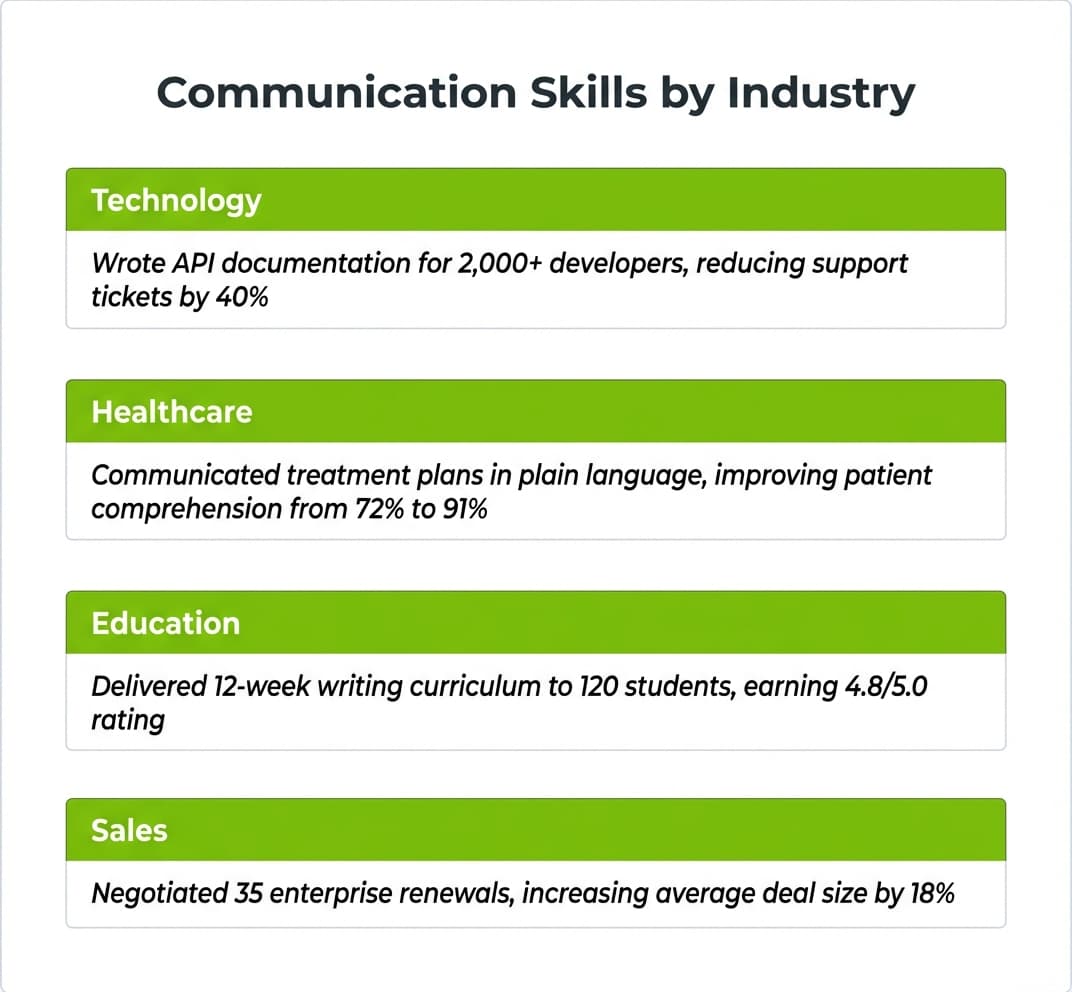
Different industries value different communication skills. Here are additional examples you can adapt for your own resume:
Technology:
"Wrote release notes and API documentation for a developer audience of 2,000 plus, reducing support tickets related to new features by 40%."
Healthcare:
"Communicated treatment plans to patients and families using plain language, improving patient comprehension scores from 72% to 91% as measured by post-visit surveys."
Education:
"Designed and delivered a 12-week curriculum on professional writing for 120 undergraduate students, receiving a 4.8 out of 5.0 instructor rating."
Sales:
"Negotiated contract renewals with 35 enterprise accounts, using consultative communication to increase average deal size by 18% year over year."
Numbers make your presentations more impressive. You should mention your audience size, how often you present, or better yet, the results you achieved through your communication efforts.
Specific examples prove your communication skills better than just claiming to be "an excellent communicator." These bullet points showcase your proven abilities and give employers solid reasons to believe you'll be valuable to their organization.
Make Your Communication Skills Work For You
Communication skills are not a box to check on a resume. They are the thread that runs through every section, from your professional summary to your cover letter. The difference between candidates who land interviews and those who get filtered out often comes down to one thing: showing rather than telling.
Instead of writing "excellent communicator," show that you led meetings that moved projects forward, wrote documentation that saved your team hours, or resolved conflicts that kept client relationships intact. Every bullet point on your resume is a chance to prove your communication skills through specific actions and measurable outcomes.
If you are ready to put this into practice, start building your resume now and let the examples and structure do the talking for you.
The strongest communication skills for a resume include verbal communication such as public speaking and presentations, written communication like reports and documentation, active listening, negotiation, conflict resolution, and cross-cultural communication. Always tailor your list to match the specific language used in the job description rather than using generic terms.
Use your work experience bullets to demonstrate communication in action. Start each bullet with a strong action verb like "presented," "negotiated," or "authored," then include what you did, who was involved, and the measurable result. For example, "Presented quarterly performance reports to a leadership team of 12, securing approval for three new initiatives" is far more convincing than "strong communication skills."
Both. List six to eight specific communication skills in your skills section using keywords from the job posting, such as "stakeholder communication" or "technical writing." Then back them up with concrete examples in your work experience bullets. This combination satisfies both ATS keyword scanning and human reviewers.
Verbal communication covers speaking-based skills like presentations, meetings, phone calls, and negotiations. Written communication covers text-based skills like emails, reports, proposals, and documentation. Most roles need both, but the balance shifts depending on the position. A sales role leans more on verbal skills while a content or technical role leans on written ones.
Draw from academic projects, volunteer work, student organizations, and personal projects. Leading a group presentation, writing for a student publication, organizing an event, or tutoring peers all demonstrate communication skills. Frame them the same way you would professional experience: describe the situation, your communication role, and the outcome.
Yes. Applicant tracking systems scan for exact keyword matches from the job description. If the posting says "stakeholder management" and your resume says "working with stakeholders," the ATS may not make the connection. Mirror the exact phrasing from the job listing in both your skills section and your experience bullets.
Put this advice to work
You just read the theory. Careerkit's AI builder turns it into an ATS-ready resume, tailored to the job you want.
Nishant Modi is the founder of Careerkit.me and a product builder based in Zürich, Switzerland. With a background in product management, marketing & management consulting, he transitioned into AI entrepreneurship after experiencing the frustration of outdated job search tools firsthand. He built Careerkit to give every job seeker access to professional grade resume tools, the platform has helped over 10,000 candidates create ATS optimized resumes. He writes about resume strategy, hiring trends, and what actually gets people hired.