A recruiter spends less than a minute on your resume before deciding whether to keep reading. In that window, the skills section is often the first thing they scan, and it is also the first thing an Applicant Tracking System (ATS) parses when ranking you against other applicants.
Watch: how to write a resume, section by section (with the data)
Yet most job seekers treat it as an afterthought, dumping a random list of buzzwords at the bottom of the page. That approach fails both the human reader and the software filter.
This guide breaks down exactly how to write a skills section that works. You will learn which types of skills to include, how to pull the right keywords from any job description, where to place skills across your resume for maximum impact, and how to format everything so it clears ATS screening. Each section includes real resume examples you can adapt for your own resume build, whether you are a seasoned professional or writing your first resume.
Why the Skills Section Matters
A strong skills section is the life-blood of a resume that works. Job seekers often fail to realize its value, yet this compact component can substantially affect their success in finding work.
The skills section isn't just another resume element, it gives you a great chance to highlight your qualifications. This dedicated area brings several benefits that boost your interview prospects.
How hiring managers use the skills section
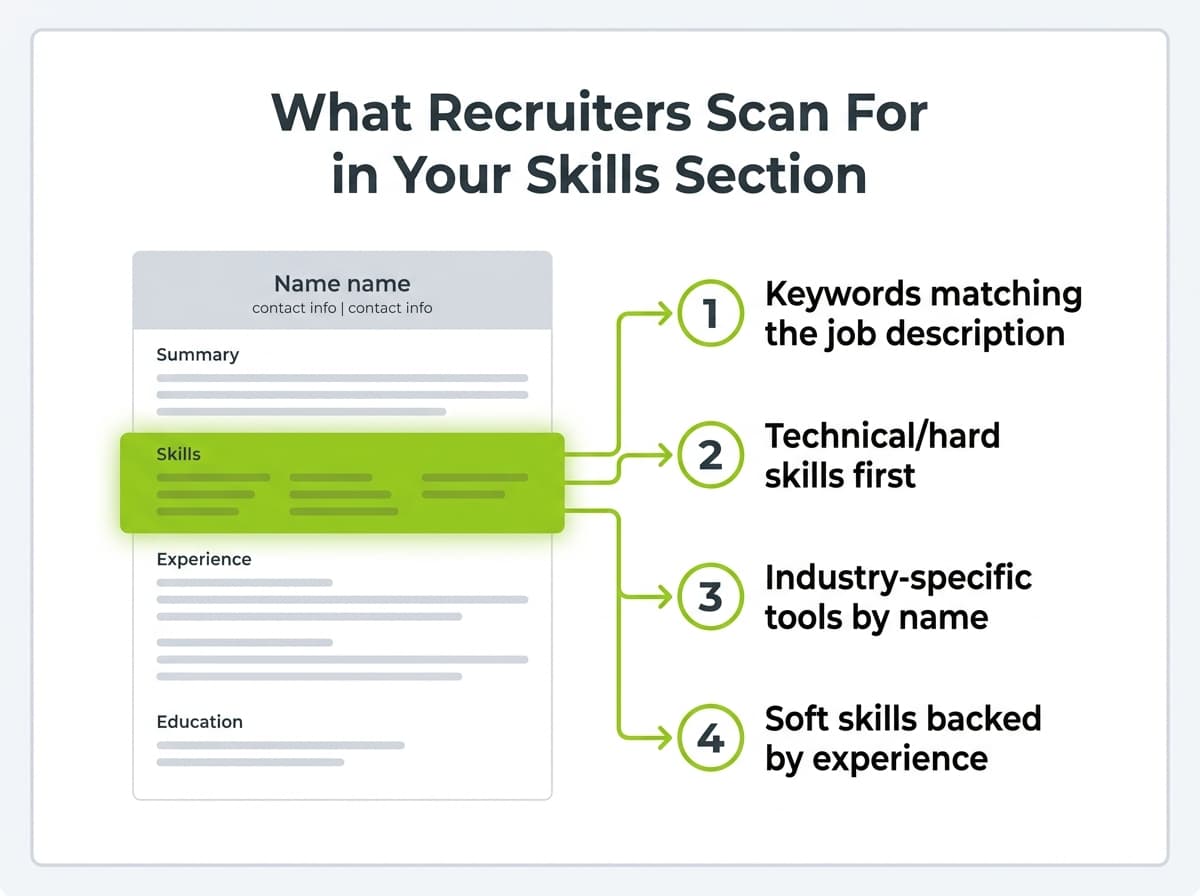
Hiring managers take a remarkably short time to review each resume before making an initial decision. During that brief window, they scan for specific qualifications that match the role, and the skills section is where most of them look first.
Recruiters evaluate both technical (hard) skills and interpersonal (soft) skills. A well-structured skills section lets them assess your fit at a glance without having to dig through detailed work experience descriptions. It helps you stand out from other applicants, shows what you bring to the organization, and spotlights the exact qualifications the company is looking for. When two candidates share similar experience levels and technical backgrounds, soft skills often become the tiebreaker.
To understand the difference, consider these two versions of the same candidate's skills section:
Before (generic, untailored):
Skills: Microsoft Office, teamwork, communication, hard worker, problem solving, leadership
After (tailored to a Digital Marketing Manager role):
Core Skills: SEO and SEM strategy, Google Analytics 4, content marketing, cross-functional team leadership, A/B testing, HubSpot CRM, paid social advertising (Meta Ads, LinkedIn Ads)
The first version tells the recruiter almost nothing. The second version mirrors the language a hiring manager would actually search for, and it signals specific, measurable abilities rather than empty self-assessments. The rest of this guide shows you how to build a skills section like the second example for any role. For a broader look at how every section of a resume works together, see our anatomy of a resume guide.
Why it helps with ATS (Applicant Tracking Systems)
Beyond impressing human reviewers, your skills section plays a vital role with Applicant Tracking Systems (ATS), the software that sorts and ranks resumes before a recruiter ever sees them.
The scale of ATS adoption is hard to overstate. According to Select Software Reviews, nearly 99% of Fortune 500 companies use an ATS platform, and 75% of recruiters rely on ATS or similar recruiting technology to screen applicants. The software compares your resume against the job description and ranks candidates based on how well their qualifications match.
Your skills section is one of the most ATS-friendly parts of your resume for three reasons. First, ATS parsers look for a standard section heading like "Skills" or "Core Competencies" to locate your qualifications, so a clearly labeled section ensures the software finds what it needs. Second, the section gives you a concentrated block of keywords that match the job posting, making those terms easy to detect for both the algorithm and the human reviewer who reads your resume afterward. Third, the skills section is the easiest part of your resume to customize per application. Instead of rewriting your entire work experience, you can swap a few skills in and out to align with each new job description.
Think of your skills section as a keyword bridge: it satisfies the ATS filters that determine whether your resume surfaces in a recruiter's search, and it gives the recruiter a quick-reference snapshot of your qualifications once they open the document.
Types of Skills to Include
Your resume becomes more meaningful when you know how to showcase the right abilities. Employers look for candidates who bring a balanced mix of different skill types. This combination shows both technical capability and workplace effectiveness.
Hard skills vs. soft skills
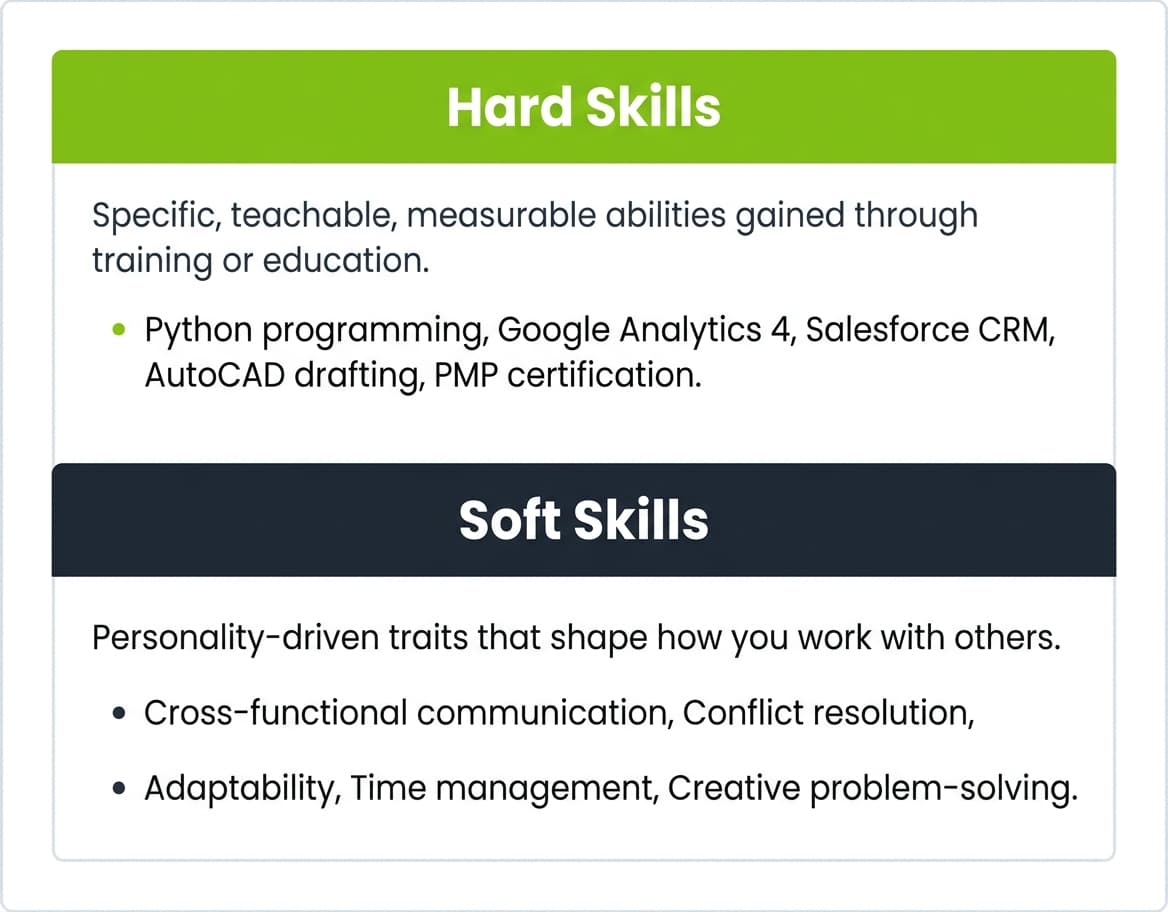
Hard skills are specific, teachable abilities you can quantify and measure. You typically gain them through formal education, training programs, or hands-on experience. Examples include programming languages like Python or JavaScript, data analysis in Excel or Tableau, certifications like PMP or AWS Solutions Architect, and proficiency with tools like Salesforce or AutoCAD. These job-specific abilities prove your expertise in a particular area and are usually the first thing an ATS keyword filter looks for.
Soft skills reflect your personality traits and how well you work with others. Communication, teamwork, adaptability, and problem-solving all fall into this category. They take longer to develop because they grow from experience rather than coursework, and they are harder to measure in a screening process. Despite that, employers increasingly prioritize them. A study by Wonderlic found that 93% of hiring leaders consider soft skills an "essential" or "very important" factor in hiring decisions, and many reported that soft skills matter even more than technical abilities when evaluating candidates.
On a resume, hard skills and soft skills play different roles. Hard skills get you past the ATS filter. Soft skills convince the human recruiter that you will actually succeed in the role. A strong skills section includes both. Here is how the two categories look in practice for a Project Manager:
Hard Skills: Agile/Scrum methodology, Jira, Microsoft Project, budgeting and forecasting, risk assessment
Soft Skills: Stakeholder communication, conflict resolution, cross-functional team leadership, time management
Transferable skills
Transferable skills are portable qualifications that stay useful regardless of the industry or role you move into. You develop them through a mix of previous jobs, volunteer work, education, and everyday life. Problem-solving, time management, adaptability, and communication are all transferable, and they are valuable in virtually every professional setting.
Consider a retail associate who spends two years resolving customer complaints, managing returns under pressure, and training new hires. Every one of those abilities translates directly into a client-facing role in technology, healthcare, or financial services. On a resume, the skills section is where you make that connection explicit for the recruiter.
The data supports this emphasis on transferable abilities. According to LinkedIn's Global Talent Trends research, 57% of senior leaders now value soft skills more than hard skills when evaluating candidates. Research conducted by Stanford Research Institute International and the Carnegie Foundation, based on interviews with Fortune 500 CEOs, found that 75% of long-term job success depends on people skills, with only 25% attributable to technical knowledge.
Industry-specific skills
Industry-related expertise helps candidates stand out in competitive markets. These specialized abilities differ across fields and show your specific knowledge in a particular sector.
Healthcare professionals need abilities like patient assessment, medical coding (ICD-10, CPT), and electronic health records (Epic, Cerner). Technology workers must demonstrate proficiency in programming languages, cloud infrastructure, and cybersecurity frameworks. Employers across every sector now give higher priority to specialized abilities that align directly with their operational needs, so listing industry-specific skills on your resume signals that you understand the day-to-day requirements of the role, not just the general concept.
A strong skills section balances all three types. You might list technical abilities like specific software proficiency, interpersonal qualities like stakeholder communication, and transferable skills like project management that show your adaptability across contexts. Different positions call for different emphasis. A software engineering role might weight 70% hard skills and 30% soft skills, while a people-management position might flip that ratio. Take time to identify your strongest abilities in each category before tailoring the section for every application.
How to Choose the Right Skills
Your resume's skills section can make or break your chances of landing an interview. Many job seekers don't take time to customize this vital section for each job application. I can help you create a skills section that appeals to hiring managers and applicant tracking systems.
Read the job description carefully
The job description is your primary guide to skill selection. Start by reading the posting from top to bottom, paying close attention to the "Requirements" and "Qualifications" sections where the most important keywords appear. Skills that show up multiple times, or that are labeled "required" rather than "preferred," tell you exactly what the hiring team cares about most.
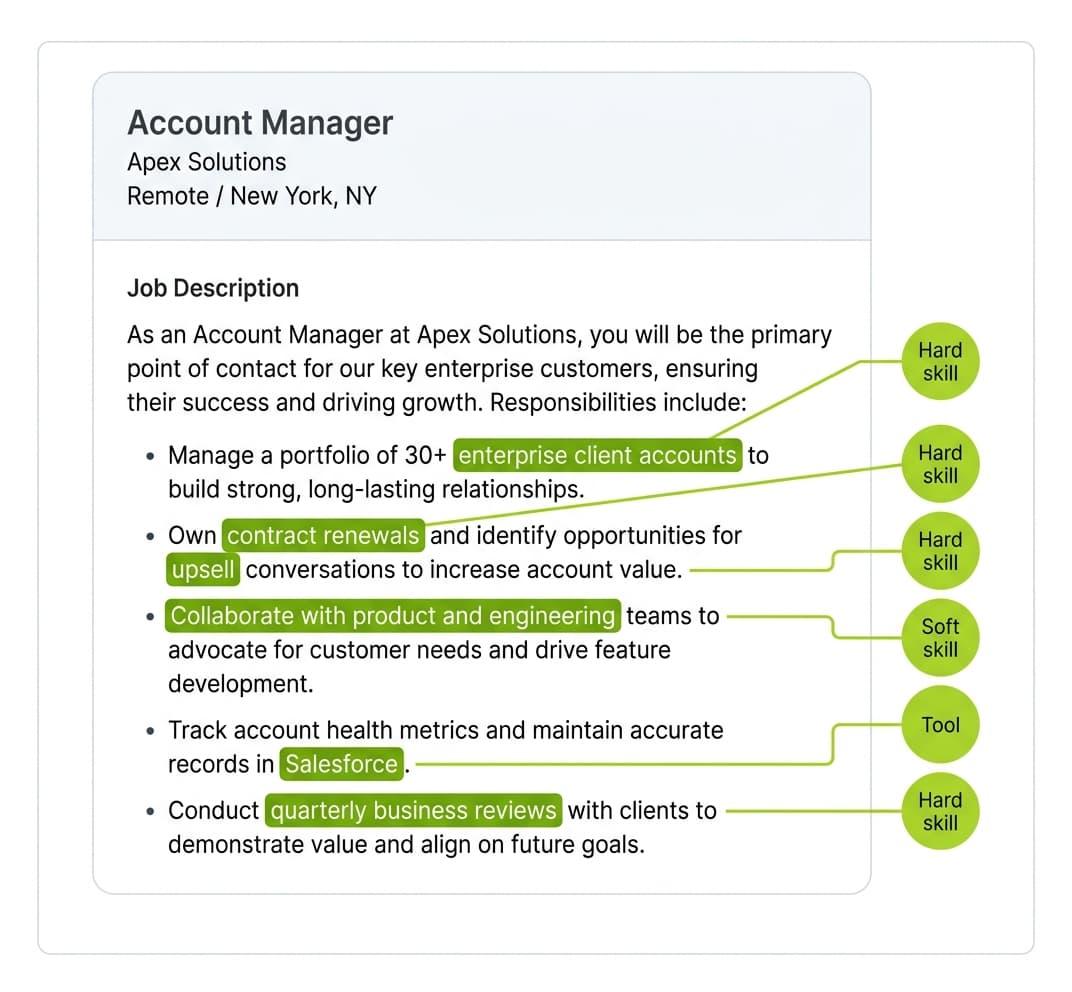
Look beyond the explicit skill listings too. Each responsibility sentence hints at abilities you should include. Here is a real-world example of how to extract skills from a job posting:
"Manage a portfolio of 30+ enterprise client accounts. Own contract renewals and upsell conversations. Collaborate with product and engineering teams to resolve client issues. Track account health metrics in Salesforce and present quarterly business reviews to stakeholders."
Notice that "cross-functional collaboration" and "stakeholder presentations" are not listed as explicit skills anywhere in the posting, but the responsibilities clearly require them. Always list both hard skills (Salesforce, contract negotiation) and soft skills (collaboration, client relationship management) that you find. This detailed extraction approach gives you a precise match to what the employer actually needs rather than forcing you to guess. To speed up this process, try our resume skills generator which pulls relevant keywords from any job description automatically.
Use keywords from the job post
Ready to land your dream job?
Join 50,000+ job seekers who have already transformed their careers with our AI-powered resume builder.