Deckblatt 2026: Should You Add a Cover Sheet in Germany?
The Deckblatt is the German cover sheet that sits between your Anschreiben and Lebenslauf. In 2026, you usually do not need one. Here is when it still helps.
If you are applying for a job in Germany, you may have come across the Deckblatt, a cover sheet that traditionally sits between the cover letter (Anschreiben) and the CV (Lebenslauf). It is a German peculiarity with no direct equivalent in Anglo-Saxon hiring markets. For most modern applications in 2026, the honest answer is: you do not need one, and including one can actively hurt your application. This guide explains why, when a Deckblatt still makes sense, and how to design one if you decide it is worth it.
If you are working on your application as a package, you can build your Anschreiben in the CareerKit cover letter editor first, then decide whether a Deckblatt adds anything. But let us start with whether you need one at all.
Why the Deckblatt rarely works today
The Deckblatt is the most contested page in the German application. Template-selling sites recommend it almost universally. Recruiters and HR specialists are increasingly sceptical. The honest answer sits between the two camps but closer to the second.
From standard to exception
Ten years ago, the Deckblatt was a standard element in classical paper applications, which were still printed and mailed in physical Bewerbungsmappe binders. The Deckblatt acted as a visual business card between the Anschreiben and the Lebenslauf. That world barely exists anymore. Indeed Germany's career guide on application design confirms that the Deckblatt is now rarely used and has become largely redundant in the era of online applications.
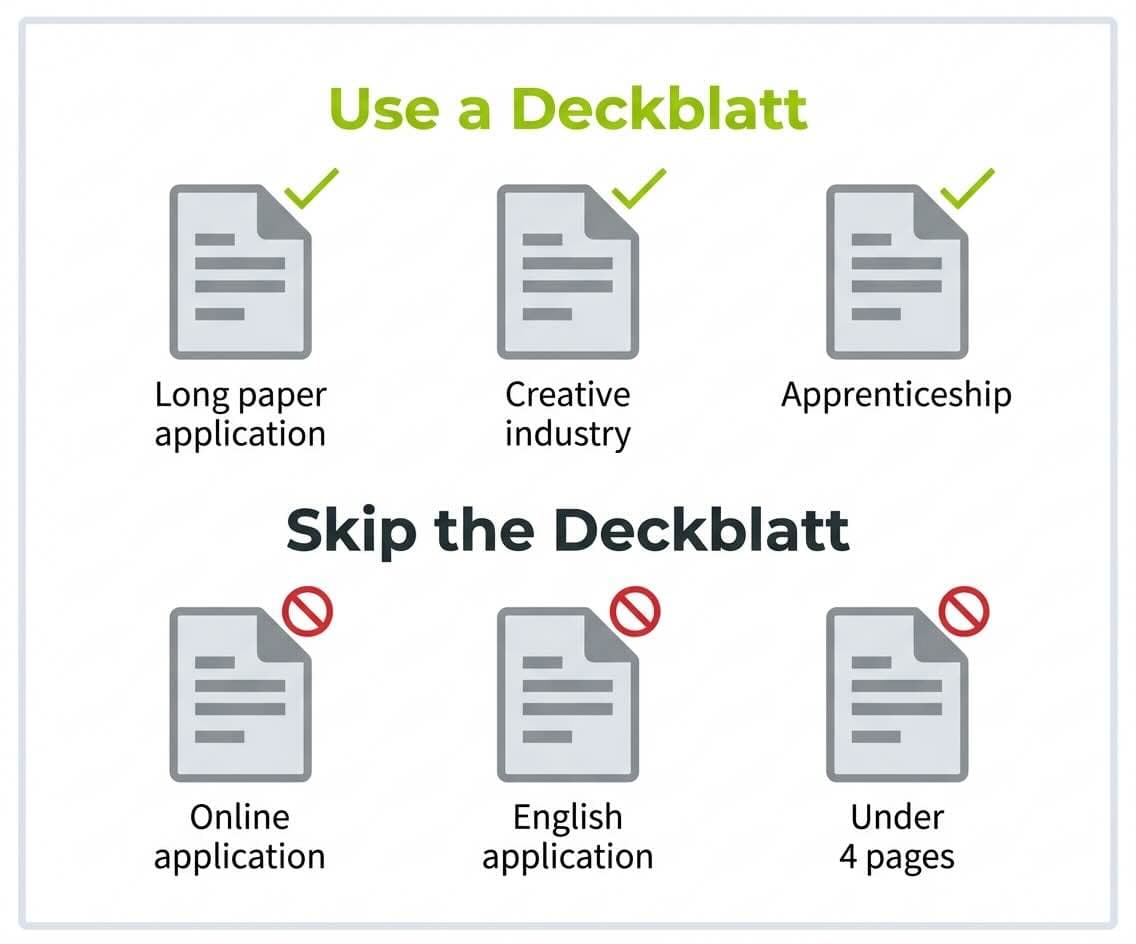
The shift is structural. In a typical online application via a company's career portal, you upload the cover letter and CV as separate or combined PDFs. An additional Deckblatt page only lengthens the document without adding value. Hiring managers usually jump straight to the CV.
What recruiters actually look at
Studies on application screening show how little time your documents get. An eye-tracking study by Ladders, reported by HR Dive, found an average of 7.4 seconds for the initial scan of a CV. In those seconds, the person behind the screen is checking whether you meet the professional requirements. A photo on a Deckblatt, followed by another photo in the CV, causes confusion rather than impact.

What most recruiters genuinely want to see is a professional email address, a clearly readable career trajectory, the right qualifications, and a thoughtful cover letter. An extra page with a decorative repetition of this information only delays the actually important content.
What digital applications changed
Three factors have devalued the Deckblatt in recent years. First: most companies, especially large groups and the Mittelstand, use Applicant Tracking Systems that parse and filter applications automatically. ATS software reads linear documents from top to bottom. An extra Deckblatt page in front of the actual content makes parsing harder without adding value.
Second: email applications have size limits, often five megabytes. An image-heavy Deckblatt with a large photo, background graphic, and multiple fonts eats into that budget. Karrierebibel notes in its Deckblatt guide that a Deckblatt bloats virtual application packages and consumes storage space.
Third: in English and international application contexts, the Deckblatt is unknown as a concept. Anyone applying in parallel to German and English-speaking roles signals a poorly adapted application format by adding a Deckblatt.
When a Deckblatt still makes sense
There are situations where a Deckblatt still works. They are rare but real. If you are in one of them, a well-made Deckblatt can score points.
Extensive classical paper applications
For a printed Bewerbungsmappe with more than five or six pages, a Deckblatt can serve structure. You summarise on the first page who you are and which position you want, and briefly list the documents that follow. This helps hiring managers who are reviewing the package with the physical binder in their hands.
That scenario is increasingly rare. Printed Bewerbungsmappen are still expected mainly in public administration, traditional family businesses, and some roles in healthcare and education. For everything else, online applications are the standard, and the structural argument for a Deckblatt disappears.
Creative industries and design roles
In ad agencies, architecture practices, graphic design studios, and fashion, the Deckblatt can serve as a first work sample. Designing your own thoughtful, original Deckblatt demonstrates a concrete skill that does not show up directly in the CV.
The discipline here is critical. A creative Deckblatt has to be genuinely designed, not clicked together from a free template. If yours looks like the Deckblatt of a hundred other applicants from the same template pool, it does not function as a work sample. It signals the opposite, that you did not put in the effort.
Apprenticeship and Ausbildung applications with limited material
If you are applying for an apprenticeship (Ausbildung) or a dual study programme, you typically have few stations to list. Your CV is short, your professional experience is just starting, and your annexes consist of school transcripts and maybe one internship certificate. A Deckblatt can create structural clarity here without feeling like padding.
In this situation, it also helps to build a strong parallel CV. The first-resume guide walks through how to do that. A well-designed Deckblatt only works if the rest of the application keeps up.
Ready to land your dream job?
Join 50,000+ job seekers who have already transformed their careers with our AI-powered resume builder.