Home/Blog/Guide/How to Write a Software Engineer Resume (2026 Guide)
Guide
How to Write a Software Engineer Resume (2026 Guide)
Write a software engineer resume that clears ATS and reads well: one column, keyword-matched skills, and work bullets with concrete metrics. Examples and templates.
Most major employers rely on Applicant Tracking Systems to screen thousands of incoming applications before a human ever reads them. According to Select Software Reviews, nearly 99% of Fortune 500 companies use an ATS, and the average corporate job posting attracts roughly 250 resumes. Your software engineer resume needs to survive that automated gauntlet, and then tell a clear, compelling story about solving problems and delivering measurable results.
This guide covers software engineer resume examples, formatting rules, and proven strategies across every career stage. You will learn how to structure each section, highlight your technical skills with concrete metrics, and tailor your content so it resonates with both ATS algorithms and the recruiter who spends roughly 7.4 seconds on that first scan. Whether you are writing an entry-level software engineer resume or polishing senior software engineer resume examples, the principles here will sharpen every line.
What Makes a Strong Software Engineer Resume
Getting your resume past automated screening and into the hands of a hiring manager requires understanding what both systems value, and where their priorities diverge.
Key Elements Recruiters Look For
Recruiters filter software engineer resumes using three primary criteria during their initial review: relevant work history, tech stack alignment, and educational background. Your positions should demonstrate deliberate career progression rather than a string of disconnected job changes. Holding each role for at least a year signals stability and the ability to see projects through to completion, according to guidance from Indeed's career resources.
Your technical portfolio carries significant weight. Recruiters scan for specific languages, years of hands-on experience, and applications from completed projects. While a four-year degree remains a common screening criterion, the 2024 Stack Overflow Developer Survey found that only about 41% of professional developers hold a bachelor's degree in computer science specifically. Bootcamp graduates represent a growing alternative path, many programs report strong job-placement rates and meaningful salary increases for graduates who can demonstrate practical skills.
Communication skills become the deciding factor during phone screens. Recruiters value candidates who can explain technical concepts in language that non-engineers understand. This signals collaboration potential and cross-functional effectiveness. Demonstrating genuine interest in the specific opportunity, rather than sending a generic pitch, matters just as much.
ATS vs Human Reviewers
Applicant Tracking Systems parse resumes into structured sections (work experience, skills, education, contact information) and then search for keywords and phrases matching the job description. These systems rank applications based on keyword overlap, prioritizing hard skills, education level (when specified), and job titles in that order. A match rate between 65% and 75% generally gets your resume into the "review" pile, though over-optimizing with keyword stuffing creates its own problems.
ATS operates as a pure matching engine, it does not evaluate personality, cultural fit, or the quality of your achievements. It simply answers one question: does this resume contain the right terms in the right density?
Human reviewers pick up where ATS leaves off. Once your resume clears the automated filter, recruiters look for stories and professional identity. They focus on achievements with measurable impact rather than generic duty lists. Clarity becomes paramount: short paragraphs, ample white space, and an F-pattern layout that lets the eye travel naturally from your name through your most recent role. According to the Ladders 2018 eye-tracking study reported by HR Dive, recruiters spend an average of 7.4 seconds on that initial scan, making first-impression readability critical.
Common Resume Mistakes to Avoid
Listing responsibilities instead of quantifiable achievements ranks as the single biggest problem on software engineer resumes. Employers want measurable results, not job descriptions they already know. Consider the difference:
Before: "Responsible for maintaining the company's web application and handling bug reports."
After: "Reduced average bug resolution time from 48 hours to 12 hours by implementing a triage automation system in Jira, clearing a backlog of 200+ tickets within three months."
The second version tells a recruiter exactly what you did, how you did it, and what changed as a result. That specificity is what earns interview callbacks.
Keyword stuffing backfires with both ATS and recruiters. Resumes crammed with 20-30 buzzwords in a single sentence signal desperation rather than qualification. Generic phrases like "results-driven professional with proven track record" lose all meaning after a recruiter reads variations of them dozens of times each day. Additionally, a2025 Resume Now survey of 925 HR professionals found that 62% of hiring managers are more likely to reject AI-generated resumes that lack personalization, so while AI tools can help you draft, you still need a human voice and specific detail.
Formatting errors create problems immediately. Many ATS platforms cannot reliably parse two-column layouts, text boxes, tables, graphics, or elaborate design elements. Information placed in headers or footers often gets missed by parsing software. Stick to standard fonts like Arial, Calibri, or Garamond at a minimum of 10-11pt size. Save as .docx format when a company requests Word files, since testing shows some ATS platforms parse Word documents more accurately than PDFs, though PDF is generally the safer default for preserving layout.
Unexplained employment gaps, misspelled technology names (it is "JavaScript," not "Java Script"), and broken portfolio links all undermine your credibility. Treat your resume like production code: test it before you ship it.
Essential Sections of a Software Engineer Resume
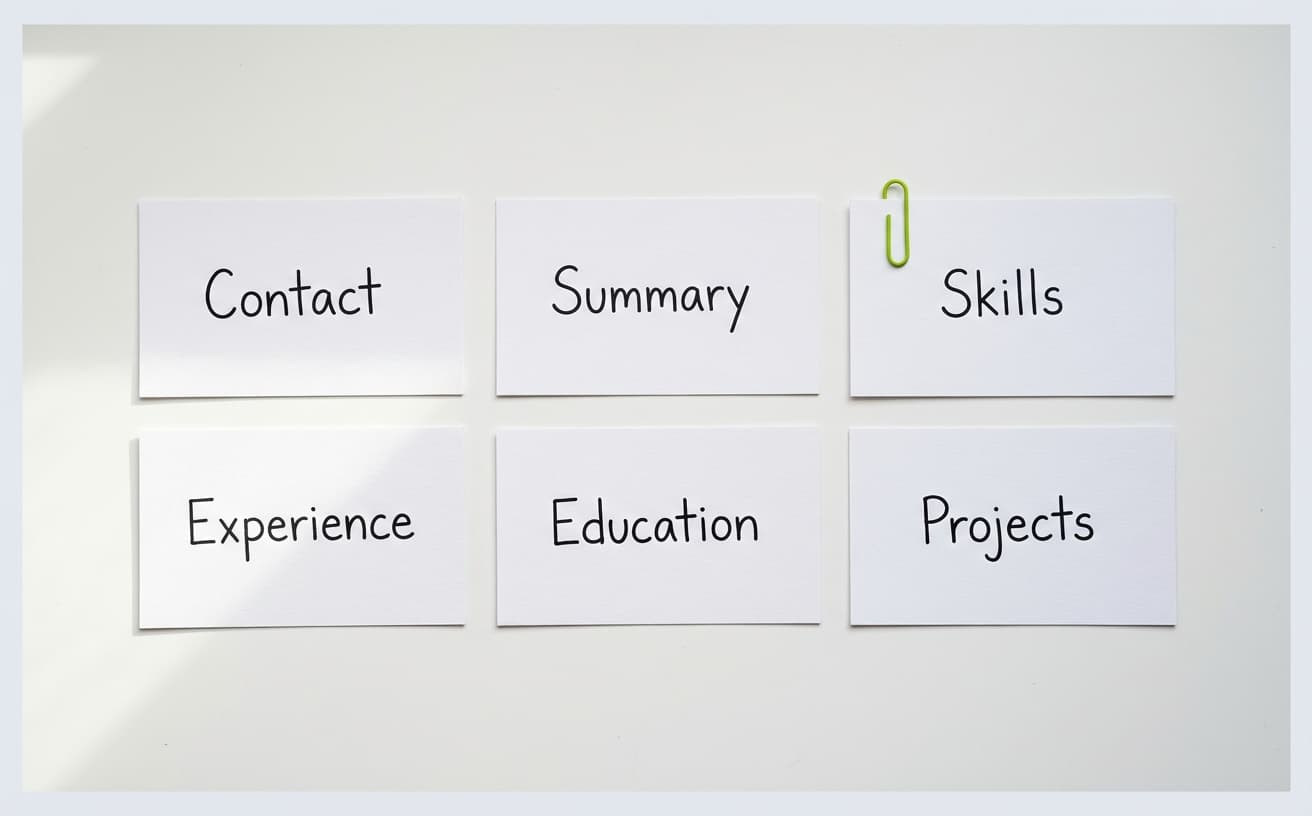
Your resume needs six core sections working together to present a complete professional profile. Each one serves a distinct purpose in the recruiter's evaluation process.
Contact Information and Header
Place your full name prominently at the top of your resume. Include a personal phone number (never your work number), your city and state or country to help recruiters determine location fit, and a professional email address, ideally formatted as firstname.lastname@email.com.
Your LinkedIn profile belongs in the header as a clickable hyperlink. Customize your LinkedIn URL to include your first and last name rather than the default alphanumeric string. Include your GitHub profile URL only if you maintain it with projects worth showcasing, pin your best repositories to the top and keep README files organized. Stack Overflow profiles, personal websites, and competitive coding profiles on platforms like LeetCode or HackerRank strengthen your header when they demonstrate active technical engagement.
Never include your full mailing address, age, gender, marital status, religion, nationality, or a photo. Test all links in your final PDF before submission. Broken links reflect poorly on any engineer, but especially on someone applying to build software.
Professional Summary or Objective
A professional summary works best for candidates with two or more years of relevant experience. Start with your job title and years of experience, then mention core skills and specializations. Highlight your biggest achievement with a number. Keep it between 50 and 100 words.
Weak summary: "Experienced software engineer looking for opportunities to grow and contribute to a dynamic team."
Strong summary: "Backend Engineer with 4 years building high-throughput APIs in Go and Python. Designed a microservices migration that reduced infrastructure costs by 28% and improved p95 latency from 900ms to 210ms. AWS Certified Solutions Architect."
Resume objectives suit entry-level candidates, recent graduates, and career changers. Focus on career aspirations and transferable skills while showing enthusiasm for the specific role. Keep objectives to 30-50 words. Instead of using "Professional Summary" as your section title, write a headline that captures your identity, something like "Backend Engineer | Go & Python | Cloud Infrastructure."
If you are building your first resume from scratch, our guide on how to make your first resume walks through the process step by step.
Technical Skills Section
Structure your technical skills with clear categories separated by colons or vertical bars. Group programming languages first, then frameworks, databases, cloud platforms, and tools. Tailor this section to match the specific skills mentioned in the job posting, placing your most relevant proficiencies at the top.
Add context where it adds value. Instead of just listing "Python," consider "Python (Proficient, 4 years, production services)" vs. "Rust (Familiar, personal projects)." This gives recruiters a quick read on where your depth truly lies.
For help identifying which skills to prioritize, try our resume skills generator, it maps job description requirements to your background and surfaces gaps worth addressing.
Work Experience
List positions in reverse chronological order. Each entry should include company name, location, job title, and dates formatted consistently (e.g., MM/YYYY). Describe accomplishments with this structure: what you achieved, the action you took, and the quantifiable outcome.
Before: "Worked on the backend team and was responsible for API development."
After: "Designed and deployed a RESTful API layer serving 2,000 requests/second using Node.js and PostgreSQL, reducing average response time by 40% and eliminating a manual data-entry workflow that consumed 15 hours per week."
Start each bullet point with a strong action verb: Designed, Implemented, Optimized, Refactored, Automated, Migrated, Scaled. Vary your verb selection across bullet points to demonstrate diverse capabilities. For more examples of high-impact bullet points, see our collection of work experience bullet point examples.
Education and Certifications
List degrees in reverse chronological order with the degree name, graduation year, university name, and location. Include your GPA only if it is above 3.5 on a 4.0 scale. Recent graduates can expand this section with relevant coursework, capstone projects, and academic honors.
Ready to put this into a real resume?
Write it here for free. Paste the job posting and the editor shows you which of its terms your draft is missing.
Certifications require the certification title, awarding organization, and date earned. For software engineers, certifications like AWS Solutions Architect, Google Cloud Professional, Kubernetes Administrator (CKA), or language-specific credentials (Oracle Certified Java Programmer, for example) add concrete credibility, especially at the mid-level stage where they help differentiate you from peers.
Projects and Portfolio
Include at least two projects with your specific contributions outlined. Link project names to GitHub repositories or live demos. Projects prove especially valuable for entry-level engineers and career switchers who may lack extensive professional experience.
Describe each project's purpose, the tech stack used, and the outcome or user impact. A project entry like "Built a real-time chat application using React, Socket.io, and MongoDB, deployed on AWS EC2, handling 500 concurrent users with sub-100ms message delivery" tells a far richer story than "Worked on a chat app."
For a deeper breakdown of what belongs in every section, our guide on the anatomy of a resume covers each block in detail with examples.
How to Format Your Resume for Software Engineering Jobs
Your resume's structure and visual presentation directly affect whether it gets parsed correctly by ATS and read comfortably by humans.
Choosing the Right Resume Template
Software engineers can choose from three main resume formats, each with distinct trade-offs.
The reverse-chronological format organizes work experience from most recent to oldest and serves as the industry standard. Recruiters expect this layout, and ATS platforms parse it reliably. It showcases career progression naturally and puts your most current expertise front and center during that critical initial scan.
The functional format groups experience under skill categories like Backend Development or Cloud Infrastructure rather than by timeline. This approach can help career changers and bootcamp graduates highlight transferable skills, but it presents compatibility risks with many ATS platforms and can make recruiters suspicious about what the timeline actually looks like.
The hybrid format combines a detailed technical skills section with reverse-chronological work history. This works well for specialized roles and maintains ATS compatibility through standard dates and job titles. For most software engineers, either the reverse-chronological or hybrid format is the safest choice.
ATS-Friendly Formatting Guidelines
Create your resume using a standard word processor like Microsoft Word or Google Docs. Reduce page margins to 0.5 inches on each side rather than relying on headers or footers, since parsing software frequently misses content placed in those areas.
Select standard fonts: Arial, Calibri, or Garamond. Unfamiliar fonts can convert characters into symbols that ATS cannot interpret. Maintain a minimum of 10pt font size for readability. Use a single-column layout that allows easy top-to-bottom reading, tables, graphics, and text boxes confuse most ATS platforms.
Structure your sections with standard headings in this order: Professional Summary (or a headline), Contact Information, Technical Skills, Work Experience, Education, Projects, and optional sections like Certifications or Publications. Avoid adding symbols, icons, or decorative elements to headers.
If you want to see how different fonts look on your resume before committing, our resume font preview tool lets you compare options side by side.
Length and Layout Best Practices
Entry-level candidates and those with fewer than three years of experience should keep their resume to one page. Extending to two pages becomes acceptable when you have substantial experience, but the most important information should always appear on page one. Two-page resumes are common across most of Europe, while US hiring managers generally prefer concise, single-page formats for early-career applicants. The Stack Overflow developer resume guide reinforces that the first page carries disproportionate weight regardless of total length.
File Format and Submission
Submit resumes as PDF files to preserve formatting, but always create them in Word or Google Docs first. Test your PDF by opening it in Chrome or Adobe Acrobat Reader and verifying that you can highlight and copy text, if text highlights cleanly, ATS can read your resume. Save as .docx when a company specifically requests Word format. Avoid .jpg, .png, or .odt formats entirely.
Writing Effective Content for Each Resume Section
The structure of your resume gets it through the door. The content of each section is what earns the interview.
Crafting a Compelling Summary Statement
Your summary needs fewer than 50 words to communicate your value proposition. Start with the noun that describes your role, "Software Engineer," "Backend Developer," "Full-Stack Engineer." Layer in your years of experience and specialization. Frame accomplishments with this pattern: what you achieved, measured by specific numbers, through particular actions. Skip passive voice and generic descriptors. Answer why you fit this position rather than narrating your career aspirations.
Before: "Motivated software developer with a passion for coding and problem-solving, seeking new opportunities."
After: "Full-Stack Engineer | 5 years building React + Node.js applications for fintech. Led a payments integration that processed $12M in transactions monthly with 99.97% uptime."
How to List Software Engineer Skills
Software names are tools, not proof of mastery. Simply listing technologies tells recruiters nothing about your ability to deliver projects. Connect each skill to a specific achievement or context where you applied it. Select two to four languages you can discuss confidently during a technical interview rather than listing every framework you have ever encountered. Depth matters more than breadth when demonstrating genuine expertise.
Structure skills as a brief summary followed by specific technologies separated by vertical bars, with proficiency indicators where helpful:
Numbers make claims credible and signal results-oriented thinking. Vague phrases like "improved performance significantly" give a recruiter nothing to evaluate. Specific metrics create a picture.
Track and quantify these categories: latency reductions (from 900ms to 280ms), throughput improvements (500 to 2,000 requests per second), error rate decreases (3.1% to 0.4%), infrastructure cost savings (28% monthly reduction), and user impact (feature adopted by 60% of active users within the first month).
When exact data is not available, ranges communicate variance honestly, "served 15 to 20 enterprise clients weekly" is still far stronger than "served many clients." Focus on money saved, people managed, time reduced, and system-level outcomes. Every bullet point on your resume should ideally answer the question: "How much?" or "Compared to what?"
Using Action Verbs and Clear Language
Start bullet points with strong action verbs that showcase technical skills and leadership ability. Replace weak verbs like "worked on" or "responsible for" with precise alternatives: Designed, Implemented, Optimized, Refactored, Automated, Migrated, Scaled, Architected, Debugged, Deployed. Action verbs increase clarity, boost persuasiveness, and eliminate the vague filler that makes resumes blend together.
Before: "Was responsible for working on the company's database migration project."
After: "Architected and executed a zero-downtime migration from MySQL to PostgreSQL, reducing query latency by 65% across 14 production services."
Vary your verb selection across bullet points to demonstrate a range of capabilities and avoid the monotony that comes from starting every line with "Developed."
Tailoring Your Resume to the Job Description
Generic resumes face steep odds. An analysis from Wellfound found that candidates who tailor their applications to each job posting see significantly higher response rates, in some cases up to 78% more callbacks compared to those submitting identical resumes everywhere. Read the job description carefully, highlight both required and preferred qualifications, and match the exact terminology from the posting rather than using synonyms. If the role says "CI/CD pipelines," write "CI/CD pipelines", not "continuous integration workflows."
Integrate keywords into your summary, skills section, and work experience naturally. Focus on job-related technical skills, transferable competencies, and domain-specific knowledge that aligns with the role requirements. A few minutes of customization per application pays significant dividends.
Ready to build or update your resume with these principles? CareerKit's resume builder helps you structure ATS-friendly content with guided prompts for each section.
Software Engineer Resume Examples and Templates
Studying successful software engineer resume examples reveals distinct patterns you can apply at every career stage.
Entry-Level Software Engineer Resume Sample
Recent graduates and bootcamp completions need a resume that emphasizes projects, education, and technical aptitude over extensive work history. Your entry-level software engineer resume should spotlight projects you completed during coursework, internships you held, and technologies you used in real applications.
Focus on concrete contributions: codebase transitions you initiated (migrating a monolithic Rails app to React microservices), bugs you diagnosed and resolved (triaging 150+ issues in Jira over a semester), and components you designed (building four reusable React components that improved code reuse by 25%). Include undergraduate research positions, IT support roles, and any trainee experience demonstrating technical problem-solving. Automation achievements, like a report-generation script saving five hours per week, prove immediate, tangible value.
If you are making a career change into software engineering, our career change resume template shows how to reframe transferable experience for technical roles.
Mid-Level Software Engineer Resume Template
Mid-level positions require quantified results across two to five years of professional experience. Your resume should demonstrate value through metrics: productivity increases, cost reductions, efficiency gains, and output improvements. Certifications in industry-standard platforms or methodologies distinguish you from candidates who lack formal validation.
Structure accomplishments as action taken measurable outcome technologies used. Highlight proficiency in specific frameworks (Spring Boot, Django, Angular) and development methodologies (Agile, Scrum, TDD). Problem-solving examples that show meaningful optimization, like reducing a database query's response time from 5 seconds to 200 milliseconds, carry substantial weight at this level.
Senior Software Engineer Resume Examples
Senior software engineer resume examples prioritize leadership alongside technical depth. Showcase progression through promotions, noting timelines and the achievements that earned advancement. Detail team management responsibilities (led a cross-functional team of seven engineers), project deliveries ahead of schedule (shipped two months early under budget), and mentorship of junior developers.
Your accomplishments at this level should reflect architectural decisions, system-wide outcomes (load efficiency increased by 37%), and strategic technology implementations. Agile certifications such as Certified Scrum Master or SAFe Agilist strengthen senior applications by demonstrating process leadership alongside technical expertise.
Specialized Role Resume Variations
Backend engineers should emphasize server-side languages, database optimization, and API design. Frontend developers should spotlight UI frameworks, load-time reductions, accessibility improvements, and user-experience metrics. Full-stack positions require a balanced demonstration of both capabilities, with project examples showing end-to-end ownership from database schema through deployed UI.
For each specialization, use the job description as your blueprint and lead with the skills and achievements that most directly match the role's primary responsibilities.
Conclusion
You now have everything needed to create a software engineer resume that passes ATS filters and impresses recruiters. Measure your achievements with specific metrics rather than listing responsibilities. Structure your resume with ATS-friendly formatting, standard fonts, and a clean single-column layout.
Tailor your resume to each job description by matching keywords naturally throughout your content. Whether you are building an entry-level software engineer resume or showcasing senior-level leadership, the principles stay the same: clarity, metrics, and relevance win interviews.
Entry-level candidates and those with fewer than three years of experience should keep their resume to one page. Mid-level and senior engineers with substantial accomplishments can extend to two pages, but the most critical information, your summary, top skills, and most recent role, should always appear on page one.
The reverse-chronological format is the industry standard for software engineering roles. It lists your most recent position first, parses reliably through Applicant Tracking Systems, and gives recruiters the career progression context they expect. A hybrid format that leads with a technical skills section before reverse-chronological work history is a strong alternative for specialized roles.
No. In the United States, United Kingdom, and most English-speaking markets, including a photo can trigger unconscious bias and may cause your resume to be rejected. Many ATS platforms also struggle to parse image-heavy layouts. Focus on content that demonstrates your skills rather than personal appearance.
Use a single-column layout with standard section headings (Work Experience, Skills, Education). Choose common fonts like Arial or Calibri at 10pt or larger. Avoid tables, graphics, text boxes, and headers/footers. Save as a .docx or clean PDF, and match keywords from the job description naturally throughout your resume.
Prioritize skills specifically mentioned in the job posting. Group them into categories such as programming languages, frameworks, databases, cloud platforms, and tools. List only technologies you can discuss confidently in an interview, depth matters more than breadth. Add proficiency indicators (Proficient, Advanced, Familiar) to provide context.
Focus on projects (coursework, personal, or open-source contributions), internships, and any technical roles you have held. Quantify contributions wherever possible, even academic projects can include metrics like "processed 10,000+ records" or "reduced runtime by 40%." Highlight transferable skills from non-technical roles and include relevant certifications or bootcamp credentials.
Software Engineer Resume Recommendations by Career Stage
Nishant Modi is the founder of Careerkit.me and a product builder based in Zürich, Switzerland. With a background in product management, marketing & management consulting, he transitioned into AI entrepreneurship after experiencing the frustration of outdated job search tools firsthand. He built Careerkit to give every job seeker access to professional grade resume tools, the platform has helped over 10,000 candidates create ATS optimized resumes. He writes about resume strategy, hiring trends, and what actually gets people hired.




.jpg&w=1920&q=75)