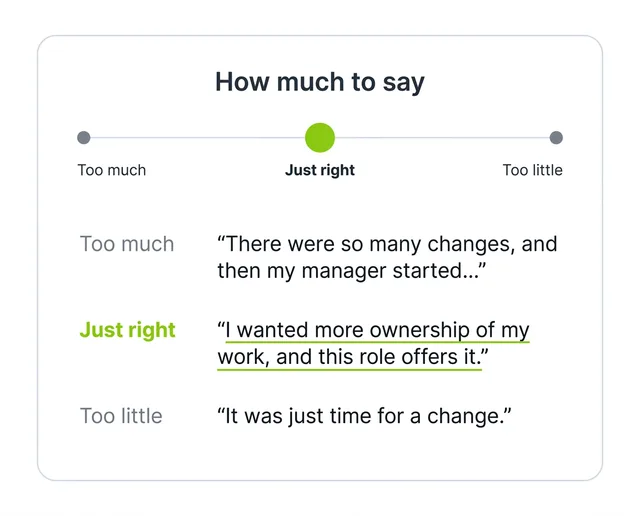
“Why did you leave your last job?” sounds like a warm-up question, but it is one of the easiest places in an interview to lose ground. Say too much and you sound bitter. Say too little and you sound like you are hiding something.
If your honest answer feels complicated, you are in good company. In Gallup’s latest workforce data, 56% of U.S. workers who were actively looking or watching for a new job said they hoped to find something better or different, and 44% said they were dissatisfied with parts of their current job. Sometimes there is one clear reason. Sometimes you simply wanted a change.
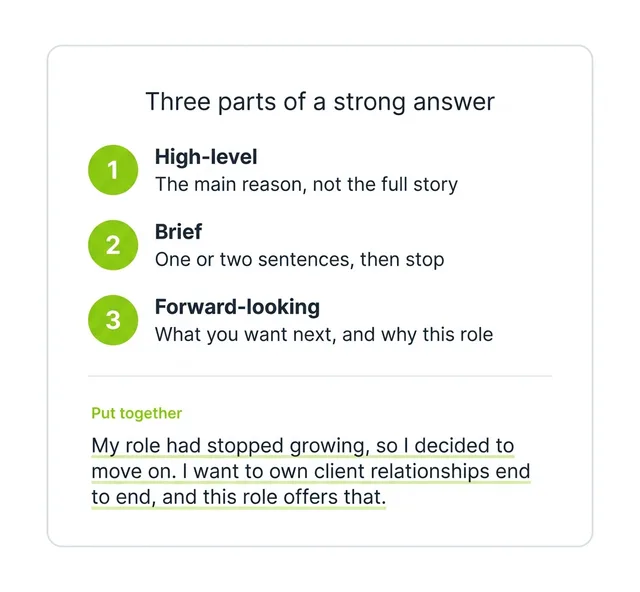
This guide covers what the interviewer is really trying to learn, why the question is harder than it sounds, the mistakes that undo an honest answer, and a three-part structure that works for almost any reason, with sample wording for the 10 most common ones.
What the interviewer is really asking
The question is not a trap, and nobody on the panel enjoys watching you squirm. It packs several smaller questions into one, and your answer tells the interviewer a lot in a few seconds.
Timing makes it sharper. The U.S. labor market has turned cautious: in July 2026, job openings were little changed at about 7.3 million, hires were little changed at 5.1 million, and the quits rate was 1.9%,according to the Bureau of Labor Statistics. When relatively few people leave jobs voluntarily, an interviewer will naturally wonder what prompted your move.
Behind the one question sit a few specific ones. What actually motivated the move: a layoff, a difficult environment, or a simple wish for something new? Was it your decision? If it was, your reason carries more weight; if it was not, the interviewer now has context for any gap. And what do you want now? Whatever was missing in your last role is probably what you will value in the next one, which tells them whether this position can offer it.
The interviewer is also watching how you tell it. Can you describe a difficult workplace without heat? Is there anything that might make you leave again soon? Do you own your part where you had one? Contradictions, evasiveness, and a pattern of short stints are the red flags. Mostly, though, they are testing whether you can say something uncomfortable clearly, without sounding blunt, defensive, or negative.