11 Things Recruiters Look For in the 6-Second Resume Scan (2026)
Six seconds. That is the average time a recruiter spends on your resume before deciding whether to keep reading or move on, according to the eye-tracking study originally published by TheLadders Research and refined in a follow-up that put the figure closer to . Either way, your resume gets less time than it takes to make a cup of coffee.
I have spent years building CareerKit around this exact problem. People put hours into resumes that fail in the first glance because they were optimized for depth instead of scan. The recruiters I know are not skimming because they are lazy. They are skimming because they have 300 applications in the queue and a hiring manager waiting on a shortlist by Friday.
The fix is not to write less. It is to write so the first six seconds carry the weight. Here are the eleven things recruiters actually look for during that scan, and how to make each one work for you.
Your Current Job Title and Company
Your most recent role is the first signal recruiters use to filter in or out. It tells them, in two lines, whether you are operating at the right level and in the right space for the job they are filling.
Why your current role gets read first
Eye-tracking research from TheLadders found that recruiters spend roughly 80% of their scan time on six elements: your name, current title and company, previous title and company, position dates, and education. Your current role sits at the top of that list. If it does not match the level or function recruiters are hiring for, the scan ends there.
This is not a vanity exercise. Recruiters search candidate databases by title, and modern ATS platforms weight job titles in their relevance scores. A title that does not match the market vocabulary disappears from the results page, no matter how strong the work behind it was.
How to align your title with the role you want
The cleanest fix is to lead with the market-standard version of your title and put your internal designation in parentheses if needed.
The dual-title approach gives recruiters and ATS the keyword they search for, while still matching your official employment records when verification happens later. The line you cannot cross is fabricating seniority. "Coordinator" cannot become "Director" on a resume, even if your actual work warranted the bigger title. Stay accurate to your scope, but translate the language.
Common mistakes that bury your visibility
Internal nomenclature is the silent killer here. If your company calls you "Member Experience Champion" and the market calls the role "Customer Support Specialist," recruiters searching for the latter will never find you. Job board search results show only your last three titles, companies, and dates, so that tiny block of text decides whether anyone clicks further.
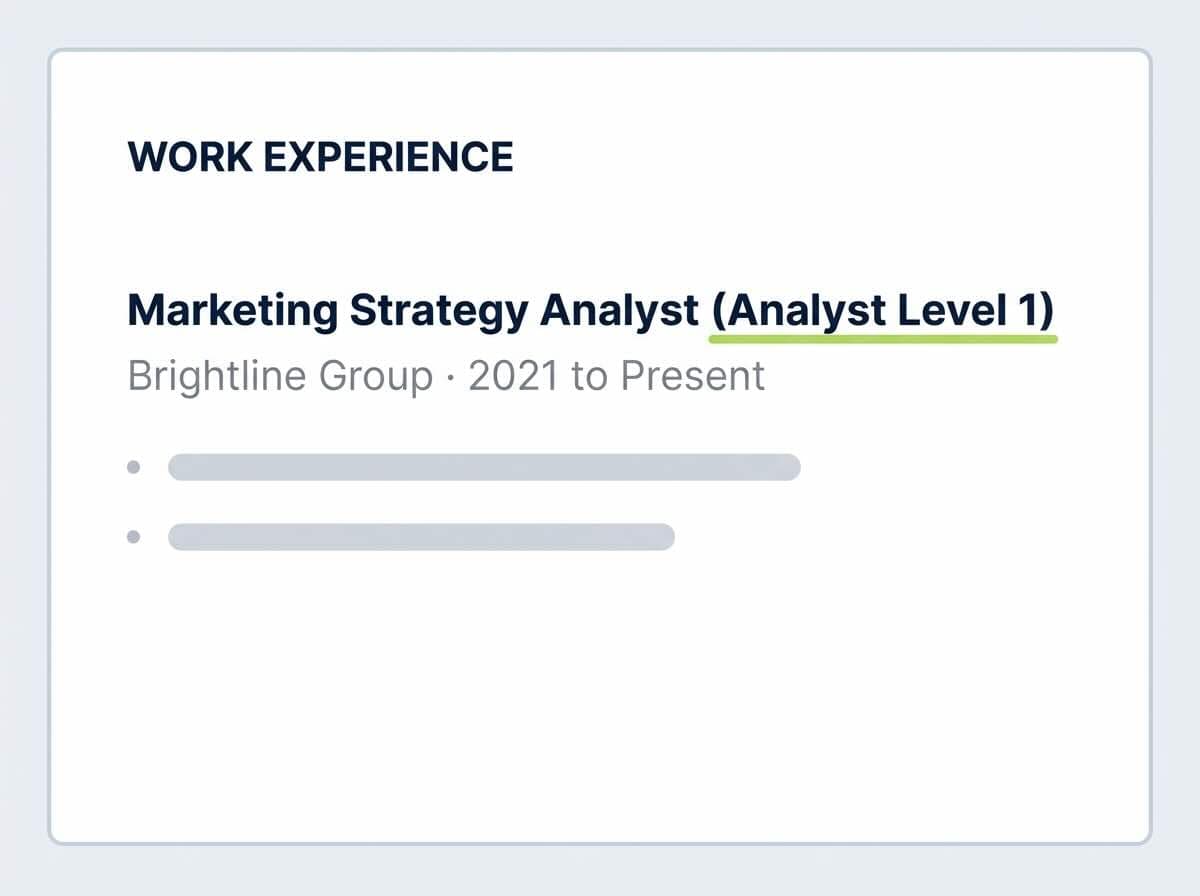
Vague level designations like "Analyst Level 1" also hurt because they tell recruiters nothing about function. Pair every internal title with a function-clear version that signals what you actually do.
Employment Dates and Career Longevity
Dates communicate stability and momentum before recruiters read a single accomplishment. They scan for gaps, for hopping, and for how long you stuck around to deliver value.
What your timeline really tells recruiters
A recruiter reading dates is asking one question: how long does this person stay? The Bureau of Labor Statistics reports that the median tenure for U.S. workers was 3.9 years in January 2024, the lowest since 2002. That gives you a useful benchmark. Roles where you stayed at least two to three years signal that you moved past the learning curve and contributed something measurable.
The point of stability is not to look like a lifer. It is to give the next employer confidence that you will be there long enough to justify the cost of training and onboarding.
How long is long enough
For most professional roles, two to four years per position is the sweet spot. That window is long enough to show ownership of meaningful work but short enough that it does not look like stagnation. Senior roles can stretch longer. Early-career roles can run shorter without raising eyebrows.
The pattern matters more than any single number. A track record of two to three year stints, each ending in a clear move up, reads as intentional. A pattern of leaving every eleven months across multiple jobs reads as a flight risk, and the harshness of that judgment increases with seniority.
Red flags worth addressing before they become silent rejections
Employment gaps over six months tend to raise questions. Indeed's career advice team treats anything beyond that as an employment gap worth addressing on the resume itself rather than leaving for the recruiter to guess about. A one-line note like "Career break, family caregiving, 2023" or "Contract role ended due to project completion" removes the question mark before it forms.
Before: 2022 - 2023 (no role listed) After: 2022 - 2023, Career break: full-time caregiver, returned to industry with completed PMP certification
Frequent short stints invite assumptions about either being fired or quitting before delivering value. If yours were contract roles, acquisitions, or layoffs, label them as such. Recruiters fill in the blank with the worst possible story when you leave it empty.
Previous Job Titles and Career Progression
Your title history tells a story. Recruiters read it as a trajectory, not a list, and they form an opinion about your potential based on the shape of that line.
How recruiters read your trajectory
Hiring managers want to know whether you have grown. Movement up the ladder, even in small steps, signals that previous employers invested in you and saw something worth investing in. Flat trajectories raise questions about whether you ever delivered enough to be promoted.
Promotions inside one company are particularly powerful. They short-circuit the doubt recruiters have about every external claim, because you have to actually earn an internal title bump in a way you do not when you change companies. If you held three roles at the same employer, group them under one company heading with overall tenure at the company level. This visual stack makes the growth obvious during the scan.
Showing strategic, not random, movement
If your moves look unrelated, add one-line context that ties them together.
Before: Operations Analyst, then Product Marketing Manager After: Promoted from Operations Analyst to Product Marketing Manager after leading the rollout of three pricing experiments that informed the new go-to-market plan
A sentence is all you need. The brief explanation turns a question ("why did this person jump from ops to marketing?") into a story about earned opportunity.
This is also where a strong resume work experience section earns its keep, because the bullets underneath each role have to back up the trajectory the titles imply.
Presenting non-traditional titles without misleading
Some companies use titles that do not exist anywhere else. Same fix as the current-role section: list the official version alongside a market-standard translation in parentheses. For multiple internal titles in one company, stack them so the progression reads vertically.
If you are switching industries entirely, a career change resume template will help you frame the move in a way recruiters can scan in seconds rather than minutes.
Company Names and Brand Recognition
A familiar logo on your resume buys you trust in a fraction of a second. A name no one has heard of forces the recruiter to do extra work, which they will not do during a six-second scan.
Why brand names move you forward
Recruiters use brand recognition as a shortcut for vetting. LinkedIn's employer branding research shows that companies with strong employer brands attract roughly 50% more qualified candidates and reduce cost per hire significantly. The flip side: candidates from those same brands carry the halo with them when they move on.
Brand weight matters most early in your career, when you do not yet have a deep track record to point to. Mid-career, the work itself starts to do more of the lifting. Late-career, the company you work at can matter again, depending on what kind of trajectory you want to close out with.
Making lesser-known company experience land
Most of your future employers will not Google a small or regional company name. They will read past it. So you have to bring the context to them.
Before: Brightline Manufacturing, Production Manager, 2019 to 2024 After: Brightline Manufacturing (private equity backed contract manufacturer producing kitchenware for T-fal, Oxo, and Le Creuset; 250 employees across two plants), Production Manager, 2019 to 2024
The added context line takes one line of resume real estate and answers three silent questions: what does this company do, how big is it, and why should I care.
Before: Riverstone Nonprofit, Development Director After: Riverstone Nonprofit (top-25 U.S. youth education foundation, $40M annual budget, donor portfolio includes three Forbes 400 families), Development Director
If your company served brand-name clients, name them. If your company was acquired or renamed, list both names so background checks and references line up cleanly.
Quantified Achievements and Results
Numbers stop the scan. Vague claims slide past unnoticed. The bullets that get read are the ones that put a concrete result in front of the recruiter's eyes within the first word or two of the line.
Pret a decrocher votre emploi de reve ?
Rejoignez plus de 50 000 chercheurs d'emploi qui ont deja transforme leur carriere avec notre createur de CV propulse par l'IA.