Choosing between a resume objective and a resume summary feels like a small decision until you remember what is actually at stake. According to the Ladders eye-tracking study reported by HR Dive, recruiters spend an average of 7.4 seconds on the initial scan of a resume. That window decides whether you advance or get filed under "no," and most of that attention lands at the top of the page, which is exactly where your opening statement sits.
In 2026, the professional summary has won. Objectives describe what you want from an employer; summaries prove what you can do for one. There are still narrow situations where an objective makes sense, but they are exceptions, not the rule. This guide walks through when each one works, what makes a summary strong, and how to write one that earns you a callback.
What Is a Resume Objective and When Should You Use It?
Resume objectives have a long history in career advice, and that history is part of why they have become a liability. They were designed for a hiring market that no longer exists.
Definition and Purpose of Resume Objectives
A resume objective is a one or two sentence statement at the top of your resume that names your career goals and the type of role you are targeting. Where a summary showcases what you have done, an objective points toward where you want to go. According to Indeed's career advice library, the objective traditionally communicates two things: the job you are seeking and the skills you bring to it.
Originally, the format helped hiring managers quickly understand a candidate's career direction. But the format has a structural problem. By stating what you want, the objective foregrounds your needs over the employer's, and that mismatch becomes more obvious every year as hiring volumes rise.
Why Objectives Are Considered Outdated in 2026
The shift away from objectives is straightforward when you look at how recruiters actually read resumes. Eye-tracking research from Ladders, summarized by HR Dive, found that recruiters scan resumes in an F-pattern, looking for current title, recent companies, and dates. A statement that opens with "Seeking a position where I can grow..." gives them nothing useful in that 7.4-second window.
The Boston College Career Center puts it directly: for most candidates, the objective is unnecessary and simply takes up space. The line could have been a measurable accomplishment instead.
There is also an ATS layer to consider. According to Select Software Reviews, nearly 99% of Fortune 500 companies use applicant tracking systems to filter and rank candidates, and 88% of employers say they are losing qualified candidates because resumes are not optimized for these systems. ATS platforms are tuned to look for skills, titles, and keywords, not aspirational language. A summary packed with relevant terms simply outperforms an objective on this front.
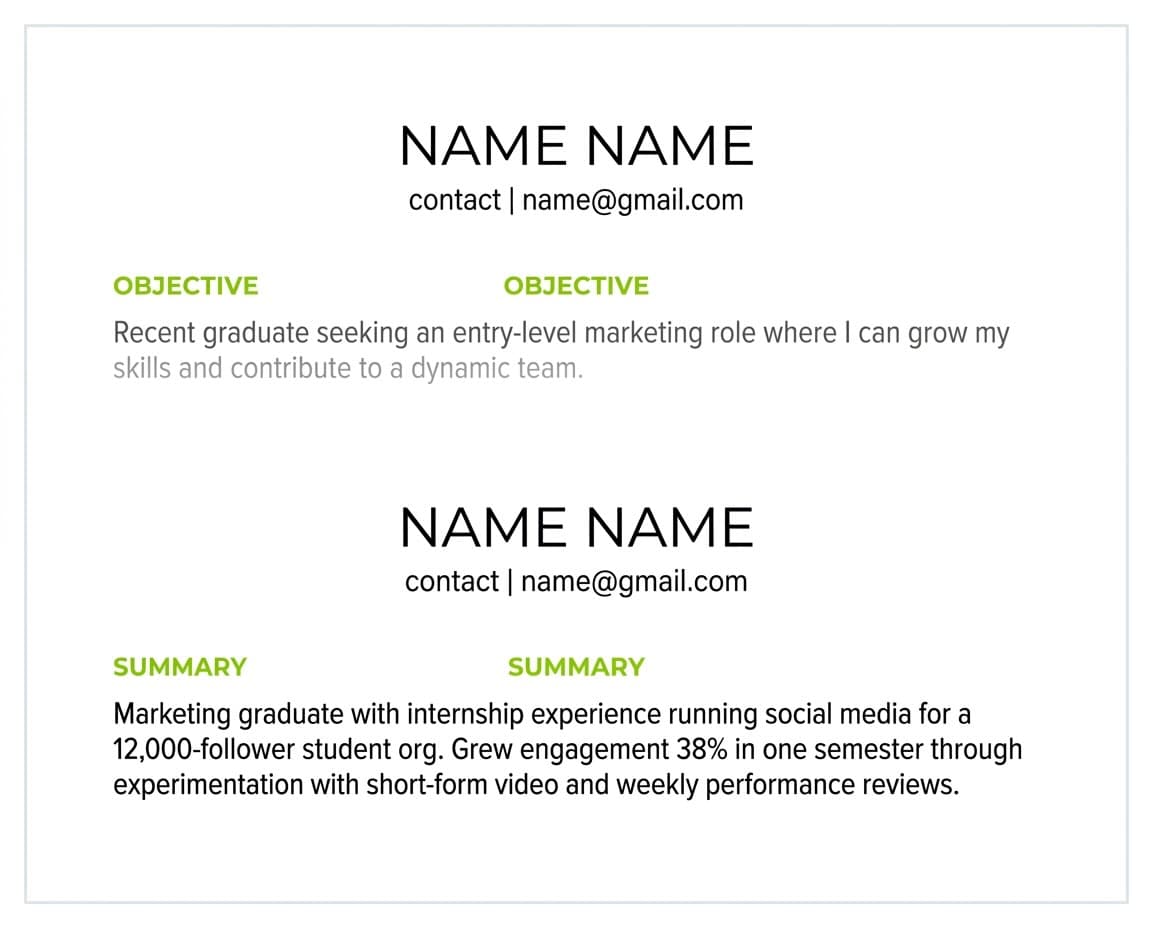
Weak objective: "Recent graduate seeking an entry-level marketing role where I can grow my skills and contribute to a dynamic team."
Stronger summary: "Marketing graduate with internship experience running social media for a 12,000-follower student org. Grew engagement 38% in one semester through experimentation with short-form video and weekly performance reviews."
The summary version says more in fewer words, surfaces a quantified result, and tells the reader what the candidate can actually do. It works whether a human or an ATS reads it first.
When Fresh Graduates Should Still Consider an Objective
The exception most career advice gets right is fresh graduates. If you are applying for your first full-time role and your resume is mostly coursework and one or two internships, you may not have the achievement density a summary needs. According to the University of Arizona Center for Career Readiness, even at the entry level a hybrid summary that names your major, relevant experience, and the kind of role you want can work. A pure objective also has a place here, especially if you are targeting a niche role that needs context.
If you are in this situation and want a more detailed walkthrough, the CareerKit guide on how to make your first resume covers the structure most early-career candidates should use.
When Career Changers Can Make an Objective Work
Career changers face a unique problem. Your previous experience does not obviously map to your new target role, so the recruiter has to do extra interpretation work. A short objective can do that interpretation for them, framing how your transferable skills apply to the new field. Indeed's career change summary guide recommends explicitly stating the transition and naming the most relevant skill.
Career change objective: "Customer service team lead with 6 years of experience moving into HR. Looking to apply proven skills in conflict resolution, employee onboarding, and cross-team communication to a People Operations Coordinator role."
That is a hybrid: it names the change, anchors transferable skills, and points at the target role without sounding aspirational. If you are navigating a pivot, the career change resume template walks through how to structure the rest of the document around that opening.
What Is a Resume Summary and Why It Works Better
For most candidates with two or more years of experience, the summary is the right opener. It does the work the objective cannot: it tells a stranger, in three or four lines, why you are a credible fit for the role.
Definition and Purpose of Resume Summaries
A resume summary is a short professional introduction at the top of the page. According to the Coursera resume summary guide, it typically runs two to four sentences and gives an overview of your qualifications, key skills, and most relevant achievements.
The purpose is to grab attention fast and signal fit. Where an objective forces a recruiter to project forward into your potential, a summary hands them evidence right at the top. Both Indeed and Virginia Tech's Career Quick Start note that summaries work best when you have measurable accomplishments to show, which is why they suit experienced professionals so well.
How Summaries Focus on Employer Benefits
The strongest summaries answer one quiet question every hiring manager has: "Can this person solve my problem?" According to Forbes' guide on writing a resume summary, the format works because it leads with what you can deliver, not what you want.
Compare these two openers for the same person:
Objective: "Experienced project manager seeking a role with leadership opportunities and a focus on innovative software development."
Summary: "Project manager with 8 years in B2B SaaS who has delivered 14 product launches on time and reduced average sprint slippage from 22% to 4%. Specializes in cross-functional teams of 10 to 25, with experience working alongside engineering, design, and customer success leads."
The objective is about the candidate's wishes. The summary is about the company's outcomes. Same person, very different first impression.
Key Components of an Effective Summary Statement
A good summary has three working parts. The first is your professional anchor: your job title or category, plus enough seniority context for the reader to place you. The second is your most relevant evidence: one or two specific, quantified results that prove you can do the work. The third is the keyword layer that helps you survive ATS screening, drawn directly from the job description you are applying to.
Keep all of this readable in three to four lines. According to the University of Arizona Career Readiness Center, strong summaries call out a few top skills and accomplishments and give the reader a clear preview of what they will see lower in the resume.
Pret a decrocher votre emploi de reve ?
Rejoignez plus de 50 000 chercheurs d'emploi qui ont deja transforme leur carriere avec notre createur de CV propulse par l'IA.