A strong work certificate opens doors; a weak one quietly closes them. In Switzerland you have a legal right to one under Article 330a of the Code of Obligations (OR), yet few people know how a correct certificate must be structured or what the polite phrasing really means. That is exactly where your next employer decides whether to invite you or screen you out.
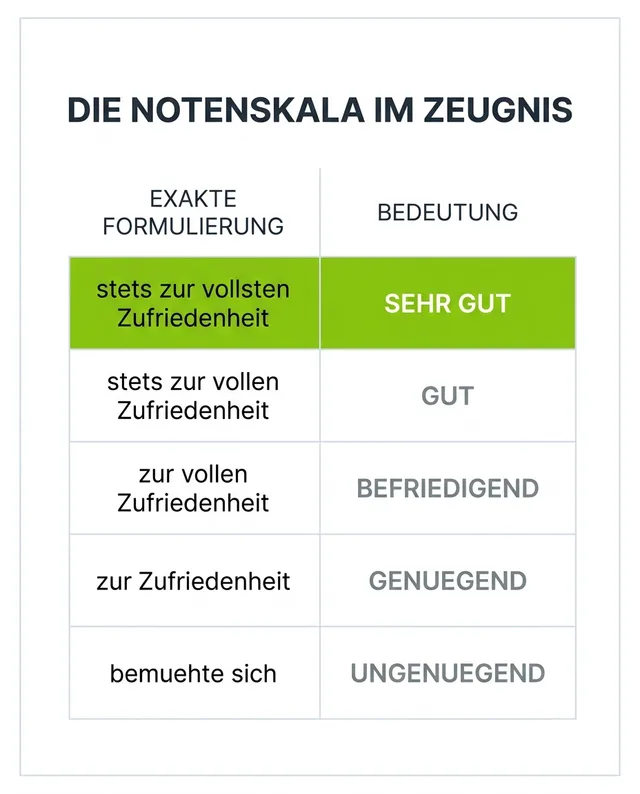
This guide gives you a complete Swiss work certificate template (Arbeitszeugnis), explains the seven mandatory parts, decodes the famous certificate language including its grading scale, and shows you what to do if your certificate is too weak. By the end you can check your own document line by line.
Your right to a work certificate in Switzerland
The legal basis is Art. 330a OR. It states that any employee can request a certificate at any time, covering the type and duration of employment as well as performance and conduct. You do not have to resign to get one: you are also entitled to an interim certificate (Zwischenzeugnis) during an ongoing employment.
The law distinguishes two types. The qualified certificate (Vollzeugnis) describes tasks, performance and conduct. The simple certificate (Arbeitsbestätigung) only states the type and duration of the job, with no assessment. In most cases you want the qualified certificate, because only that one supports your professional advancement. The choice is yours, not the employer's.
Two principles sit in tension: truth and goodwill. The certificate must be truthful and complete, and at the same time worded benevolently so as not to needlessly hinder your progress. The Federal Supreme Court clarified in BGE 129 III 177 that when the two collide, truth wins. You have a right to an objectively true certificate, not to the best possible one.
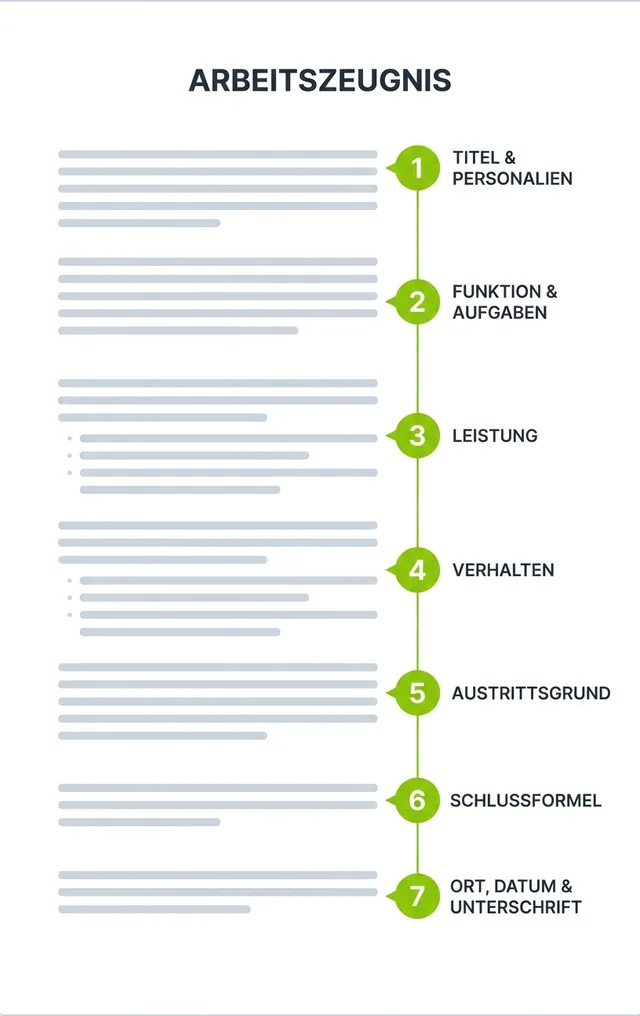
The structure: the seven mandatory parts
A qualified work certificate in Switzerland follows a fixed structure. If one of these parts is missing or conspicuously short, experienced HR staff already read that as a signal.