Search "how to learn AI skills" and most of what comes back is a computer science syllabus. Linear algebra. Statistics. Calculus. Neural network architectures. All of that matters if you want to build models for a living, and almost none of it is what your next employer will actually ask you to do.
Here is what those guides miss. The people getting hired on AI skills right now are mostly not engineers. They are marketers who rebuilt their reporting, recruiters who halved their screening time, analysts who stopped waiting on the data team. They picked up a narrow, practical set of skills over a few weeks, and they can prove it with something they built.
This guide covers the skills that actually appear in job descriptions, a 30-day plan to learn them for free, and how to write them on a resume without sounding like every other candidate who listed "proficient in ChatGPT."
Why AI skills now decide who gets the offer
Every year someone declares a skill essential and the labour market shrugs. This one is behaving differently, and the numbers are unusually clear about it.
The pay gap is real, and it keeps widening
PwC's 2026 Global AI Jobs Barometer analysed more than a billion job advertisements across 27 countries. Workers in roles that demand AI skills earn a wage premium of 62 percent. The same measure was 25 percent in 2024 and 57 percent in 2025.
That trajectory is the important part. A one-off shortage corrects itself as supply catches up. This one has widened three years running, which is what a structural shift looks like rather than a spike. Over the same period, postings requiring AI skills grew 69 percent while the job market as a whole grew 9 percent.
AI stopped being a tech department story
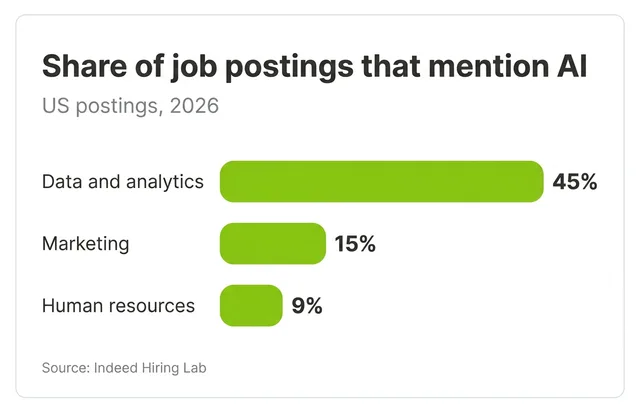
If you work in marketing, HR, finance or operations, the reasonable assumption used to be that this was someone else's problem. Indeed Hiring Lab data says otherwise. AI-related postings reached 5.9 percent of all US listings by June 2026, past the previous peak of 3.3 percent in 2022. More telling, 822 distinct job titles now carry AI-related terms, roughly one in twelve.