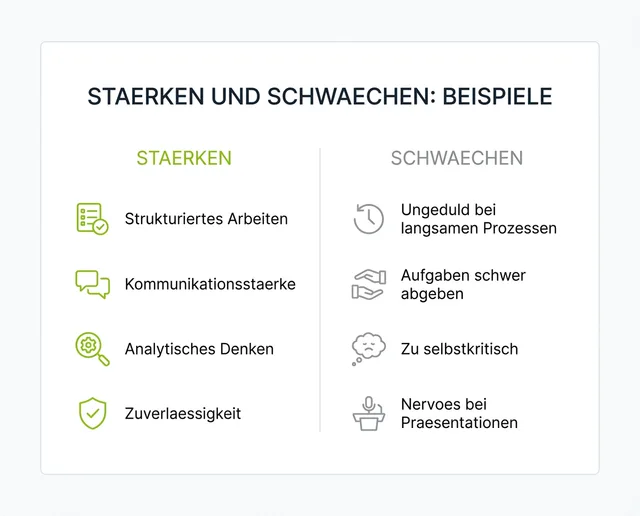
"What are your strengths and weaknesses?" is one of the most dreaded interview questions. Yet it is an opportunity: answer it honestly and concretely and you come across as self-aware and composed. This guide shows why the question is asked, how to prove strengths rather than claim them, and how to name a weakness without hurting yourself, with concrete examples to adapt.
As a career coach I usually hear two mistakes: memorised clichés for strengths and disguised boasting for weaknesses ("I am too much of a perfectionist"). Both are seen through at once.
Why this question is asked
It is not about a list, it is about self-reflection. Recruiters want to see whether you assess yourself realistically, whether your strengths fit the role, and whether you work on weaknesses. A good answer combines honesty with relevance to the specific job. For how the question fits into the interview, see our guide to the job interview.
Naming strengths: prove, do not claim
Choose two or three strengths that fit the role and back each with a short example. A claimed strength is worthless; a proven one convinces:
Before: "I am a great team player and very resilient."
After: "I work in a structured way: on the last project I owned the planning and we held the deadline despite two people dropping out."