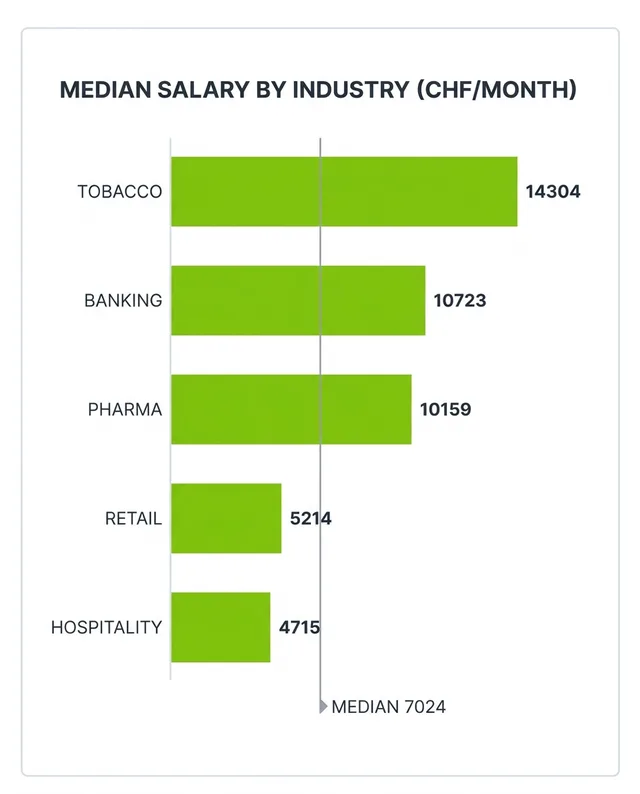
If you want to know whether your pay is fair, you need an honest benchmark. In Switzerland that benchmark is the median salary: in 2024 it stood at CHF 7,024 gross per month for a full-time position, according to the Swiss Federal Statistical Office, which released the new wage structure survey on 25 November 2025. Two years earlier it was CHF 6,788, a rise of 3.5 percent.
That single number tells you little about your own case, though. A bank employee in Zurich, a service worker in Ticino and a 28-year-old engineer earn wildly different amounts even though they work in the same country. In this guide I break the average salary down by industry, region, age and gender, convert the gross figure honestly into a net one, and show you how to put these numbers to work in a salary negotiation.
Median or average: which figure you should actually compare
Most people say "average salary" but reach for the wrong value. The arithmetic mean adds up every salary and divides by the number of employees. A handful of seven-figure executive packages drag it upward, so the figure sits higher than most people ever earn.
The median is more honest. It marks the exact middle: one half of all employees earn more, the other half less. That is precisely why the Federal Statistical Office works with the median. If you want to place your own salary, the median is your yardstick, not the mean.
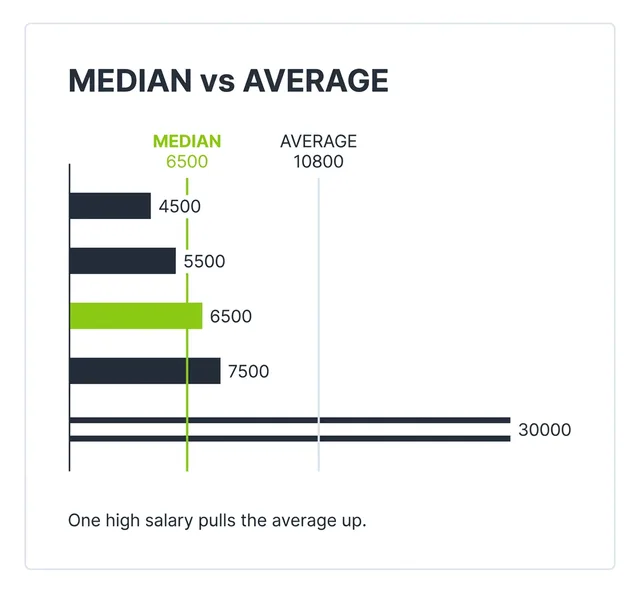
An example makes the difference concrete. Picture a small team:
Five salaries on the team: 4,500, 5,500, 6,500, 7,500 and 30,000 francs. The mean lands at 10,800 francs because that one top package distorts everything. The median sits at 6,500 francs, the real value in the middle. Four out of five people earn less than the "average."
So if you read that the average salary is above 8,000 francs and your own pay is lower, that does not mean you are underpaid. Compare against the median for your industry and region instead.