How to Create a Perfect German Bewerbung in 10 Minutes (2026)
Writing a full German job application in ten minutes sounds impossible. Anyone who has wrestled with the Anschreiben, then polished the Lebenslauf, then second-guessed the font knows how long it actually takes. You can still do it in ten minutes, as long as you know which parts matter and which you can safely skip.
I built CareerKit for exactly this problem. Based in Zurich, I spend most of my time with people who pour hours into applications without the quality improving. Most of that time gets burned on things recruiters barely look at, while the few elements that decide between an interview and a rejection get treated as afterthoughts.
This article shows you the fastest path to a Bewerbung that wins the few seconds of attention it actually gets. You will get the DIN 5008 standards that apply across the DACH region (Germany, Austria, Switzerland), the order you should work in, and the phrasing you can use directly. This is written for anyone applying for jobs in German-speaking markets, including expats and international candidates who are encountering the Bewerbung format for the first time.
What goes into a perfect Bewerbung
A complete application in the DACH region consists of three parts: the Anschreiben (cover letter), the Lebenslauf (CV), and the Anlagen (attachments). Skip or weaken any of these and you risk the interview, no matter how strong the others are.
The three mandatory components
The German Federal Employment Agency defines a complete Bewerbung as Anschreiben, Lebenslauf, and Zeugnisse (certificates and references). Some companies also expect a Motivationsschreiben (motivation letter), while a growing number of DAX 40 corporations and well-funded startups have dropped the Anschreiben requirement entirely. Read the posting carefully before you start. It will usually tell you what is expected.
The Lebenslauf is the centerpiece. A Stepstone Austria and Mind Take study found that 68 percent of recruiters consider the Lebenslauf the single most important part of the application, followed by the motivation letter at 22 percent and certificates at 10 percent. If you have to cut time anywhere, do not cut it on the Lebenslauf.
How much time recruiters actually spend
The same study used eye-tracking to find that recruiters spend an average of 43 seconds on a Lebenslauf, even though they estimate it feels like two minutes. Of those 43 seconds, 22.3 go to work experience, 7 to the most recent position, 6.1 to education, and 4.7 to soft skills.
That means you have less than a minute to make your case. That minute decides whether your application moves to the "interesting" pile or the rejection one. Everything you put on the page has to survive that reality check.
The right order to build it in
Start with the Lebenslauf, not the Anschreiben. Once the Lebenslauf is in place, you know exactly which experiences and strengths the cover letter should highlight. Going the other way almost always leads to duplicated work and inconsistencies between the two documents. Plan for roughly five minutes on the Lebenslauf, three on the Anschreiben, and two on attachments and layout.
Writing the Anschreiben in a few minutes
The Anschreiben has one job: to show why you fit this specific role at this specific company. Generic phrases waste both space and time. Three paragraphs, one page, one clear argument.
Structure following DIN 5008
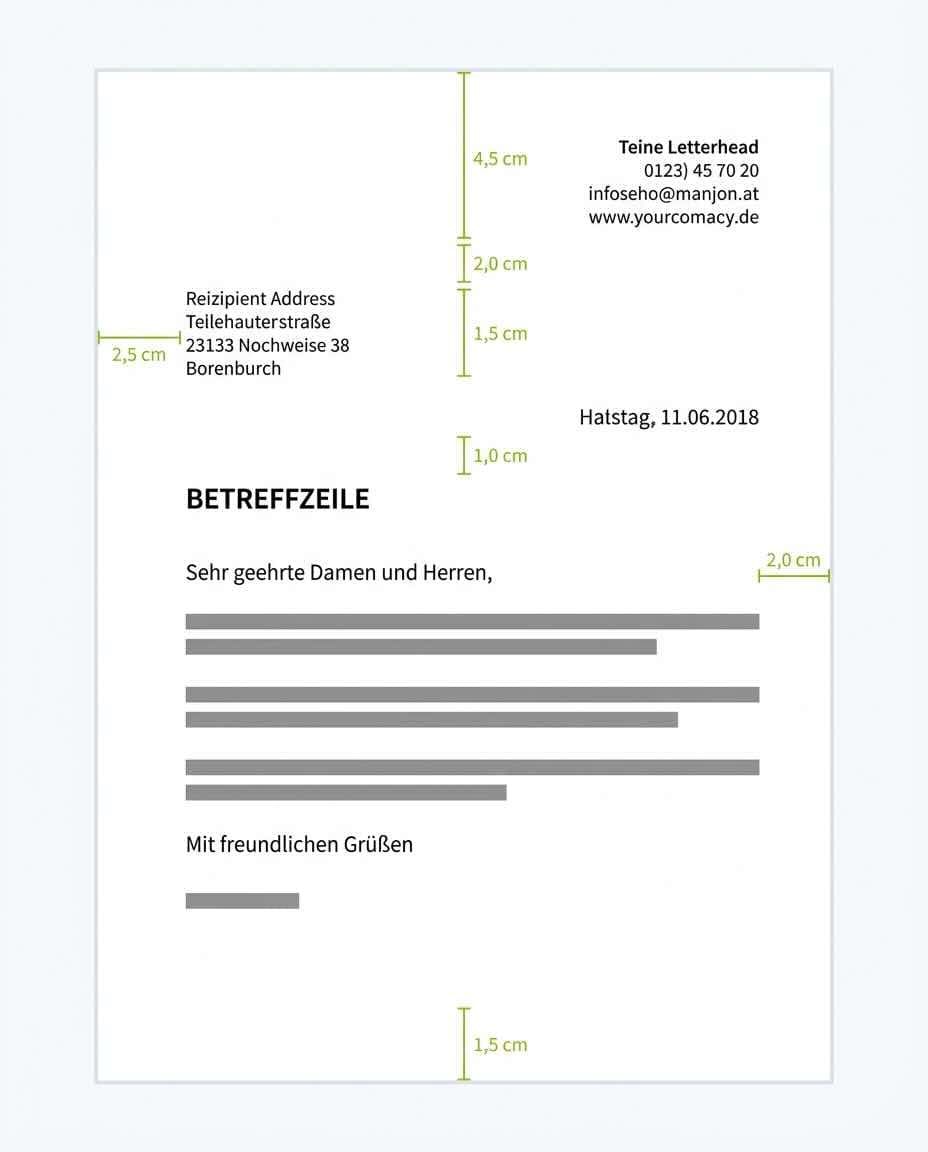
The DIN 5008 standard defines the formal format for German business letters and is treated as the default for applications too. Your contact information goes right-aligned at the top, the recipient address left below it, location and date right-aligned, then the subject line, salutation, body, sign-off, and signature. Top margin 4.5 cm, left margin 2.5 cm, right margin 2.0 cm. Font size 11 or 12 points, line spacing 1.15.
You do not have to follow the norm to the millimeter, but knowing it makes your Anschreiben look instantly professional. Recruiters recognize the familiar structure and find what they are looking for without effort.
The three paragraphs that matter
A strong Anschreiben has an opening, a body, and a close. Each paragraph has its own job to do.
Before: I am hereby applying for the advertised position as a project manager at your company, which I learned about on your website. After: Your project manager posting in the energy transition team caught my attention immediately, because that is exactly the focus I have been building for the past three years at a Swiss utility.
Before: In my previous role I took on many different responsibilities and was able to demonstrate my abilities. After: At Helion AG I delivered twelve photovoltaic projects worth a combined CHF 4.2 million on time and on budget, and rebuilt the internal onboarding for new project managers from scratch.
Before: I look forward to a positive response and am available for a personal interview at any time. After: I would welcome the chance to show you in person how I can help drive your part of the energy transition. My earliest possible start date is March 1, 2026.
The before versions could come from anyone. The after versions could only come from you, because they include concrete numbers, real company names, and a clear link to the posting.
Tailored to the company
Spend two minutes on the company's website before you write. Look for the word that comes up over and over (mission, values, current product, recent milestone) and pick it up in your first paragraph. You do not need to write a novel. One sentence that proves you actually know the company sets you apart from the pile.
If you do not want to rewrite the Anschreiben from scratch every time, build it with the CareerKit cover letter generator and adapt only the first paragraph per role. The structure stays consistent, the personalization happens where it matters.
Building the Lebenslauf in five minutes
The Lebenslauf is the most important document in your application. It gets read longer, scrutinized more, and saved by HR more often than anything else you submit. Even so, you can build a strong one in five minutes if the structure is right.
Reverse chronological is the standard
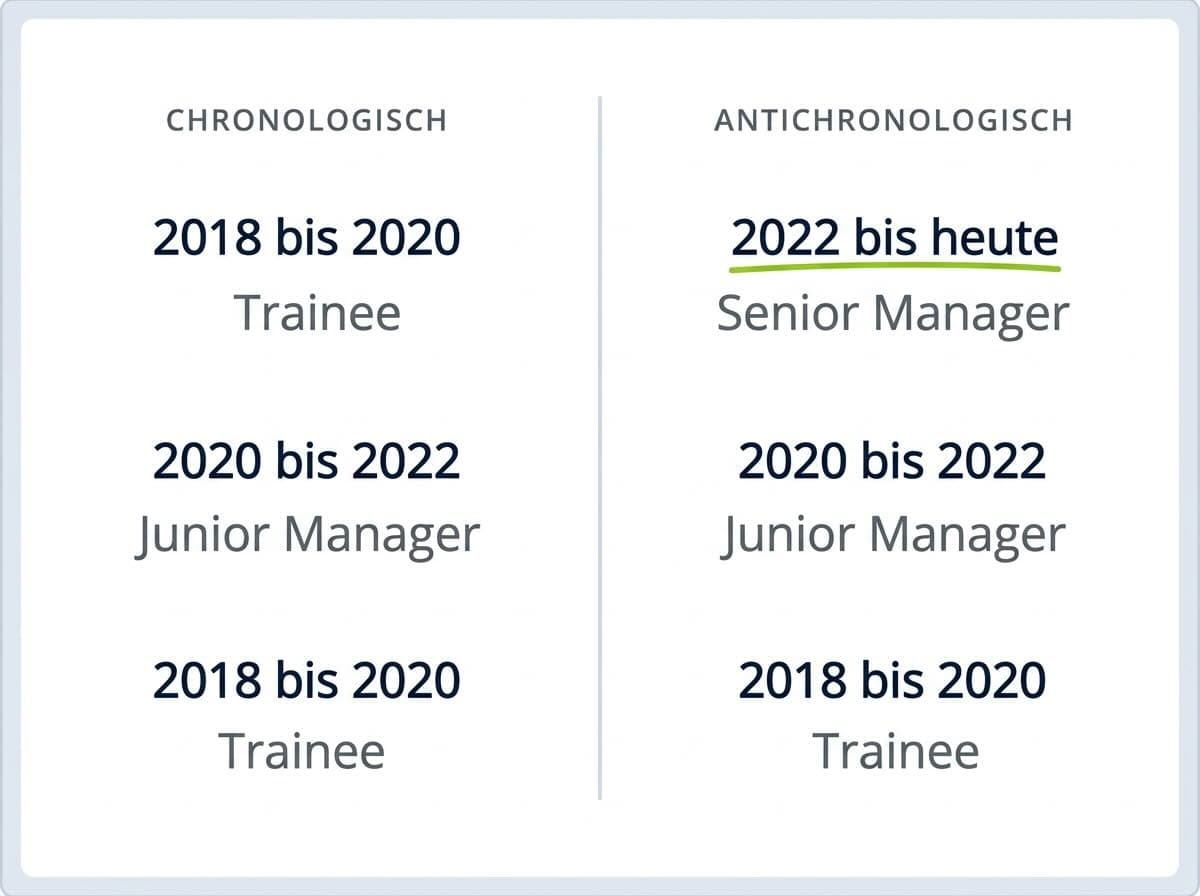
Indeed Germany and the German Federal Employment Agency both recommend the tabellarischer, antichronologischer Lebenslauf (tabular reverse-chronological CV) as the default. The most recent position goes at the top, then the previous one, and so on. Education follows the same logic.
The reason is simple. Recruiters care most about what you are doing now and what you did just before that. Forcing them to scroll down to find your current role wastes the few seconds you have.
Ready to land your dream job?
Join 50,000+ job seekers who have already transformed their careers with our AI-powered resume builder.