A recruiter will spend roughly 7.4 seconds on your resume before deciding whether to keep reading or move on, according to the Ladders eye-tracking study reported by HR Dive. That window is barely enough time to register your name, your last title, and the shape of the page. Almost every word in between is wasted unless it earns attention on contact.
The single biggest lever you control inside that window is the verb at the start of each bullet. "Was responsible for managing the team" disappears. "Led a team of twelve through a platform migration" lands. Same job, different verb, completely different signal.
This guide gives you more than 250 resume action verbs grouped by what they actually do, paired with before-and-after examples drawn from real bullets, and tested against how modern hiring works in 2026. By the end, you will know which verbs belong in your resume, which to delete on sight, and how to pair them with metrics so they survive both algorithmic screening and a hiring manager who is already late to a meeting.
Why Resume Action Verbs Matter More in 2026
The job market in 2026 is unusual: there are jobs, but more people chasing each one. Understanding the scale of the competition makes clear why verb choice is no longer a stylistic preference.
Translated to a recruiter's inbox: more resumes per posting, less time per resume, less margin for resumes that read like job descriptions instead of accomplishments.
Two filters now stand between you and a hiring manager. The first is software. Select Software Reviews' 2026 ATS statistics report confirms that roughly 99% of Fortune 500 companies use an applicant tracking system, and 75% of recruiters use an ATS or similar tool as part of their workflow. The second is a human skim that, per the Ladders study cited above, averages 7.4 seconds.
Both filters reward the same thing: clean sentences that start with a verb describing what you did, followed by a result. Bullets that bury their verb in a passive construction or hide their result behind "responsible for" lose on both passes.
Why Active Verbs Outperform Passive Language
Active voice puts you at the front of the sentence as the person doing the work. Passive voice makes you a bystander to your own career. The difference shows up immediately when you compare bullets side by side.
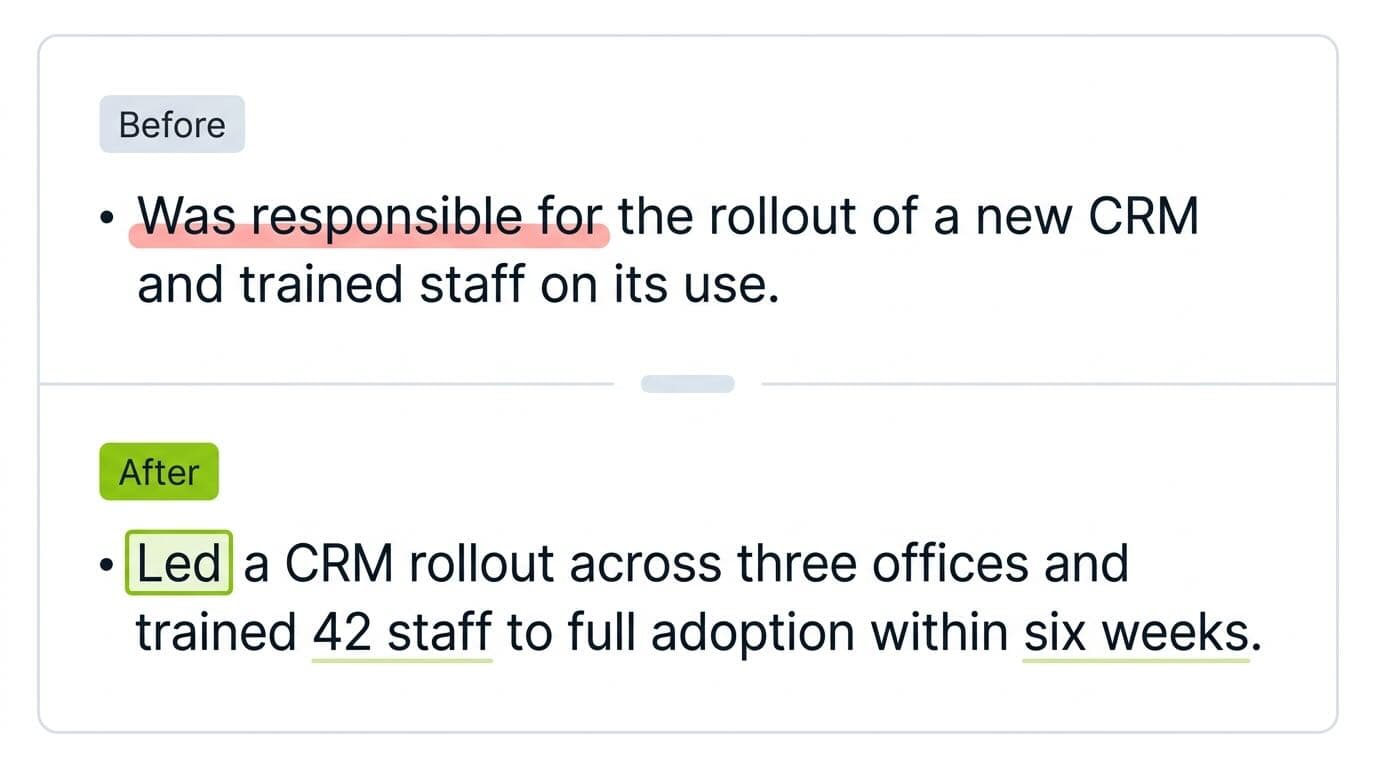
Before: Was responsible for the rollout of a new CRM and trained staff on its use.
After: Led a CRM rollout across three offices and trained 42 staff to full adoption within six weeks.
Same job. The second version is shorter, names a concrete verb, gives scale, and ends in an outcome. That is the pattern every section that follows is built around. If you want to see this rewriting style applied across full bullets, our guide to strong work-experience bullet points walks through it in depth.
Words That Weaken Your Resume
Before adding stronger verbs, it helps to know which language is actively hurting you. Three categories deserve the delete key on sight.
Overused Clichés to Strip Out
"Team player," "detail-oriented," "results-driven," "self-starter," "fast learner," "hard worker," and "works well under pressure" appear on almost every resume submitted in any given week, which means they no longer say anything. A recruiter reads them and moves on. Demonstrate the trait instead of claiming it.
Before: Excellent communication skills and a strong team player.
After: Negotiated a $500K contract with a key supplier and ran the weekly cross-team standup that aligned sales, ops, and finance on quarterly targets.
Passive Phrases That Hide Your Contribution
"Was responsible for," "duties included," "tasked with," "involved in," and "assisted with" all share the same defect: they describe the existence of a job without showing what you actually did inside it. Replace them with a direct verb.
Before: Was responsible for managing a team and involved in the budget process.
After: Managed a team of nine and owned a $1.2M annual budget across two cost centers.
Vague Filler That Adds No Information
"Familiar with," "some experience in," "various projects," "many initiatives," and "helped improve performance" leave a recruiter guessing about scope, scale, and result. Specifics are not optional.
Before: Familiar with various marketing tools and helped improve campaign performance.
After: Ran HubSpot and Google Ads for nine product launches and raised qualified-lead conversion from 2.1% to 3.4% over four quarters.
How to Pick the Right Verb for the Right Bullet
Not every strong verb belongs on every resume. Your career stage, your industry, and the specific accomplishment all narrow which verbs land and which oversell.
Match Verb Intensity to Your Career Stage
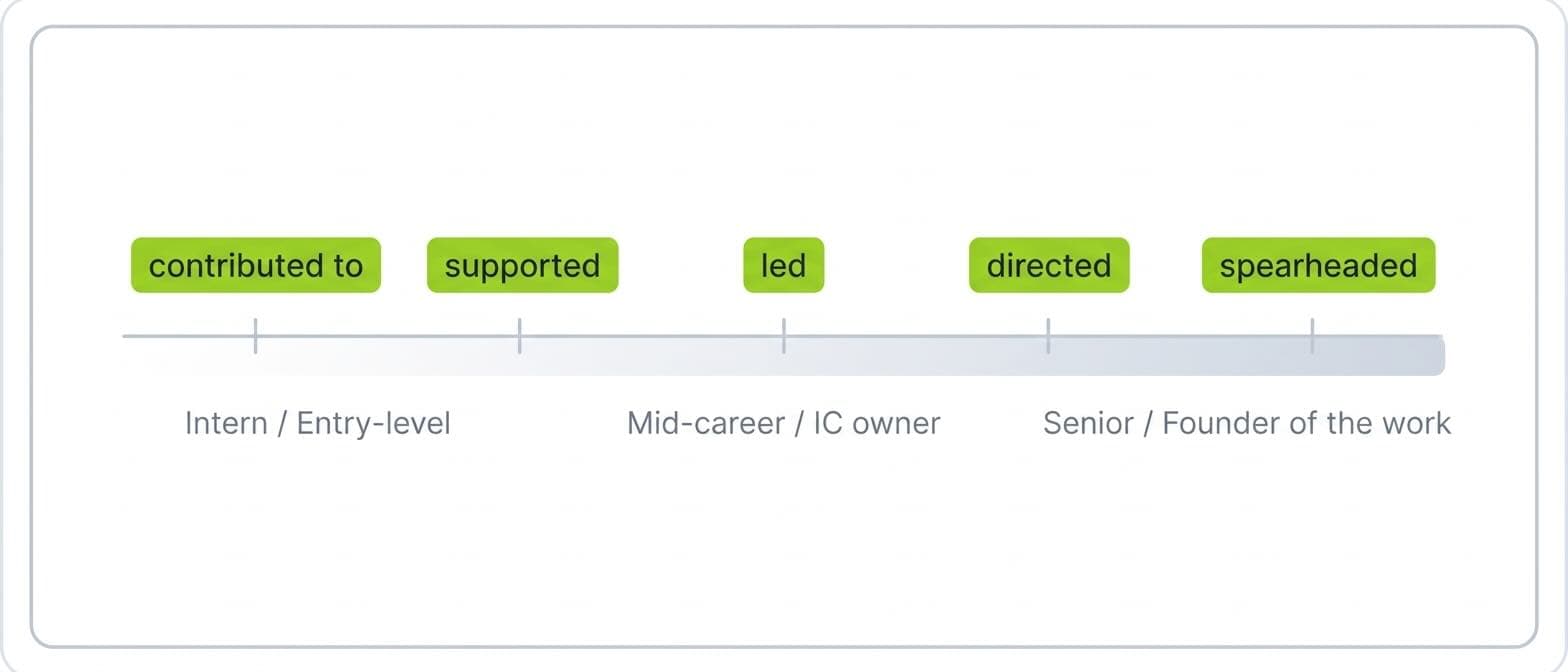
Senior verbs on an entry-level resume read as exaggeration, and entry-level verbs on a senior resume read as small thinking. Harvard's Mignone Center for Career Success makes the same point: the verb you pick should match the scope of what you actually owned.
If you ran a small project as part of someone else's initiative, "contributed to" or "supported" is honest. If you owned the project end to end, "led" or "directed" is accurate. If you created the project from scratch and pulled others in, "launched," "spearheaded," or "pioneered" earns the space.
Before (overclaimed for an intern): Spearheaded the redesign of the customer onboarding flow.
After: Contributed to the customer onboarding redesign by mapping current-state user friction across 30 interview transcripts.
Mirror the Language in the Job Description
Indeed's guide to resume power words recommends scanning the posting for the verbs the employer used and reflecting that language back, where it is honestly true of you. ATS keyword matching aside, this is also how a hiring manager confirms in three seconds that you read the job.
If the posting asks for someone who "drives cross-functional initiatives," your bullet about coordinating a project benefits from the verb "drove" over the verb "helped."
Before: Helped coordinate a cross-team launch.
After: Drove a cross-functional launch across product, marketing, and support, hitting a 12-week timeline with no slip.
Use Industry-Native Verbs
A finance team expects "audited," "forecasted," "reconciled," and "modeled." A design team expects "prototyped," "iterated," "shipped," and "tested." A nurse manager expects "triaged," "administered," "charted," and "stabilized." Using the verbs your industry actually uses signals fluency before the metric even arrives.
Our anatomy of a resume guide covers how to map your skills section against the verbs and tools in the posting, which works hand in hand with verb selection in your experience section.
Pair Every Verb With a Result
The verb is half the bullet. The result is the other half. A bullet that opens with "engineered" but ends with "various improvements" is no stronger than a passive sentence: it just sounds noisier. Yale's Office of Career Strategy uses an Action + Project + Result framework, which is simply the discipline of finishing what the verb starts.
Before: Engineered process improvements across the team.
After: Engineered a new ticket-triage workflow that cut average response time from 14 hours to 3.
Achievement and Accomplishment Verbs
Achievement verbs do the heaviest lifting on a resume because they describe finished work and measurable outcomes. They are the right opener whenever you have a number to attach.
Success and Completion Verbs
Use achieved, accomplished, attained, completed, delivered, earned, executed, finalized, produced, secured, succeeded, surpassed, exceeded, outperformed, showcased, won. Each one signals that something started and finished under your watch. "Exceeded," "surpassed," and "outperformed" are the right choice when the result went past the original target.
Growth and Performance Verbs
Use amplified, accelerated, boosted, capitalized, drove, expanded, fortified, generated, grew, increased, lifted, maximized, multiplied, propelled, raised, scaled, stimulated, sustained. These work especially well when you can attach a percentage or dollar figure.
Before: Improved sales performance for the territory.
After: Grew territory revenue from $2.1M to $3.4M over 18 months by reopening eight dormant accounts.
Before: Achieved sales targets consistently.
After: Exceeded quarterly quota in seven of eight quarters, finishing FY25 at 128% of plan.
Leadership and Initiative Verbs
Leadership verbs describe the act of taking responsibility for people, projects, or direction. They earn their place when you genuinely owned the outcome, not when you participated in something someone else owned.
Team Leadership Verbs
Use mentored, coached, guided, trained, developed, motivated, unified, fostered, recruited, supervised, enabled, inspired, championed, empowered, aligned, strengthened. These describe building capacity in other people, which is what hiring managers look for when assessing leadership potential at any level.
Project Ownership Verbs
Use spearheaded, pioneered, directed, championed, launched, instituted, established, initiated, orchestrated, chaired, organized, coordinated, executed. "Spearheaded" and "pioneered" carry the most weight because they imply you started something that did not exist before.
Decision-Making Verbs
Use assessed, prioritized, delegated, authorized, finalized, resolved, determined, approved, allocated. These signal judgment under constraints, which matters more in senior roles than raw activity.
Before: Led change initiative across the operations team.
After: Directed an operations restructuring that consolidated four teams into two, preserved 91% of staff, and cut handoff time by 30%.
Before: Helped onboard new team members.
After: Mentored four new hires through their first 90 days, cutting time-to-first-deal from 11 weeks to 7.
Management and Supervision Verbs
Management verbs describe operational ownership rather than founding leadership. They are the right choice when you ran the machine someone else built.
Day-to-Day Management Verbs
Use managed, supervised, oversaw, administered, coordinated, scheduled, assigned, monitored, controlled, tracked, reviewed, evaluated. Pair these with the size and scope of what you ran.
Resource and Budget Verbs
Use allocated, budgeted, forecasted, planned, optimized, procured, secured, negotiated, sourced, controlled, balanced, conserved. These work especially well in operations, finance, and procurement roles where dollar accountability is the headline.
Compliance and Oversight Verbs
Use audited, inspected, verified, certified, enforced, approved, validated, monitored, ensured. Use these honestly: they imply formal responsibility for a process, not casual involvement.
Before: Managed vendor relationships and reduced costs.
After: Renegotiated 14 supplier contracts and cut annual procurement spend by $340K (12%) while preserving SLAs.
Before: Supervised the customer support team.
After: Supervised a 25-person support team across two shifts and raised CSAT from 78 to 89 over three quarters.
Communication and Presentation Verbs
Communication verbs signal that you can move information between people and influence decisions. They cover everything from a board presentation to a stakeholder email.
Spoken Communication Verbs
Ready to land your dream job?
Join 50,000+ job seekers who have already transformed their careers with our AI-powered resume builder.