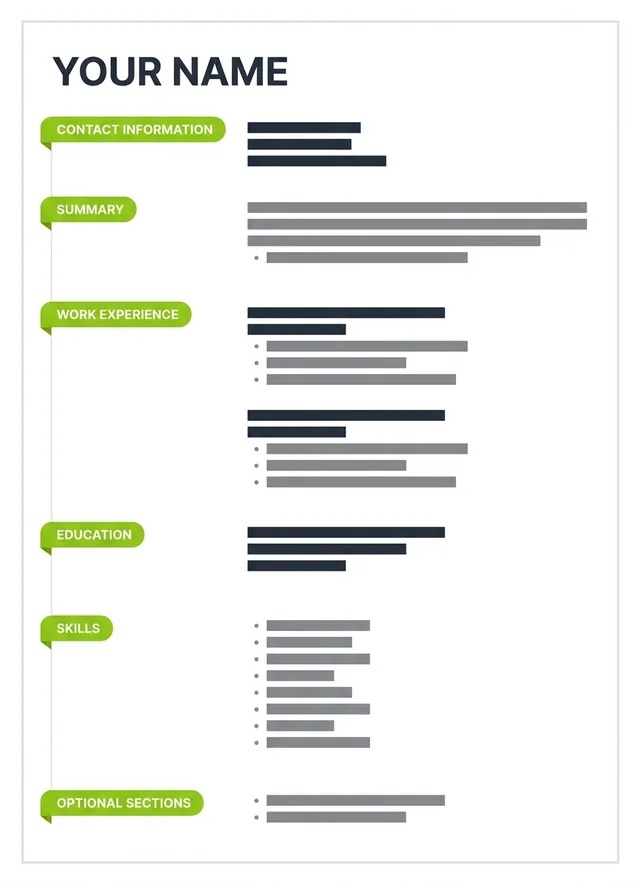
Your work history should appear in reverse chronological order, starting with your current or most recent job. Each role needs the company name, your title, employment dates, and key responsibilities. Use action verbs to showcase achievements rather than routine tasks, and calculate results whenever possible.
The most relevant positions from the last 10-15 years matter most.
4. Education
Recent graduates should put education near the top of their resume. Professionals with more than three years of experience can place it after their work history. The basics include your degree, institution name, graduation year (skip it if you graduated over five years ago), and relevant honors.
5. Skills section
Your skills should be organized by type technical, soft, and industry-specific to make them easy to read. The job description provides keywords that help with ATS searches. Pick your most relevant skills for the position, and balance technical abilities with interpersonal qualities.
6. Optional sections: awards, languages, hobbies
These extra sections help you stand out from other candidates. Languages should show proficiency levels, while relevant awards and hobbies can demonstrate valuable traits. Skip controversial hobbies or those that don't show interaction with others. These sections belong at the end of your resume and should stay brief.
How to format each section for clarity and impact
Your resume's visual appeal plays a key role in how recruiters see your qualifications. Good formatting will give a strong first impression during those quick few seconds of review.
Use of bullet points and action verbs
Bullet points help readers scan your resume quickly. Each job experience should have 3-4 bullets, and each bullet should be 1-2 lines long. Start bullets with strong action verbs instead of weak phrases like "responsible for" or "helped with". To cite an instance, change "Did inventory counts" to "Performed regular inventory audits, identifying solutions that achieved 10% revenue increase".
Strong action verbs you can use:
- For management: Administered, Coordinated, Delegated
- For achievements: Accelerated, Transformed, Simplified
- For communication: Worked together, Persuaded, Negotiated
Font size, spacing, and layout tips
Readable fonts like Arial, Calibri, or Garamond work best in 10-12 point size. Text smaller than 10 point becomes hard to read. Margins should stay between 0.5-1 inch. A margin smaller than 0.5 inch might cut off content in PDF format. Bold text in your name and section headers creates clear visual order. Your spacing and date format should stay consistent throughout.
How to keep it to one page (or not)
The one-page rule doesn't hold true anymore for experienced professionals. All the same, entry-level positions need just one page. You can make your resume shorter by adjusting margins (minimum 0.5 inch), reducing line spacing between sections, combining related skills, and removing older positions. Two-sentence bullets work better than paragraphs, and they should start with action verbs rather than "responsible for" phrases. Experienced professionals can use two pages if the content matters.
Tailoring your resume for each job
Generic resumes rarely catch a hiring manager's attention in today's competitive job market. Your chances of getting an interview increase when you tailor your resume for each application. Studies show that 83% of recruiters prefer candidates who customize their resumes.
Using keywords from job descriptions
Companies now use Applicant Tracking Systems (ATS) to pre-scan applications. These systems filter out candidates who don't match the job description based on keyword relevance. The systems:
- Search for specific keywords related to the job's requirements
- Rank applications based on keyword frequency and placement
- Prioritize resumes that use keywords in context
The job posting needs careful analysis to identify the right keywords. Skills that appear multiple times or stand out deserve attention, particularly in the first paragraph. You should weave these terms naturally throughout your document. Remember, ATS rejects 75% of qualified applicants due to formatting issues alone.
Customizing your summary and skills
Your summary section makes first impressions quickly. Use it to highlight your most relevant qualifications. The job title you're applying for should appear prominently, and the language should match the job description. The employer's most valued skills need priority placement, using exact phrases from the posting.
Creating multiple resume versions
A master version of your resume with complete bullet points for each position saves time. The customization process becomes easier when you remove bullets that don't arrange with the target role. You might need 2-3 base versions with industry-specific terminology if you're targeting multiple industries. This approach will give you relevant content without constant rewrites.
A good resume comes down to seeing the hiring process from a recruiter's viewpoint. This piece decodes everything that makes your resume catch attention in those crucial review seconds.
Time-pressed hiring managers spend less than a minute looking at your credentials. Your resume must be clear and organized since it serves as your professional first impression. Each section needs strategic crafting to pass both human and ATS evaluations.
Even the most qualified candidates lose chances because of poor formatting or missing keywords. The six core sections we got into - contact information, summary/objective, work experience, education, skills, and optional sections - work together to tell your professional story effectively.
Clean layouts, strategic bullet points, and action-driven language make your qualifications jump out at recruiters who scan in that characteristic F-pattern. The way you format these sections affects readability by a lot.
Maybe even more importantly, customization gives you the strongest edge in today's competitive job market. You need extra effort to tailor your resume for each position, but this approach boosts your interview chances dramatically. Generic applications fall flat compared to carefully customized documents that mirror job description language.
Building a resume might feel daunting at first. Breaking it into manageable sections makes it nowhere near as intimidating. Think of your resume as a living document that grows with your career and adapts to each new chance you pursue.
Understanding what hiring managers want to see helps reshape your resume from a basic job history into a powerful marketing tool that opens doors to your next career move.