Chronological vs Functional Resume 2026: Which Wins? | Careerkit
Startseite/Blog/Blog/Chronological vs Functional Resume 2026: Which Wins?
Blog
Chronological vs Functional Resume 2026: Which Wins?
Chronological vs functional resume in 2026: see how each performs with ATS, recruiters, and your career stage, and which one actually gets you interviews.
Pick the wrong resume format and your application can stall before any human ever opens it. Pick the right one and the same work history reads as a clear, confident case for the job. The decision sounds technical, but it is one of the highest-leverage choices you make during a job search.
Most job seekers in 2026 are weighing two options: a chronological resume that walks through your work history in reverse order, or a functional resume that leads with skill groupings and pushes job titles to the back. There is also a third option that often outperforms both. The right answer depends on what your career looks like, who is reading the resume, and how the software in front of the recruiter is built to read it.
This guide breaks down how each format performs in 2026, where each one wins or loses, and how to decide which one belongs on your next application.
What Resume Formats Look Like in 2026
The hiring funnel has changed faster in the last two years than it did in the previous ten. Before you choose a format, it helps to understand what your resume is actually walking into.
How ATS and AI Screening Work Today
Almost every mid-size and large employer uses an applicant tracking system to receive, parse, and rank applications. According to Select Software Reviews, nearly 99% of Fortune 500 companies use an ATS to handle hiring at scale. The system extracts your contact details, work history, education, and skills, then converts what it pulls into a structured record that a recruiter can search.
AI now sits on top of that pipeline. SHRM's 2025 Talent Trends report shows that AI use in HR jumped to 43% in 2025, up from 26% the year before, and recruiting is the single most common application. Inside recruiting, SHRM data shows 44% of organizations using AI to screen resumes and 51% using it across recruiting tasks broadly.
What that means for you is simple. A clean, predictable structure is no longer a stylistic preference. It is the format that lets the software find your job titles, dates, and skills in the right places so a recruiter can act on them. If you want a deeper walkthrough of every section a strong resume needs, our anatomy of a resume guide covers the structure piece by piece.
The Move Toward Skills-First Hiring
The other shift reshaping resumes in 2026 is the move toward skills-first hiring. SHRM reports that more employers are evaluating candidates on demonstrated capabilities rather than credentials, and the 2025 SHRM Talent Trends data shows 27% of organizations have removed degree requirements for at least some positions. The World Economic Forum's Future of Jobs Report 2025 found that 63% of employers consider skill gaps the single biggest barrier to business transformation.
Skills matter more than they used to. That does not, however, mean a skills-first format is the right choice. The way a recruiter sees your skills depends on the structure your resume gives them.
Why Format Choice Matters More Than Ever
Format decides whether your information lands in the right field or scrambles into the wrong one. Tables, multi-column layouts, text boxes, and graphics are the most common parsing failures, according to MIT Career Advising and Professional Development. When the parser cannot find a section, that information often disappears from the recruiter's search.
The pressure on the human reader is just as real. The often-cited Ladders eye-tracking study covered by HR Dive put the average initial scan at 7.4 seconds. Whether your reader spends seven seconds or seventy, the structure of the page determines what they see first. A clean format gets you a fair read. A confusing one gets you skipped.
The Chronological Resume Format
The reverse chronological format is the one most recruiters expect to see. It tells your story job by job, starting with your current role and working backward.
How a Chronological Resume Is Structured
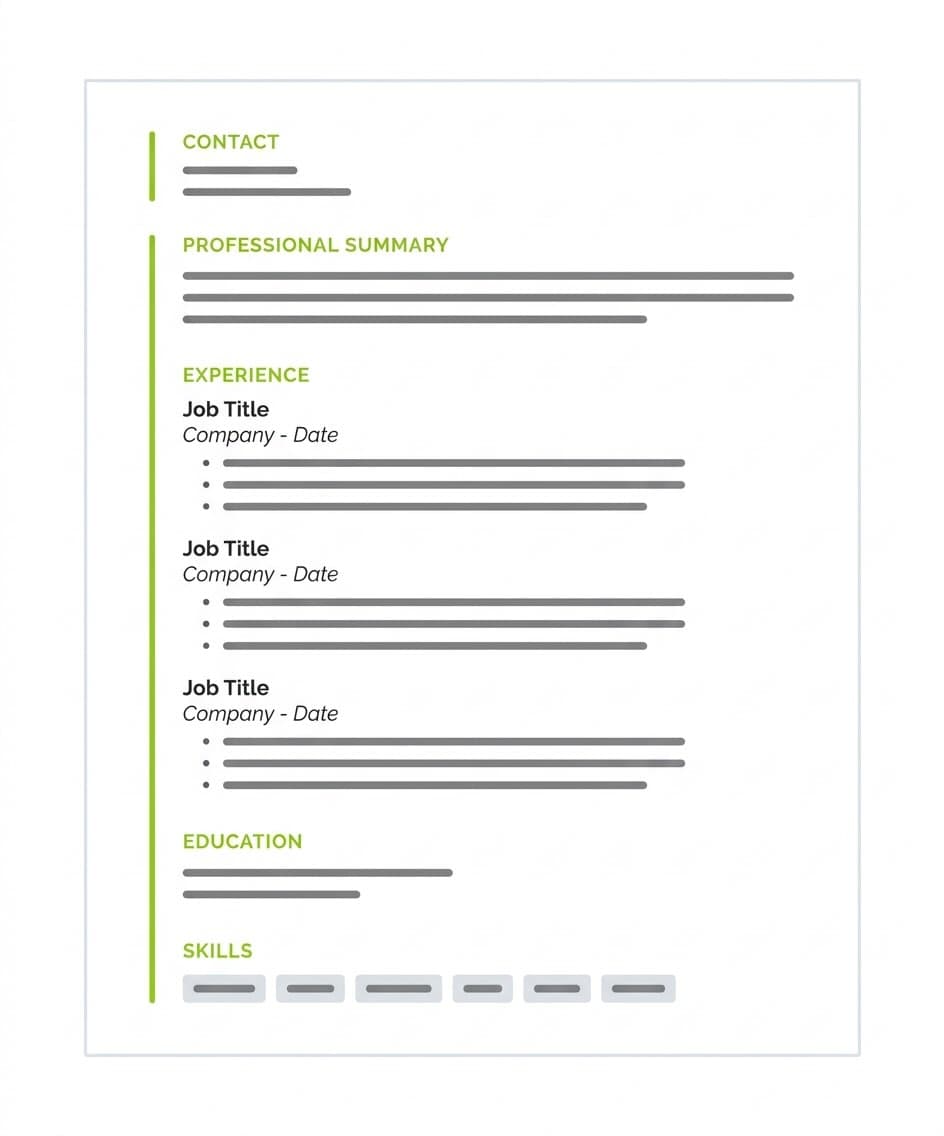
The basic frame is consistent. Contact information sits at the top, followed by a short professional summary. Work experience comes next, with each role listed in reverse order under a clearly dated entry. Education and skills sit toward the bottom. Indeed's resume format guide lays out the same structure.
Here is what a single role looks like in this format:
Senior Marketing Manager Acme Corporation, Zurich | March 2023 to Present
Led a team of six on a regional rebrand that lifted qualified leads by 34% in year one. Restructured the campaign analytics stack to cut weekly reporting from three days to four hours.
The information a recruiter is looking for in those first seconds, like your title, your employer, and your dates, all sit exactly where they expect to find them.
Where Chronological Resumes Win
Chronological format is the easiest format to verify and the easiest one to scan. If your last role lines up with the role you want next, a recruiter can see the fit almost instantly. The format also handles promotions well, because growth inside the same company reads at a glance.
Look at the difference in how a promotion can be presented:
Weak version
Marketing Roles Acme Corporation, 2020 to Present Various marketing responsibilities including campaign management.
Strong version
Senior Marketing Manager Acme Corporation, Zurich | March 2023 to Present
Marketing Manager Acme Corporation, Zurich | June 2020 to February 2023
Promoted twice in three years. Took ownership of the regional rebrand and grew qualified leads by 34% in the first year as Senior Manager.
The strong version answers a recruiter's first question (where are you now and what did you do?) before they have to ask it. Each bullet under your most recent role earns more visual attention than the rest of the page combined, so write the strongest, most quantified achievement first. Our guide on writing work experience bullet points that actually land goes deeper on what makes a bullet read as proof rather than a job description.
Where Chronological Resumes Fall Short
The same structure that makes the format easy to read also makes any irregularity in your timeline visible. Employment gaps stand out. So does a recent role that does not match the field you are now applying to. Recent graduates with limited work history can find the experience section feeling thin.
Career changers face a specific problem here. If your last two roles sit in a different industry from the one you want next, the chronological format puts that mismatch at the top of the page. Your transferable skills exist somewhere in the bullet points underneath, but the recruiter has to dig to find them. If you are in this situation, our career change resume template shows how to reframe a chronological resume to lead with relevance instead of recency.
Best Industries and Career Stages for Chronological
Traditional sectors like finance, law, healthcare, and academia almost always expect chronological. The format works best when your recent experience is in your target field, your timeline is steady, and your career growth tells a clear story. If you are putting together your first resume and you have internships, part-time work, or strong academic projects, chronological is also typically the right call. Our first resume guide walks through how to structure that page when your work history is short.
If your recent timeline supports it, you can build the resume itself in a few minutes inside the CareerKit resume builder, which uses ATS-safe templates by default so you do not have to fight Word formatting.
The Functional Resume Format
The functional resume flips the order. Instead of leading with jobs and dates, it leads with skill groupings. Work history is shorter and pushed lower on the page.
Bereit fuer Ihren Traumjob?
Schliessen Sie sich 50.000+ Jobsuchenden an, die ihre Karriere bereits mit unserem KI-gestuetzten Lebenslauf-Builder verwandelt haben.