Free Resume Score Checkers: What They Actually Check (2026 Guide)
The "75% of resumes are rejected by ATS" stat is a myth. Learn what resume score checkers actually evaluate, see before/after examples, and find out what really gets your resume past recruiters in 2026.
In today’s competitive job market, standing out to recruiters and applicant tracking systems (ATS) is more important than ever. With most large employers using ATS to manage applications and high-demand roles attracting 400 to over 2,000 applicants within days, optimizing your resume isn't just a good idea, it's essential. Fortunately, there are several free resume score checkers available online that can help job seekers improve their resumes, increase their chances of passing ATS filters, and ultimately land interviews.
Why Use a Resume Score Checker?
Many job seekers focus on crafting compelling cover letters or preparing for interviews, but often overlook the first hurdle: getting their resume noticed. Research from Indeed's hiring lab consistently shows that resume quality is the single biggest factor in whether a candidate gets to the interview stage. ATS software is used by 99% of Fortune 500 companies and 75% of all employers to manage incoming applications, sorting and ranking candidates based on criteria set by the hiring team. This means a resume that looks great to a human might never be seen if it’s not optimized for ATS.
Resume score checkers analyze your resume against ATS algorithms, providing a score and actionable feedback on how to improve formatting, keywords, and content. If you're starting from scratch, our guide on how to make your first resume walks through every step before you even get to the scoring stage. This can dramatically increase the likelihood of your resume making it through initial screenings.
There's a widely repeated claim that 75% of resumes are automatically rejected by ATS, but a 2025 study by Enhancv interviewing 25 U.S. recruiters found that 92% of recruiters say their ATS does not auto-reject resumes based on formatting, keywords, or content. The real problem isn't a robot deleting your application. It's volume: when a single role gets hundreds of applicants, recruiters spend seconds per resume, and anything that's poorly formatted, missing keywords, or hard to scan gets skipped. A resume checker helps you fix exactly those issues before you hit submit.
Moreover, resume score checkers can help you tailor your resume for specific job applications. By comparing your resume to job descriptions, these tools can highlight the most relevant skills and experiences that align with what employers are seeking. Understanding what each section of your resume should accomplish makes this feedback much easier to act on. This targeted approach not only enhances your chances of passing the ATS but also demonstrates to hiring managers that you have a clear understanding of the role and its requirements.
How to Evaluate a Resume Score Checker (Before You Trust One)
Not all resume checkers deliver the same value. Some scan for basic formatting issues, others compare your resume against a specific job description, and a few do little more than count keywords. Before you trust a tool with something as important as your next job application, here's what to look for.
Does It Check Against a Real Job Description?
The most useful resume checkers don't evaluate your resume in a vacuum. They compare it to a specific job posting and show you where your language aligns and where it doesn't. A checker that only gives you a generic "score" without referencing the role you're targeting is missing the point. For example, a project manager resume might score well on general structure but completely miss the keywords a particular employer is filtering for, like "Agile," "cross-functional leadership," or "P&L ownership." If your tool doesn't let you paste a job description alongside your resume, it's not doing enough. Careerkit's resume builder handles this automatically — it reads the job description you provide and tailors your resume content to match the role's specific requirements.
Does It Go Beyond Keywords?
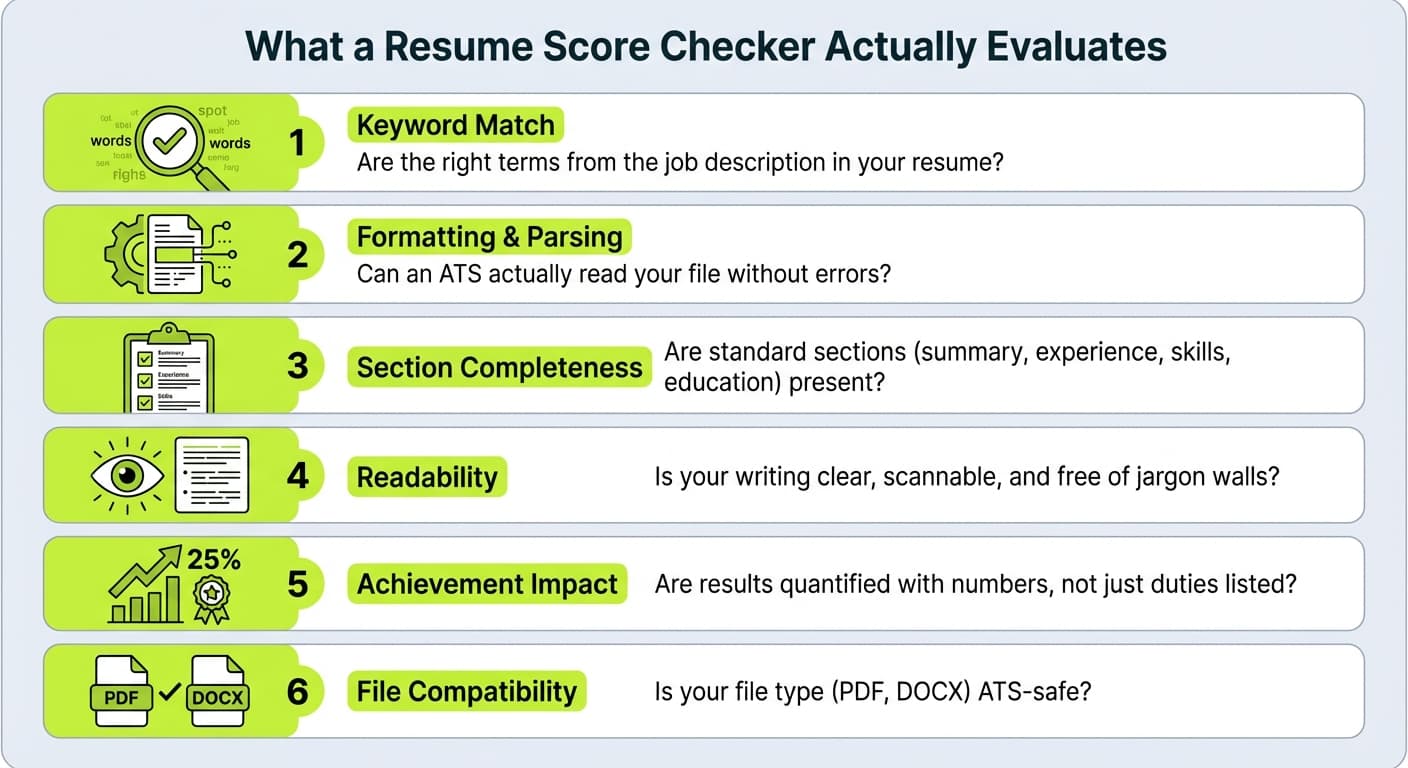
Keyword matching is table stakes. A good resume checker also evaluates formatting compatibility (can an ATS actually parse your file?), section completeness (are you missing a skills section or a summary?), readability (is your writing clear and scannable?), and achievement impact (are you quantifying results or just listing duties?). If a tool only tells you "add more keywords," it's solving maybe 20% of the problem. Look for tools that flag issues like missing contact information, inconsistent date formats, or overly complex layouts that confuse ATS parsers. You can use Careerkit's resume skills generator to identify the right skills for your target role, and the font preview tool to make sure your formatting stays ATS-safe.
Does It Give You Actionable Fixes — Not Just a Number?
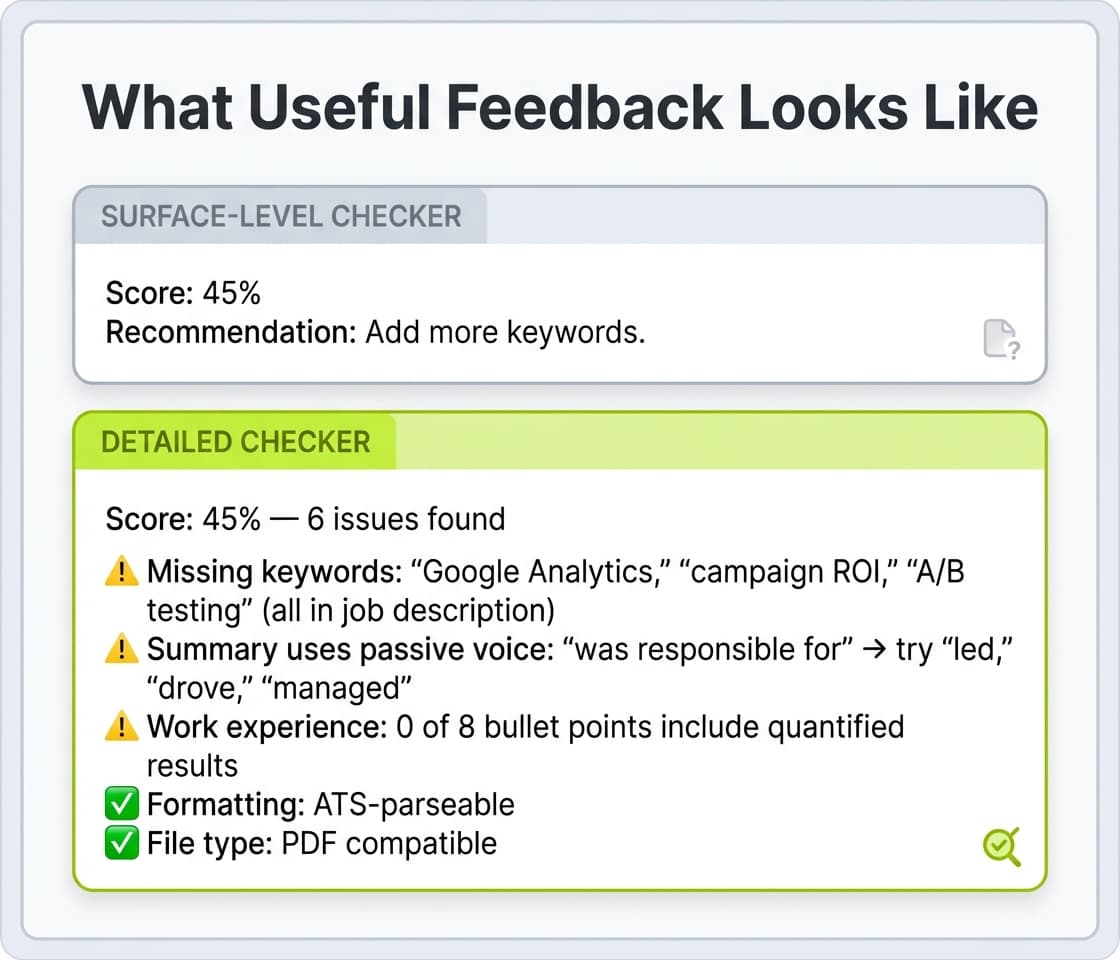
A score of "62%" means nothing if the tool doesn't tell you specifically what to change. The best checkers provide line-by-line feedback: this bullet point is vague, this section heading is nonstandard, this skill from the job description is missing entirely. Here's what a useful feedback loop actually looks like. Say you're applying for a marketing analyst role. A surface-level checker might say "keyword match: 45%." A useful one would tell you: "The job description mentions 'Google Analytics,' 'campaign ROI,' and 'A/B testing' — none of these appear in your resume. Your summary uses passive language ('was responsible for') instead of action verbs. Your work experience section is missing quantified results." That level of specificity is what turns a score into an actual improvement. For guidance on writing stronger bullet points with real impact, see our detailed examples guide.
How Resume Score Checkers Improve Your Chances
The value of a resume checker isn't just theoretical. There's peer-reviewed research on what happens when job seekers get writing assistance, and the results are concrete.
What the Research Says
A field experiment with nearly 500,000 job seekers, conducted by MIT Sloan researchers and published in Management Science, found that job seekers who received algorithmic writing assistance on their resumes were hired 8% more often and earned 8.4% higher wages. This improvement stems from enhanced keyword alignment, better formatting, and clearer presentation of skills and achievements.
Common Issues Checkers Catch
Resume checkers help identify common pitfalls such as missing keywords, poor formatting, and lack of clarity, all of which can cause your resume to get skipped. Pairing a checker with an ATS-optimized resume builder lets you fix these issues as you write, rather than after the fact. By addressing these issues, job seekers can ensure their resumes are both machine-readable and compelling to human reviewers.
Here's what keyword alignment looks like in practice. Say you're applying for a Data Analyst role and the job description emphasizes "SQL," "Tableau," and "stakeholder reporting."
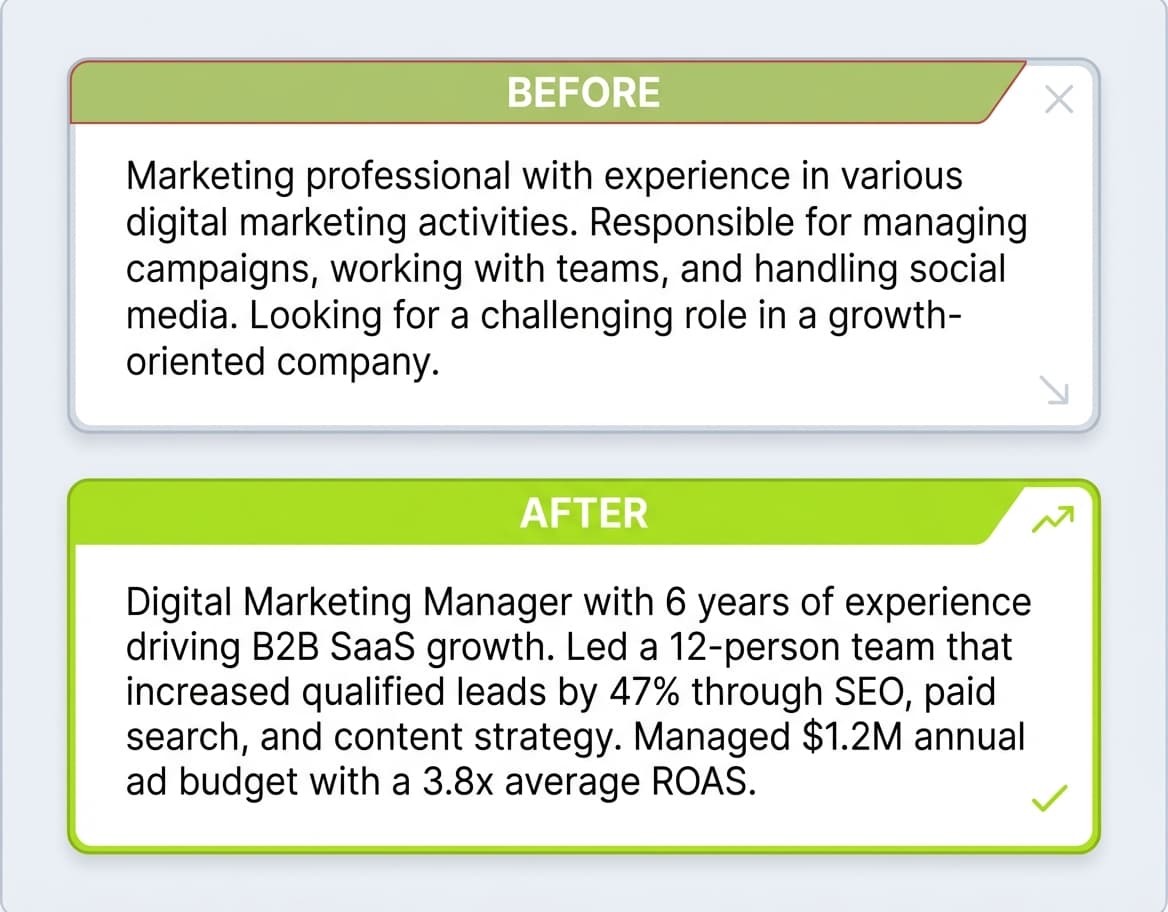
Before: Worked with data tools to create reports for different teams. Helped improve processes and made dashboards for leadership.
After: Built automated SQL queries that reduced weekly reporting time by 4 hours. Created Tableau dashboards tracking 12 KPIs for C-suite stakeholder reporting. Identified $340K in cost savings through trend analysis across three business units.
The "before" version describes the same work but uses none of the language an ATS or recruiter is scanning for. The "after" version mirrors the job description's exact terms while quantifying impact.
Understanding ATS and Its Impact on Your Job Search
Before you can optimize for ATS, it helps to understand what these systems actually do and more importantly, what they don't do.
Bereit fuer Ihren Traumjob?
Schliessen Sie sich 50.000+ Jobsuchenden an, die ihre Karriere bereits mit unserem KI-gestuetzten Lebenslauf-Builder verwandelt haben.