Harvard College Bullet Point Resume Template: A Comprehensive Guide
Free Harvard College Bullet Point Resume Template with the official download link, the bullet formula Harvard teaches, action verbs by category, and before-and-after examples you can copy.
Crafting a strong resume gets easier when you start from a structure that already works. The Harvard College Bullet Point Resume Template, published by Harvard's Mignone Center for Career Success, is one of the most widely used and copied resume formats in the world. It is free, ATS-compatible, and built around a single principle: every bullet should start with a verb, describe a specific action, and end with a measurable result.
This guide breaks down the template section by section, shows you the bullet formula Harvard teaches, and gives you the action verbs and before-and-after rewrites you need to use it well. If you are building your first resume, you may also want to read alongside this one.
Where to Download the Harvard Bullet Point Resume Template
The official template lives on the Harvard Mignone Center for Career Success site. You can download it directly from Harvard here. Harvard offers it in three formats: Word (.docx), Accessible Word (.docx), and Google Docs.
The template is free, requires no Harvard login, and is updated by the MCS team. Harvard also publishes a paragraph-format version, but the bullet-point version is the one most students and early-career applicants use because it is faster to scan and easier to tailor per application.
What the Harvard Bullet Point Template Actually Looks Like
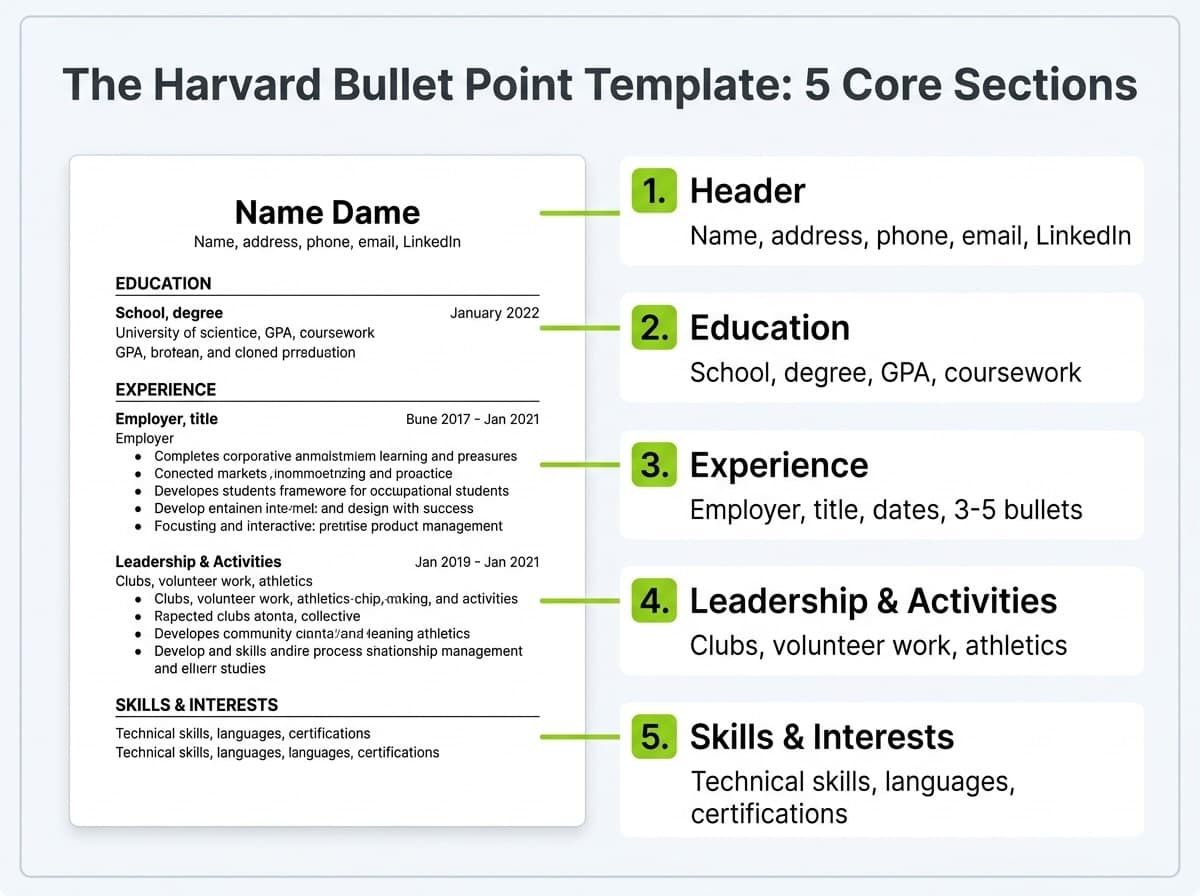
The template is one page, single column, and uses five core sections in a specific order. Knowing the structure matters because the order itself is part of the formula: Harvard puts education before experience for new graduates, since that is what a recruiter scanning a junior resume looks for first.
The Five Core Sections
The header sits at the top with your name in a slightly larger font, followed by your address, phone number, email, and a LinkedIn or portfolio URL. No photo. No headline. No objective statement. The Harvard template trusts the bullets to do the selling.
Education comes next for students and recent graduates. List the school, degree, graduation date, GPA if it is 3.5 or above, and relevant coursework or honors. For experienced applicants, this section moves below experience.
Experience is the longest section. Each role gets a heading line with employer, location, job title, and dates, followed by 3-5 bullet points. Bullets are the core of the template, and the next section breaks down exactly how to write them.
Leadership and Activities is where Harvard differentiates from most other formats. Student government, clubs, volunteer work, and athletic teams all go here, with the same bullet structure as paid work. For a junior applicant, this section often carries as much weight as the experience section.
Skills and Interests closes the resume. Technical skills, languages, certifications, and one short line of personal interests. For a deeper breakdown of what belongs in each section, see our anatomy-of-a-resume guide.
The Harvard Bullet Point Formula
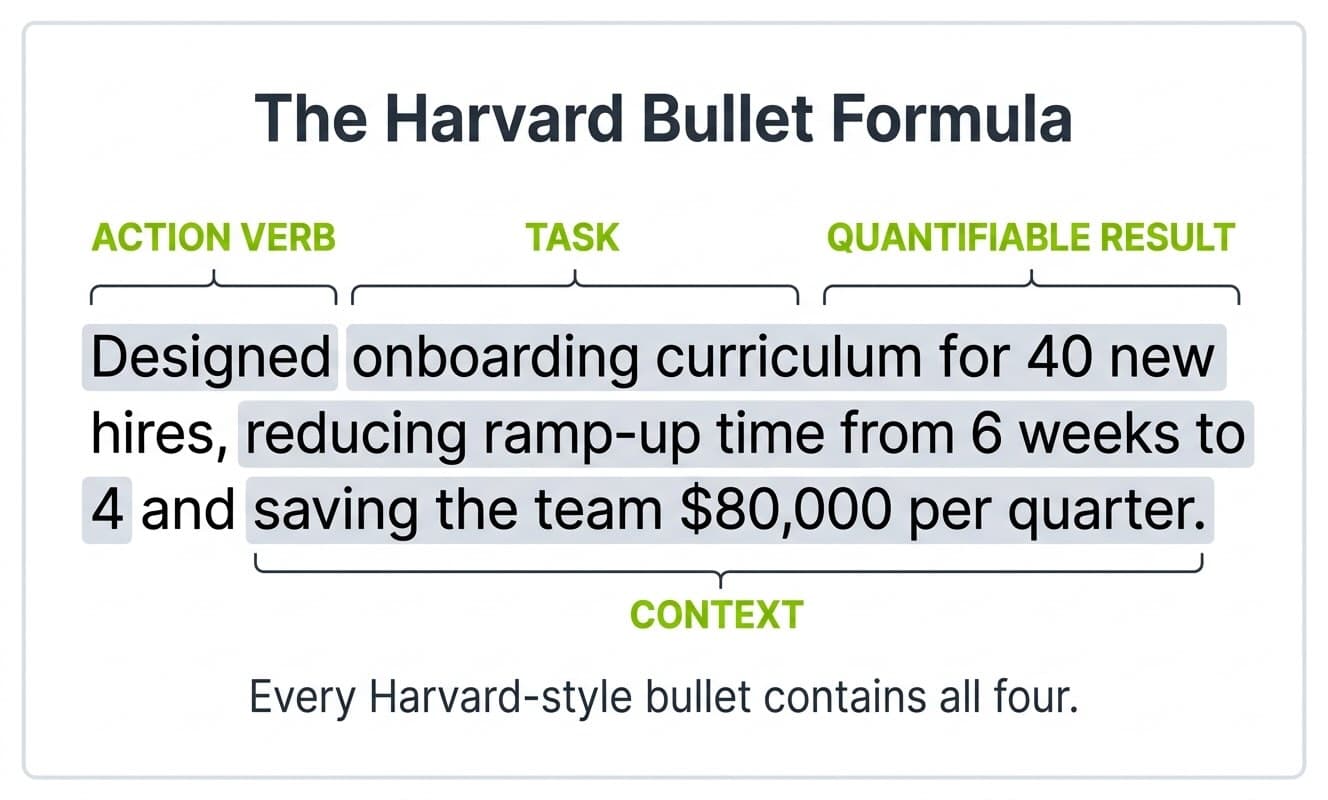
Every bullet on a Harvard-style resume follows the same four-part structure: action verb, what you did, quantifiable result, and why it mattered. Most applicants get the first two parts right and skip the last two, which is why their resumes read like job descriptions instead of accomplishments.
Here is what the formula looks like in practice:
Verb + Task + Result + Context Designed onboarding curriculum for 40 new hires, reducing ramp-up time from 6 weeks to 4 and saving the team an estimated $80,000 per quarter in lost productivity.
The verb is "Designed." The task is "onboarding curriculum for 40 new hires." The result is "reducing ramp-up time from 6 weeks to 4." The context is the dollar value the team got back. A recruiter scanning this in 7.4 seconds (the average initial scan time, according to a Ladders eye-tracking study reported by HR Dive) gets the entire story without needing to read the surrounding paragraphs.
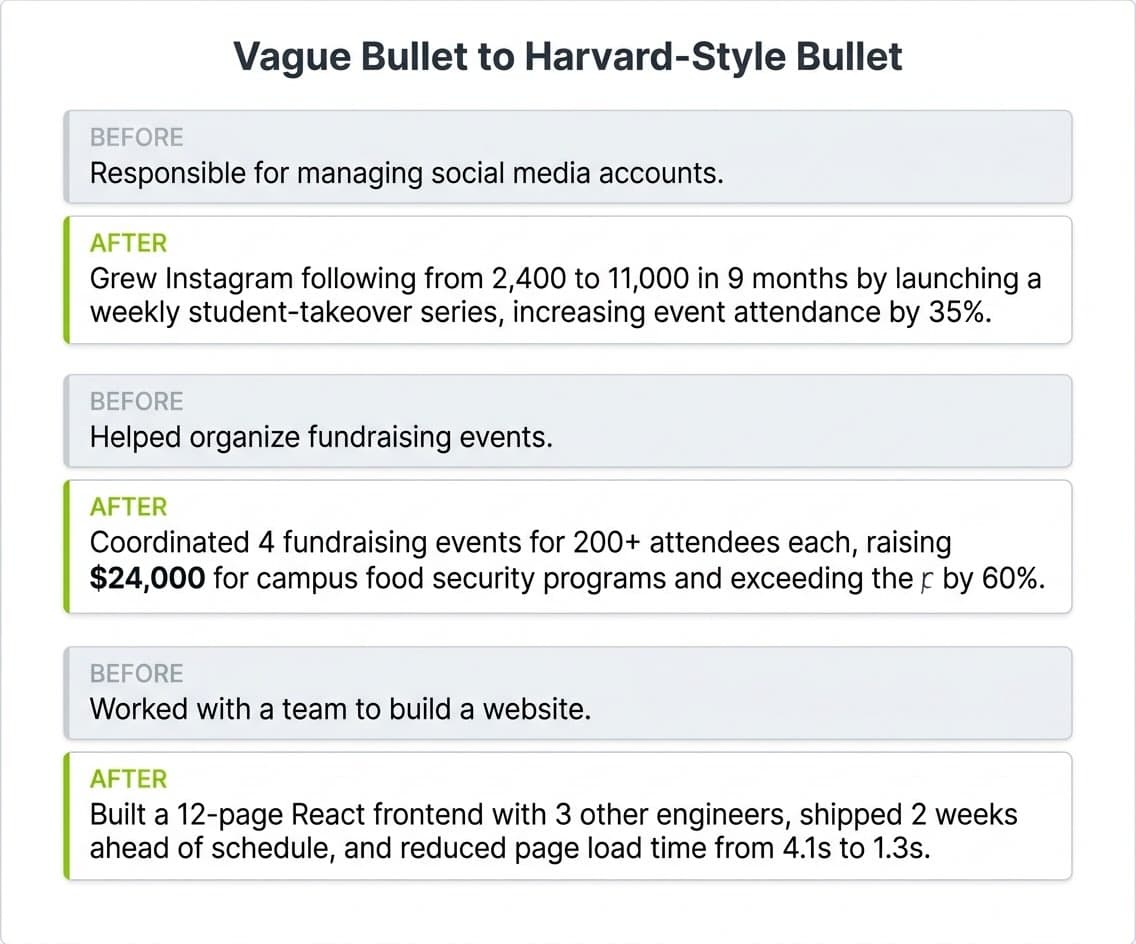
Vague bullets are the most common reason a Harvard-format resume fails to land interviews. The fix is rarely to add more words. It is usually to add the verb, the number, and the outcome.
Before: Responsible for managing social media accounts. After: Grew Instagram following from 2,400 to 11,000 in 9 months by launching a weekly student-takeover series, increasing event attendance by 35%.
Before: Helped organize fundraising events. After: Coordinated 4 fundraising events for 200+ attendees each, raising $24,000 for campus food security programs and exceeding the prior year's total by 60%.
Before: Worked with a team to build a website. After: Built a 12-page React frontend with 3 other engineers, shipped 2 weeks ahead of schedule, and reduced page load time from 4.1s to 1.3s.
The pattern in every rewrite is the same: a stronger opening verb, a number that quantifies the work, and a downstream outcome that shows why a hiring manager should care.
Pret a decrocher votre emploi de reve ?
Rejoignez plus de 50 000 chercheurs d'emploi qui ont deja transforme leur carriere avec notre createur de CV propulse par l'IA.