Best Free ATS Resume Builder: Top 5 Tested for 2026
Best free ATS resume builder for 2026: 5 tools tested (Careerkit, Canva, Indeed) with pros, cons, and what actually helps your resume pass ATS filters.
Most resumes never reach a human recruiter. Research from Harvard Business School and Accenture found that automated screening systems reject over 10 million qualified candidates each year in the U.S. alone, often because of formatting issues the applicant never knew existed. If you have ever submitted dozens of applications without hearing back, the problem likely was not your experience, it was how your resume was structured for Applicant Tracking Systems (ATS).
top 5 free ATS resume builders for 2026
I have spent the past two years building Careerkit, an AI-powered resume builder, and have reviewed thousands of resumes that failed ATS scans for preventable reasons: two-column layouts, missing standard headings, or keyword gaps that a five-minute fix could solve. That experience is what informed this comparison.
Below, I break down five free ATS resume builders, including Careerkit, with honest pros and cons for each, so you can pick the one that fits your situation. If you want to understand exactly which resume sections matter most before choosing a tool, start with our anatomy of a resume guide.
Why ATS Optimization Matters
Understanding how applicant tracking systems work is the first step to beating them. This section covers what ATS software actually does, why most resumes fail, and what you can control.
How ATS Software Screens Your Resume
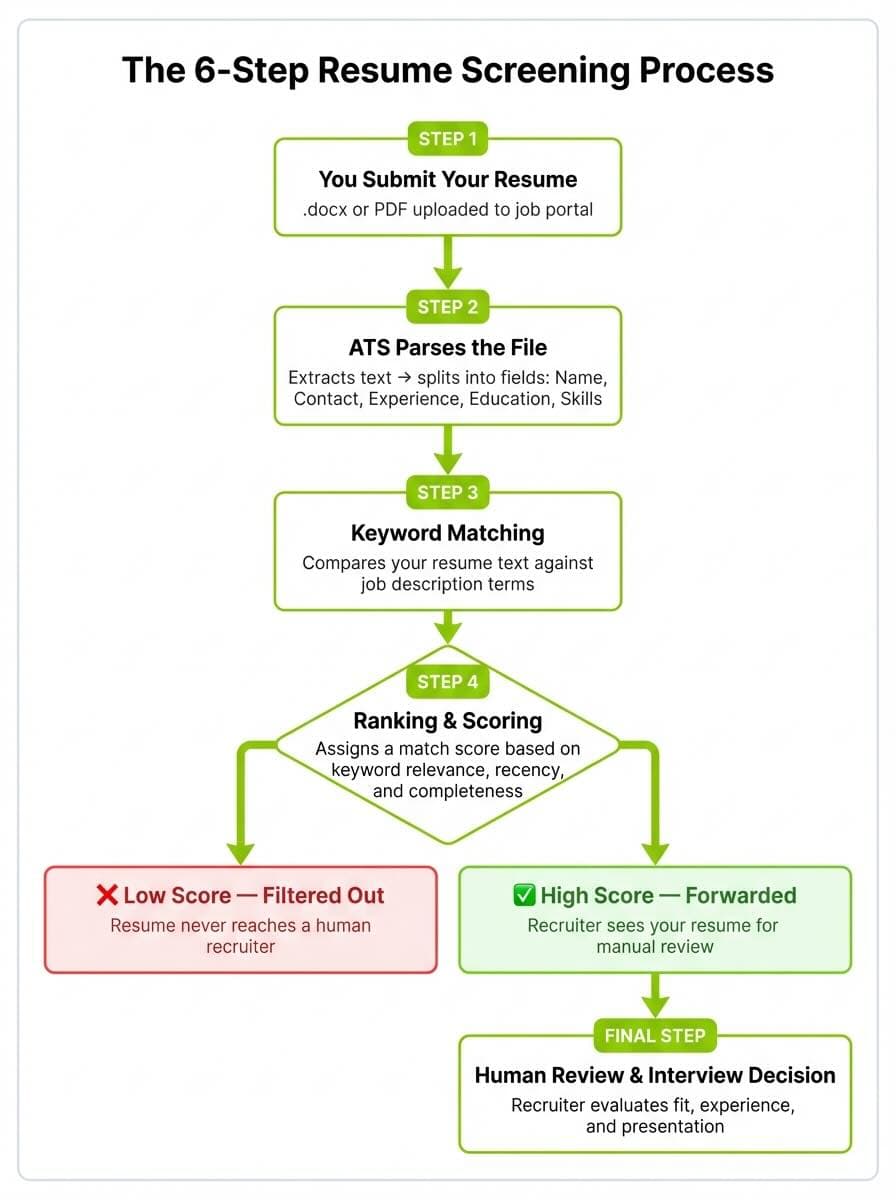
An ATS parses your resume into structured data such as name, contact info, work history, skills and then ranks you against other applicants based on keyword matches and formatting clarity. According to Select Software Reviews, which aggregates data from SHRM, LinkedIn, and other industry sources, nearly 99 percent of Fortune 500 companies and 75 percent of recruiters use an ATS or similar tech-driven screening tool. The software is not reading your resume the way a person would. It is looking for exact or close matches to the terms in the job posting, organized under standard section headings like "Work Experience," "Education," and "Skills."
This means a resume that uses creative headings like "Where I've Made an Impact" instead of "Work Experience" can lose data in the parse. Two-column layouts, text boxes, and embedded images cause similar problems. If you are unsure whether your formatting is safe, our resume font preview tool lets you test how your resume renders in a clean, ATS-readable format.
Most resumes are eliminated at Step 3 or 4. ATS resume builders help you pass both.
Why Qualified Candidates Get Filtered Out
The Harvard Business School "Hidden Workers" study found that automated hiring systems routinely filter out qualified candidates due to rigid keyword matching and formatting requirements, not because the candidates lacked skills. SHRM has separately reported on how ATS configuration issues contribute to this problem, noting that the way these systems are set up often rejects candidates who may be qualified but lack certain credentials on paper. Common reasons resumes get rejected include missing job-title keywords that the posting used, non-standard file formats like .pages or designed PDFs, headers and footers that ATS software cannot read, and skills listed in paragraph form instead of a scannable list.
The fix is not to game the system with keyword stuffing. It is to present your real qualifications in the structure that ATS software expects. The builders below each handle this differently, and that is what I evaluated them on.
1. Careerkit — Best for AI-Powered ATS Optimization
Careerkit is the tool I built after spending years watching qualified candidates get rejected by ATS software for preventable formatting and keyword issues. It is a free AI-powered resume builder designed specifically around ATS compatibility.
Price: Free to start
ATS Safety: ★★★★★
Key strengths: AI-tailored bullet points · ATS-tested templates (Greenhouse, Lever, Workday) · Cover letter builder · AI headshots · Career Link profile
Limitations: Smaller template library than legacy tools
What Sets Careerkit Apart
Unlike most free builders that give you a template and leave you on your own, Careerkit's AI analyzes your experience and generates tailored bullet points that align with how ATS software parses achievements. The builder uses clean, single-column templates that pass ATS scans reliably, and every template has been tested against common ATS platforms including Greenhouse, Lever, and Workday.
Careerkit works well for any job seeker, but it is especially strong for career changers and early-career professionals who need help translating their experience into ATS-friendly language. If you are not sure which skills to highlight for a specific role, the skills generator tool can help you identify relevant keywords based on your target job title.
Pros: AI-tailored bullet points, ATS-tested templates, free to start, includes cover letter and headshot tools, Career Link profile page.
Cons: Newer platform with a smaller template library than legacy builders.
Limitations: No AI content suggestions · No keyword optimization
What It Does Well
The platform walks you through each section with prompts and examples, which makes it a good choice for first-time resume writers. If you have never created a resume before, pair this tool with our guide to making your first resume for a step-by-step walkthrough. All downloads are free, there are no hidden paywalls for PDF exports.
Limitations
Resume.com does not offer keyword analysis or AI-powered content suggestions, so you are responsible for tailoring your resume to each job posting yourself. The templates are functional but basic, and there is limited guidance on writing strong work experience bullet points.
Pros: Completely free, easy to use, clean templates, no account required.
Ready to land your dream job?
Join 50,000+ job seekers who have already transformed their careers with our AI-powered resume builder.
Cons: No AI assistance, no keyword optimization, limited customization.
3. Canva — Best for Visual Design
Canva is a general-purpose design tool with a large library of resume templates. It is a good option if visual presentation matters for your industry, for example, in marketing, design, or media roles.
Price: Free with premium options
ATS Safety: ★★★☆☆
Key strengths: Huge template library · Full design control · Free PDF export
Limitations: Many templates are NOT ATS-safe · No keyword guidance
What It Does Well
Canva's drag-and-drop editor gives you more creative control than any dedicated resume builder. You can adjust colors, fonts, and layouts freely, and the template library is enormous. PDF export is free, which is the format most ATS platforms accept.
Limitations
Here is the catch: many of Canva's most popular resume templates are not ATS-friendly. Two-column layouts, text boxes, and decorative elements can break the ATS parse entirely. If you use Canva, stick to single-column templates, avoid text boxes, and test the output. For a comparison of which fonts render cleanly across ATS platforms, try our resume font preview tool.
Pros: Huge template library, strong design flexibility, free PDF downloads.
Cons: Many templates are not ATS-safe, no keyword guidance, no resume-specific AI features.
4. Indeed Resume Builder — Best for Quick Apply Integration
Indeed's resume builder is built directly into the world's largest job board. If you already use Indeed to search for jobs, building your resume there means you can apply to listings with one click.
Price: Completely free
ATS Safety: ★★★★☆
Key strengths: One-click apply to Indeed jobs · ATS-safe templates · Integrated salary data
Limitations: Very limited customization · No AI writing assistance
What It Does Well
Indeed's builder is straightforward. You enter your information, choose a clean template, and your resume is stored in your Indeed profile for instant applications. The templates are intentionally simple and ATS-compatible, no design flourishes that could break parsing. Indeed also shows you salary estimates and company reviews alongside job postings, which can help you tailor your resume's language to specific employers.
Limitations
The builder offers very limited customization. You cannot adjust fonts, spacing, or layout beyond what the template provides. There is no AI assistance for writing bullet points, and the content suggestions are generic. If you need help writing strong achievement-based bullet points, our work experience examples guide covers what actually works.
Cons: Minimal customization, no AI writing help, templates are very basic.
5. Google Docs Resume Templates — Best for Full Control
Google Docs is not a resume builder in the traditional sense, but its free resume templates are a reliable fallback if you want total control over your content and formatting.
Limitations: Zero content guidance · No keyword suggestions or AI help
What It Does Well
Google's built-in resume templates are clean, single-column, and ATS-friendly out of the box. Because you are working in a standard document editor, there are no parsing issues, what you see is what the ATS gets. It is also the easiest option for collaboration. If you are working with a career coach or mentor, you can share your resume for real-time feedback.
Limitations
Google Docs gives you zero guidance. There are no keyword suggestions, no AI writing help, and no prompts to improve your content. You need to know what a strong resume looks like before you start. If you are unsure, read through our complete resume section breakdown first, then come back to build. For more dedicated resume builder options, see our best resume builders roundup for 2026.
Pros: Completely free, no account beyond Google, easy sharing and collaboration, clean ATS formatting.
Cons: No resume-specific features, no AI help, requires you to know what good looks like.
What About Jobscan, Zety, and Other Paid Builders?
You will see tools like Jobscan, Zety, and Novoresume recommended on many listicles. They offer useful features, but their free tiers are heavily restricted, Jobscan limits keyword scans, Zety locks PDF downloads behind a paywall, and Novoresume caps free resumes at one page with a watermark. If you are looking for a genuinely free builder with AI-powered features, the five options above give you more without asking for your credit card.
How to Get the Most Out of Any ATS Resume Builder
A resume builder handles formatting and structure, but the content decisions are still yours. These five practices apply regardless of which tool you choose.
Tailor Your Keywords to Each Job Posting
ATS software ranks candidates by how closely their resume matches the language in the job description. This does not mean copying the posting word for word, it means identifying the specific terms a company uses and reflecting them naturally in your experience and skills sections. For example, if a posting says "cross-functional collaboration" and your resume says "worked with other teams," the ATS may not register the match. Read the job description once for meaning, then a second time to pull out the exact phrases you should mirror. If you need help identifying which skills to include, the Careerkit skills generator can suggest relevant keywords based on your target role.
Lead With Achievements, Not Responsibilities
Hiring managers and ATS algorithms both respond better to measurable accomplishments than to duty lists. Instead of writing "Responsible for managing a sales team," write something like "Led a 12-person sales team that exceeded quarterly targets by 18 percent over three consecutive quarters." The difference is specificity: numbers, outcomes, and context. Aim for three to four achievement-based bullet points per role. For more examples of how to write strong experience entries, see our work experience bullet points guide.
❌ Before (weak)
Responsible for managing a sales team and overseeing quarterly targets. Handled client relationships and prepared reports for senior management.
✅ After (strong)
Led a 12-person sales team that exceeded quarterly revenue targets by 18% over three consecutive quarters. Grew key account portfolio from 15 to 34 clients, contributing $1.2M in new annual recurring revenue.
Keep Your Formatting ATS-Safe
Even the best content will fail if the ATS cannot parse it. Stick to a single-column layout, use standard section headings like "Work Experience," "Education," and "Skills," and avoid text boxes, tables, headers/footers, and embedded images. Save your file as a .docx or a simple PDF, not a designed PDF exported from Canva or Illustrator with flattened text layers. According to a report from Harvard Business School, rigid formatting filters in automated hiring systems are one of the top reasons qualified candidates get screened out before a human ever sees their application.
✅ Do
Single-column layout Standard headings: "Work Experience," "Education," "Skills" .docx or simple text-based PDF 10–12pt standard fonts (Arial, Calibri, Garamond) Plain bullet points for achievements
❌ Don't
Two-column or sidebar layouts Text boxes, tables, or embedded images Creative headings like "Where I've Made an Impact" Headers and footers containing contact info PDFs exported from Canva or Illustrator with flattened text layers
Add a Professional Profile Link
Including a link to your LinkedIn profile or a career portfolio page gives recruiters a fast way to verify your background and see additional context that your one-page resume cannot cover. According to LinkedIn's own data, users with complete profiles are 40 times more likely to receive opportunities through the platform, a stat cited by university career centers as a baseline reason to fill out every section. If you use Careerkit, your Career Link serves this purpose, it is a shareable, always-updated profile page that complements your static resume.
Test Before You Submit
Before sending any application, open your finished resume in a plain text editor (Notepad on Windows, TextEdit set to plain text on Mac). If the content appears in a logical, readable order with no jumbled characters or missing sections, the ATS will likely parse it correctly. If entire sections are missing or scrambled, your formatting has a problem. This 30-second check can save you from submitting a resume that an ATS will silently reject. When you are satisfied, build your final version in Careerkit to ensure ATS-safe formatting from the start.
Which ATS Resume Builder Should You Use?
The right tool depends on where you are in your job search. If you want full design control and already know what a strong resume looks like, Google Docs templates will get the job done. If you live on Indeed and want one-click applications, their built in builder is the path of least resistance. And if visual presentation matters in your industry, Canva works, as long as you stick to single-column, ATS safe templates.
But if you want a builder that handles both formatting and content, one that uses AI to tailor your bullet points to specific job descriptions, tests templates against real ATS platforms, and includes a cover letter builder and Career Link profile at no cost, that is what I built Careerkit to do.
The Harvard Business School "Hidden Workers" study made one thing clear: most resume rejections are preventable. The fix is not a better job history. It is a resume that is structured the way automated systems expect. Whichever builder you choose, make sure it gets that part right.
An ATS resume builder is a tool that helps you create a resume formatted specifically to pass through Applicant Tracking Systems. These builders use ATS-safe templates with single-column layouts, standard section headings, and clean formatting so that automated screening software can accurately parse your qualifications. Some, like Careerkit, also use AI to help tailor your resume content to match specific job descriptions.
Yes, for most job seekers a free ATS resume builder is sufficient. The most important factors for passing ATS filters are clean formatting, relevant keywords, and standard section headings, all of which free tools can handle. Premium features like advanced analytics or unlimited templates are helpful but not essential. Careerkit's free plan includes AI-powered content suggestions and ATS-tested templates, which covers what most candidates need.
The simplest test is to open your resume in a plain text editor like Notepad or TextEdit. If the content appears in a logical, readable order without jumbled text or missing sections, the ATS will likely parse it correctly. You should also check that you are using standard headings such as "Work Experience," "Education," and "Skills," and that your file is saved as a .docx or a simple PDF rather than a designed PDF with flattened text layers.
You can, but you need to be selective. Many of Canva's popular resume templates use two-column layouts, text boxes, and decorative elements that break ATS parsing. If you use Canva, choose a single-column template, avoid text boxes entirely, and export as a PDF. Test the result in a plain text editor before submitting. For a safer option, a dedicated ATS resume builder like Careerkit or Indeed's builder will produce ATS-compatible formatting by default.
There is no fixed number. The goal is to reflect the language of the specific job posting naturally throughout your resume, particularly in the skills section and work experience bullet points. Read the job description carefully and identify the key technical skills, tools, and phrases it uses, then make sure those terms appear in your resume where they honestly apply to your experience. Keyword stuffing, or listing terms you cannot back up in an interview, will hurt you more than help.
The safest formats are .docx and simple, text-based PDFs. Avoid PDFs exported from design tools like Canva, Illustrator, or InDesign, as these often flatten text into images that ATS software cannot read. If a job posting specifies a preferred format, always follow that instruction. When in doubt, .docx is the most universally compatible option across ATS platforms.
Put this advice to work
You just read the theory. Careerkit's AI builder turns it into an ATS-ready resume, tailored to the job you want.
Nishant Modi is the founder of Careerkit.me and a product builder based in Zürich, Switzerland. With a background in product management, marketing & management consulting, he transitioned into AI entrepreneurship after experiencing the frustration of outdated job search tools firsthand. He built Careerkit to give every job seeker access to professional grade resume tools, the platform has helped over 10,000 candidates create ATS optimized resumes. He writes about resume strategy, hiring trends, and what actually gets people hired.






.png&w=1920&q=75)
