Choisir la bonne police pour votre lettre de motivation peut sembler un détail mineur, mais elle joue un rôle crucial pour faire une forte première impression. Une police bien choisie améliore la lisibilité, transmet du professionnalisme et communique subtilement votre personnalité aux recruteurs. En effet, selon les recherches sur le recrutement publiées par Indeed, la présentation et le soin apporté aux détails visuels comptent parmi les premiers signaux qu'utilisent les recruteurs pour évaluer l'effort d'un candidat avant même de lire un seul mot. Cet article explore les meilleures polices pour une lettre de motivation professionnelle, en expliquant pourquoi le choix de la police compte et comment sélectionner le style parfait pour votre secteur et votre marque personnelle.
Pourquoi le choix de la police compte dans votre lettre de motivation
Les polices sont bien plus que des lettres sur un écran ; elles portent un poids émotionnel et influencent la façon dont votre message est perçu. Des recherches en typographie du Nielsen Norman Group montrent que les polices à empattement sont étroitement associées à la tradition et à l'autorité, des qualités qui pèsent dans des domaines comme le droit et la finance. Les polices sans empattement modernes signalent clarté et élan, ce qui les rend mieux adaptées aux environnements tech et start-up. Choisir la bonne police est une décision de marque délibérée qui révèle à un recruteur quelque chose de votre jugement professionnel avant même qu'il lise une seule phrase. Vous pouvez prévisualiser l'apparence de chaque police dans un vrai document grâce à l'outil d'aperçu des polices de Careerkit.
Au-delà de l'esthétique, le choix de la police influe sur la lisibilité. Les recruteurs parcourent souvent des dizaines, voire des centaines de candidatures. Une police claire et lisible garantit que votre lettre de motivation est facile à lire et que vos points clés ressortent. Selon les recherches de la SHRM sur l'acquisition de talents, les recruteurs signalent régulièrement l'effort visible et la qualité de la présentation comme un élément de différenciation entre des candidats d'expérience comparable, et le choix de la police fait partie mesurable de cette première impression. De plus, la bonne police peut renforcer la hiérarchie visuelle globale de votre lettre, en guidant l'œil du lecteur vers les éléments les plus importants, comme vos compétences et vos réalisations.
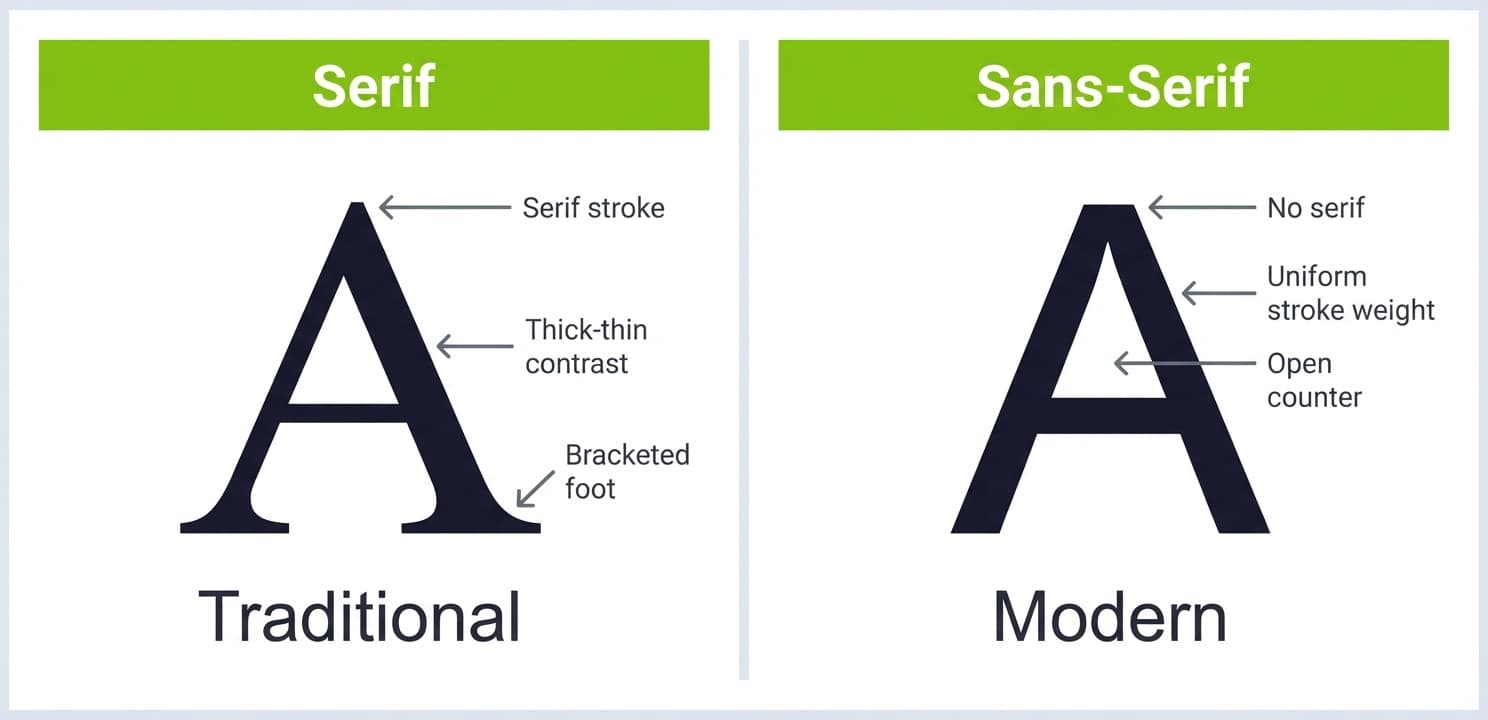
Les polices peuvent influencer subtilement la perception qu'a le lecteur de votre professionnalisme et de votre souci du détail. Les polices à empattement, qui présentent de petites lignes ou traits attachés à l'extrémité des lettres, transmettent souvent une impression de formalité et de fiabilité. Les polices sans empattement, dépourvues de ces traits, tendent à paraître nettes, modernes et directes. Cette distinction peut être cruciale lorsque vous postulez à des postes où la culture d'entreprise est soit traditionnelle, soit innovante. Une start-up, par exemple, pourrait apprécier une police sans empattement fraîche qui reflète son approche dynamique, tandis qu'une entreprise bien établie privilégiera peut-être une police à empattement classique qui transmet stabilité et fiabilité.
Une manière concrète d'appliquer une hiérarchie typographique consiste à mettre votre nom dans une graisse en gras de la police choisie tout en gardant le corps du texte dans la graisse normale. Cela crée du contraste et une structure visuelle sans introduire une seconde police. Le résultat est un document qui guide naturellement l'œil du lecteur sans rivaliser pour attirer l'attention. Par ailleurs, la taille et l'espacement de votre police peuvent aussi jouer un rôle important dans la manière dont votre lettre est reçue. Une police trop petite peut fatiguer les yeux du lecteur, tandis qu'un espacement excessif peut donner à votre lettre un aspect décousu. Un choix de police bien réfléchi, associé à une taille et à un espacement appropriés, peut renforcer la présentation globale de votre candidature et laisser une impression durable auprès d'employeurs potentiels.
Les meilleures polices pour une lettre de motivation professionnelle
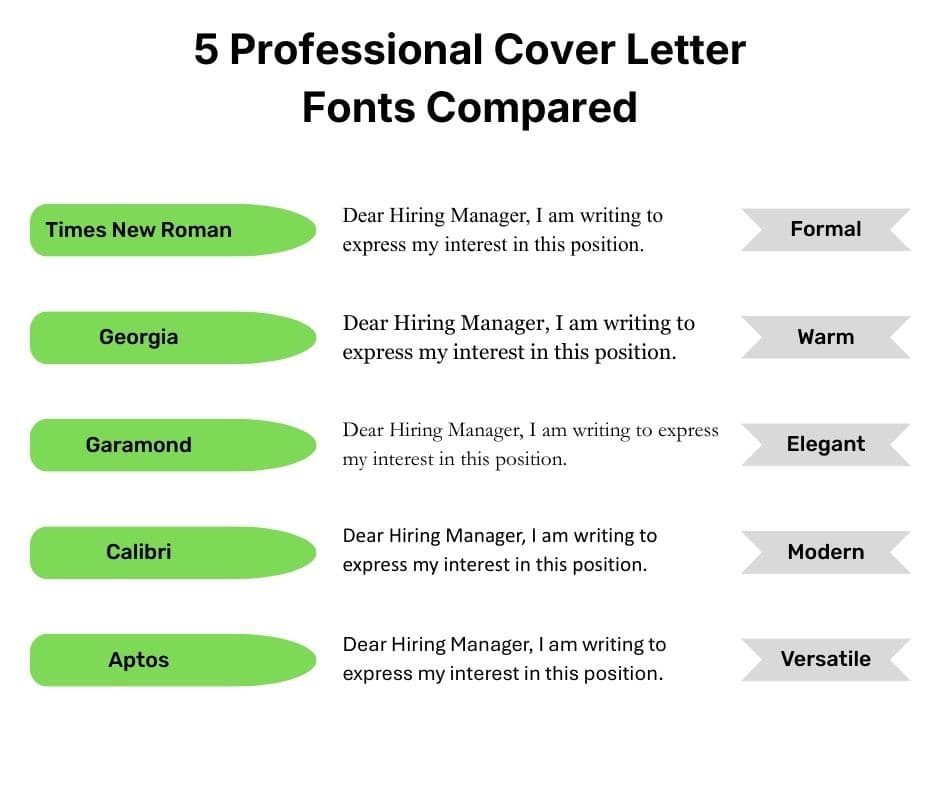
Lors du choix d'une police, il est important de tenir compte des normes du secteur, de la lisibilité et du ton que vous souhaitez donner. Voici les meilleures polices recommandées pour les lettres de motivation professionnelles. Chaque entrée ci-dessous comprend un vrai exemple de lettre de motivation afin que vous puissiez voir le ton que crée chaque police. Pour prévisualiser l'une de ces polices dans votre propre document avant de vous décider, utilisez l'outil d'aperçu des polices de Careerkit.
1. Times New Roman
Times New Roman reste un choix classique pour les lettres de motivation et les CV. Son style à empattement est largement reconnu pour sa lisibilité et son allure formelle. Une analyse des polices de CV réalisée par SEEK a identifié Times New Roman comme l'une des polices les plus recommandées pour les documents professionnels, appréciée pour sa lisibilité intemporelle et sa reconnaissance quasi universelle dans tous les secteurs et systèmes de suivi des candidatures.
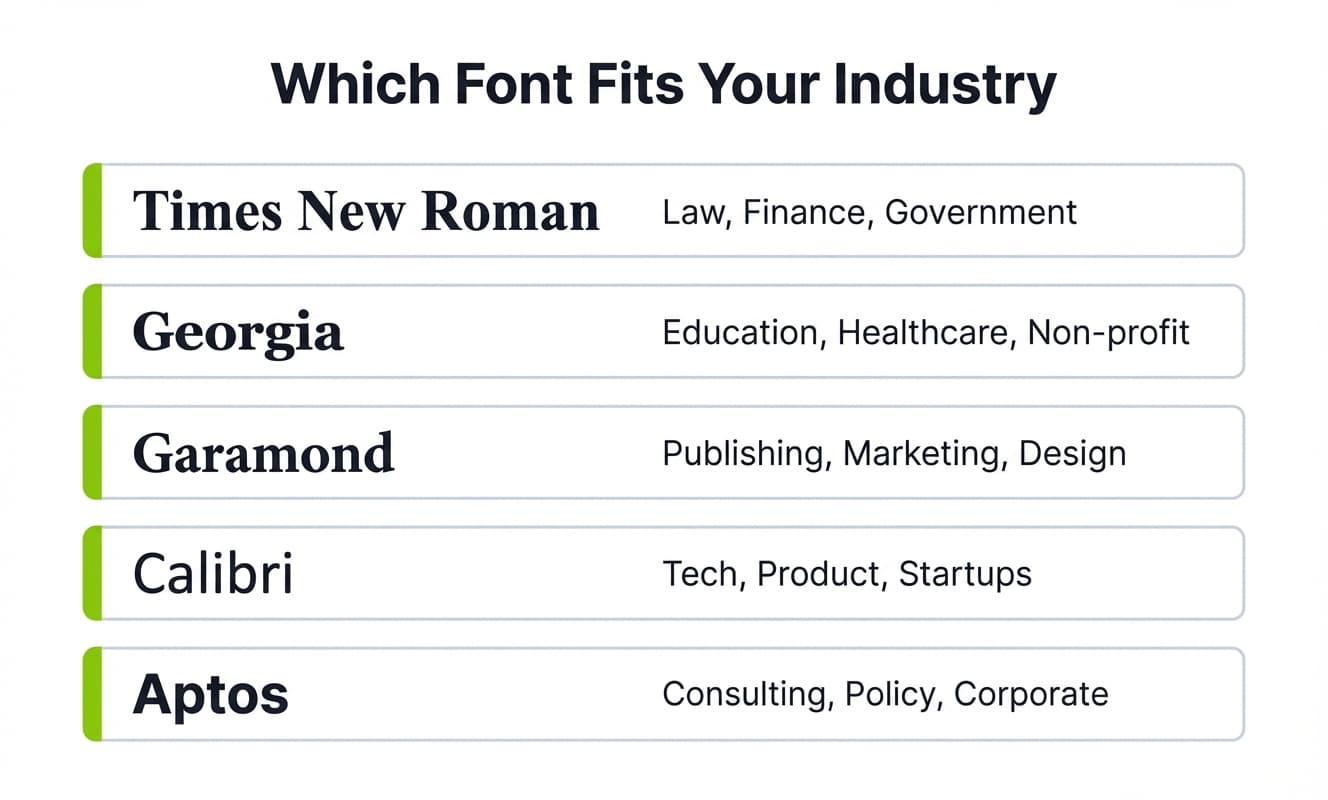
Cette police convient particulièrement aux secteurs traditionnels comme le droit, la finance et les postes dans l'administration, où une allure sobre et soignée est attendue. Sa familiarité peut aussi rendre votre lettre de motivation digne de confiance et pleine d'autorité. De plus, l'usage répandu de Times New Roman dans les milieux universitaires et professionnels évoque la crédibilité, ce qui en fait un excellent choix pour les candidats qui veulent établir un ton sérieux et affirmé. Voyez comment elle s'affiche à différentes tailles grâce à l'outil d'aperçu des polices de Careerkit.
"Je vous écris pour manifester mon intérêt pour le poste de Senior Compliance Officer chez Barclays. Fort de sept années d'expérience réglementaire dans les services financiers, j'ai développé une compréhension approfondie des cadres que votre équipe gère au quotidien."
Times New Roman, 11 pt. Se lit avec une autorité formelle. Idéal pour les candidatures en droit, banque, administration et secteur public.
2. Georgia
Georgia est une autre police à empattement qui apporte une touche légèrement plus moderne à la typographie traditionnelle. Elle est conçue pour être très lisible à l'écran, ce qui en fait un excellent choix pour les candidatures numériques. Georgia a été spécialement conçue par Microsoft pour une grande lisibilité à l'écran, ce qui en fait un choix fiable pour les candidatures numériques où votre lettre sera lue sur un moniteur avant même d'être imprimée.
Les formes de lettres légèrement plus grandes de Georgia par rapport à Times New Roman peuvent aussi rendre votre lettre de motivation plus accessible tout en conservant le professionnalisme. L'esthétique chaleureuse et accueillante de cette police aide à créer un lien personnel avec le lecteur, ce qui est particulièrement précieux dans des domaines comme l'éducation et la santé, où l'empathie et l'accessibilité comptent autant que les qualifications.
"Je suis enthousiaste à l'idée d'apporter mes cinq années d'expérience en classe au poste d'enseignante principale de CM1 à l'école élémentaire Riverside. Mon approche est centrée sur l'apprentissage guidé par l'élève, la pédagogie différenciée et une communication régulière avec les familles."
Georgia, 11 pt. Chaleureuse et lisible. Idéale pour les postes en éducation, santé, associatif et services sociaux.
3. Garamond
Pret a decrocher votre emploi de reve ?
Rejoignez plus de 50 000 chercheurs d'emploi qui ont déjà transforme leur carrière avec notre createur de CV propulse par l'IA.
Garamond est une police à empattement élégante, connue pour son raffinement et sa lisibilité. Elle est souvent privilégiée par les professionnels qui veulent transmettre de la sophistication sans sacrifier la clarté. Comme Georgia, Garamond porte un sentiment de tradition, ce qui peut être un atout dans les domaines conservateurs.
Ses courbes gracieuses et son espacement équilibré en font un plaisir de lecture et aident votre lettre de motivation à se distinguer subtilement parmi des polices plus couramment utilisées. Garamond est étroitement associée aux œuvres littéraires et à l'édition, ce qui en fait un choix idéal pour les candidats des secteurs créatifs comme l'écriture, le design et le marketing, où une touche d'art renforce l'impression d'ensemble.
"En tant que stratège de marque avec une décennie d'expérience dans la construction d'identités éditoriales pour des éditeurs indépendants, je crois que c'est à l'intersection du langage et du design que naît le travail créatif le plus porteur de sens."
Garamond, 11 pt. Élégante et éditoriale. Idéale pour les postes en édition, communication, design et marketing.
4. Calibri
Pour ceux qui postulent dans le secteur technologique ou dans des industries plus modernes, Calibri est un choix sans empattement très répandu. C'est la police par défaut de Microsoft Office depuis 2007, ce qui signifie qu'elle s'affiche proprement sur pratiquement tous les appareils et clients de messagerie, sans erreurs de substitution ni décalages de mise en forme lorsqu'un recruteur ouvre votre fichier. Ses lignes nettes communiquent efficacité et clarté, et ses bords légèrement arrondis lui donnent une allure amicale sans sacrifier le professionnalisme, ce qui en fait un choix naturel pour les start-up, les entreprises de produits et toute organisation qui valorise une culture moderne et collaborative.
"Je postule pour le poste de Product Manager chez Notion. Au cours des trois dernières années chez Atlassian, j'ai livré quatre fonctionnalités multiplateformes qui ont réduit le volume de tickets de support de 34 pour cent tout en améliorant le NPS de 12 points."
Calibri, 11 pt. Nette et contemporaine. Idéale pour les postes en logiciel, produit, fintech et start-up.
5. Aptos
Introduite comme la nouvelle police par défaut de Microsoft en 2023, Aptos trouve un équilibre entre professionnalisme traditionnel et lisibilité moderne. Cela en fait un choix idéal pour les secteurs formels qui apprécient aussi une touche contemporaine.
Microsoft a conçu Aptos spécifiquement pour la clarté à la fois sur les supports imprimés et numériques, ce qui lui confère un avantage pratique pour les candidatures soumises dans plusieurs formats. Si vous postulez à des postes couvrant des environnements d'entreprise, de conseil ou du secteur public, Aptos est un choix actuel solide, qui paraît soigné sans sembler démodé.
"Je postule pour le poste de Senior Policy Analyst à la Commission européenne. Mon parcours couvre cinq années de recherche fondée sur les données probantes dans la réglementation du climat et de l'énergie, dans trois États membres de l'UE."
Aptos, 11 pt. Institutionnelle et pourtant moderne. Idéale pour les postes en conseil, politiques publiques, finance et fonctions professionnelles transversales.
Quelle taille de police et quel espacement utiliser, et faut-il les accorder à votre CV
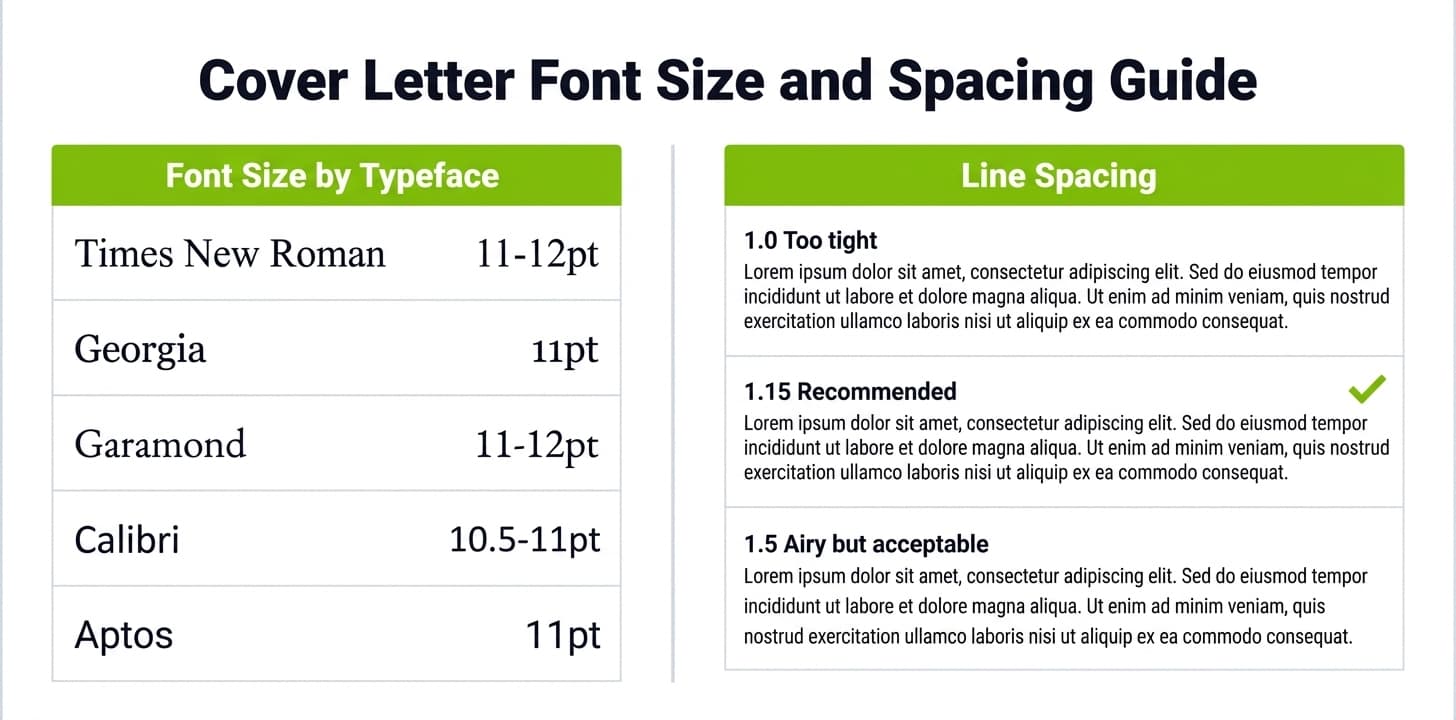
Une excellente police de lettre de motivation échoue tout de même si la taille ou l'espacement ne conviennent pas. Réglez le corps du texte entre 10,5 et 12 points : 11 ou 12 pour une lettre plus courte, 10,5 lorsque vous luttez pour tout garder sur une seule page. En dessous de 10 points, la lecture fatigue, et au-dessus de 12, cela paraît gonflé. Utilisez un interligne simple ou de 1,15, une ligne vide entre les paragraphes plutôt que des retraits, et des marges de 2,5 cm de chaque côté pour que la page respire. Prévisualisez l'apparence de chaque police à différentes tailles avant de vous décider, car la même taille en points s'affiche nettement plus grande en Georgia qu'en Calibri.
La police de votre lettre de motivation doit-elle correspondre à celle de votre CV ? Oui. Un recruteur voit presque toujours les deux documents côte à côte, et une police cohérente se lit comme un choix délibéré et organisé, tandis que deux polices différentes donnent l'impression que deux personnes différentes les ont rédigés. Choisissez une police dans la liste ci-dessus et appliquez-la à votre CV, à votre lettre de motivation et à toute page de références. Quand la rédaction elle-même est prête, créez votre lettre de motivation dans Careerkit pour que l'espacement et les marges soient gérés à votre place. Si vous vous demandez encore si vous en avez seulement besoin, notre guide lettre de motivation ou CV explique quand cela compte le plus.
Conseils pour utiliser les polices efficacement
Choisir la bonne police n'est que la moitié du travail. La façon dont vous l'appliquez dans votre document détermine si le résultat paraît soigné ou irrégulier. Ces trois principes vous aideront à tirer le meilleur parti de la police que vous choisissez, que vous partiez de zéro ou que vous peaufiniez un brouillon existant. Si vous voulez que la mise en forme soit gérée à votre place, le générateur de lettre de motivation de Careerkit applique automatiquement une typographie et un espacement professionnels.
Restez simple et cohérent
Limitez-vous à une ou deux polices au maximum. Utiliser trop de polices peut donner à votre lettre de motivation un aspect encombré et peu professionnel. Par exemple, vous pourriez utiliser une version en gras de votre police choisie pour votre nom ou vos titres, tout en gardant le corps du texte dans un style normal.
La cohérence dans la taille de police, l'espacement et l'alignement contribue aussi à une apparence nette et soignée. En règle générale, 11 pt fonctionne bien pour la plupart des polices. Si vous utilisez Times New Roman ou Garamond, 11 pt ou 12 pt se lisent peut-être mieux en raison de leur hauteur d'x plus petite. Calibri et Aptos paraissent plus grandes à la même taille en points, donc 10,5 pt ou 11 pt est généralement le bon choix. Par ailleurs, utilisez un interligne compris entre 1,15 et 1,5 pour donner de l'air au texte sans créer d'espaces gênants. Une étape que la plupart des candidats oublient : exportez toujours votre lettre de motivation en PDF avant de l'envoyer. Cela verrouille votre choix de police et évite les erreurs de substitution qui surviennent lorsqu'un recruteur ouvre un fichier .docx sur un système où votre police choisie n'est pas installée. Lorsque vous créez votre lettre de motivation avec Careerkit, cela est géré automatiquement.
Accordez votre police au secteur
Tenez compte des normes et des attentes du secteur auquel vous postulez. Les domaines traditionnels comme le droit, la finance et le monde universitaire privilégient souvent des polices à empattement comme Times New Roman ou Garamond. Les industries créatives et tech peuvent être plus réceptives à des polices sans empattement modernes comme Calibri ou Aptos.
Adapter votre lettre de motivation au poste et à la culture d'entreprise est l'un des moyens les plus clairs de signaler que vous comprenez l'environnement dans lequel vous entrez. Rechercher l'identité visuelle de l'entreprise peut guider votre choix de police : une start-up à l'identité moderne réagira mieux à Calibri ou Aptos qu'à Times New Roman. Une institution financière centenaire ressentira l'inverse. La même logique s'applique à votre CV, où la cohérence de police entre les deux documents renforce votre souci du détail professionnel. Pour un aperçu complet de la façon dont les attentes de mise en forme varient selon la section, consultez le guide sur l'anatomie d'un CV solide. Pour des exemples finalisés rédigés pour votre domaine, consultez nos exemples de lettre de motivation pour ingénieur logiciel, exemples de lettre de motivation pour analyste de données et exemples de lettre de motivation pour chef de projet.
Privilégiez la lisibilité
Aussi élégante qu'une police puisse être, si elle est difficile à lire, elle jouera contre vous. Évitez les polices trop décoratives ou de type script qui peuvent distraire ou dérouter le lecteur.
Assurez-vous d'un contraste suffisant entre la couleur de la police et le fond, et utilisez un texte noir ou gris foncé standard sur fond blanc pour une clarté maximale. Des paragraphes courts et ciblés font plus pour la lisibilité que n'importe quelle astuce de mise en forme. Limitez chaque paragraphe à trois ou quatre phrases et commencez par votre point le plus fort. Les recruteurs qui lisent des dizaines de candidatures survolent d'abord la première ligne de chaque paragraphe, si bien que placer votre qualification la plus pertinente en tête rend la lettre plus facile à traiter sous la pression du temps. L'objectif est un document qui invite le lecteur à entrer plutôt que de lui demander de chercher votre valeur.
Réflexions finales : faire ressortir votre lettre de motivation
Votre lettre de motivation est votre présentation personnelle auprès d'un employeur potentiel. Si le contenu de votre lettre est primordial, la façon dont elle est présentée peut influencer sensiblement la perception du lecteur. Sélectionner la bonne police est un moyen subtil mais puissant de renforcer votre professionnalisme et de rendre votre candidature mémorable.
En choisissant des polices comme Times New Roman, Georgia, Garamond, Calibri ou Aptos, vous alignez votre lettre de motivation sur les attentes du secteur et les normes de lisibilité. Associer votre choix de police à une mise en forme réfléchie montre aux recruteurs que vous avez investi un réel soin dans votre candidature, et c'est cet effort visible qui distingue une lettre oubliable d'une lettre qui vaut un rappel. Pour voir comment votre lettre de motivation s'inscrit dans le tableau plus large de ce que les recruteurs évaluent en premier, lisez notre guide sur ce que les recruteurs lisent réellement en premier lorsqu'ils examinent des candidatures.
En fin de compte, la meilleure police pour votre lettre de motivation est celle qui complète votre message, convient à votre secteur et rend votre lettre agréable à lire. Prêter attention à ces détails est le genre de préparation délibérée qui se remarque. Une fois votre lettre de motivation au point, assurez-vous que votre CV atteigne le même niveau de soin. Utilisez le générateur de CV de Careerkit pour créer un CV prêt pour les ATS qui s'accorde proprement avec votre lettre de motivation et donne aux recruteurs une première impression cohérente et professionnelle sur l'ensemble de votre candidature.
Passez à l'étape suivante de votre parcours professionnel avec Careerkit
Vous avez déjà fait le travail de réflexion. Vous savez quelle police convient à votre secteur, comment la dimensionner et l'espacer correctement, et comment l'exporter pour qu'elle parvienne aux recruteurs exactement comme prévu. Il est temps de tout assembler. Le générateur de lettre de motivation de Careerkit vous offre des modèles compatibles avec les ATS dotés d'une typographie professionnelle intégrée, une aide à la rédaction par IA pour affiner votre accroche et vos paragraphes, et un export PDF en un clic pour que votre choix de police reste intact, de votre écran jusqu'à la boîte de réception du recruteur.
Les meilleures polices pour une lettre de motivation sont Times New Roman, Georgia, Garamond, Calibri et Aptos. Le bon choix dépend de votre secteur. Les polices à empattement comme Times New Roman et Garamond conviennent aux secteurs traditionnels tels que le droit et la finance. Les polices sans empattement comme Calibri fonctionnent mieux dans les environnements tech et start-up. Aptos est un solide choix polyvalent pour les postes en entreprise et en conseil.
11 pt est la valeur par défaut la plus sûre pour la plupart des polices. Times New Roman et Garamond ont une empreinte visuelle plus petite, donc 12 pt est aussi acceptable pour celles-ci. Calibri et Aptos paraissent plus grandes à la même taille en points, donc 10,5 pt ou 11 pt est généralement le bon choix. Associez toujours la taille choisie à un interligne de 1,15 à 1,5.
Oui. Utiliser la même police pour votre lettre de motivation et votre CV crée une présentation cohérente et professionnelle. Les recruteurs consultent souvent les deux documents côte à côte, et des polices dépareillées donnent une impression de manque de cohérence.
Les deux sont techniquement acceptables mais surexploitées dans les documents d'entreprise et peuvent rendre votre lettre de motivation générique. Calibri ou Aptos sont des choix plus solides, car elles ont été conçues spécifiquement pour la lisibilité des documents professionnels et s'affichent plus proprement à l'écran.
Non. Les polices de type script, manuscrites et décoratives ne conviennent aux lettres de motivation dans aucun secteur. Elles sont difficiles à lire à la taille du corps de texte, échouent souvent à l'analyse par les ATS et signalent un manque de jugement professionnel. Même pour des postes en design, c'est votre portfolio qui porte la créativité. Votre lettre de motivation doit être nette et facile à lire.
Les polices inhabituelles ou décoratives peuvent créer des erreurs de reconnaissance de caractères dans les systèmes ATS. Les polices standard comme Calibri, Times New Roman, Georgia, Garamond et Aptos sont toutes compatibles avec les ATS. Soumettez toujours un PDF pour garantir que la police est intégrée et que le texte est conservé exactement tel qu'il a été rédigé.
Les polices à empattement (Times New Roman, Georgia, Garamond) ont de petits traits à l'extrémité de chaque lettre et sont associées à la tradition et à la formalité. Les polices sans empattement (Calibri, Aptos) n'ont pas ces traits et se lisent comme nettes et modernes. Le bon choix dépend de la culture et des attentes du secteur auquel vous postulez.
Exportez votre lettre de motivation en PDF avant de l'envoyer. Lorsque vous envoyez un fichier .docx, la police ne s'affiche correctement que si l'appareil du destinataire a cette police installée. Un PDF intègre la police dans le fichier lui-même, si bien que votre lettre de motivation a exactement l'apparence que vous lui avez donnée, quel que soit l'appareil ou le client de messagerie qu'utilise le recruteur.
Mettez ces conseils en pratique
Vous connaissez la théorie. Le créateur IA de Careerkit la transforme en CV optimisé ATS, adapté au poste que vous visez.
Nishant Modi is the founder of Careerkit.me and a product builder based in Zürich, Switzerland. With a background in product management, marketing & management consulting, he transitioned into AI entrepreneurship after experiencing the frustration of outdated job search tools firsthand. He built Careerkit to give every job seeker access to professional grade resume tools, the platform has helped over 10,000 candidates create ATS optimized resumes. He writes about resume strategy, hiring trends, and what actually gets people hired.