Creating your first resume feels overwhelming when you have zero formal work experience. But here is the truth: you already have more experience than you realize. Babysitting, pet-sitting, lawn mowing, volunteering, playing on sports teams, and participating in clubs all count as valuable experience that employers want to see.
According to the Bureau of Labor Statistics, about 53% of young people ages 16 to 24 were employed in July 2025, and the youth labor force grows sharply each spring and summer as students seek their first jobs. The competition is real, but a well-structured high school resume template can set you apart by showcasing your achievements and potential, even without traditional work history.
This guide walks you through exactly what to include, how to write each section, and provides concrete examples you can adapt for your own first resume.
What Should a High School Student Resume Include?
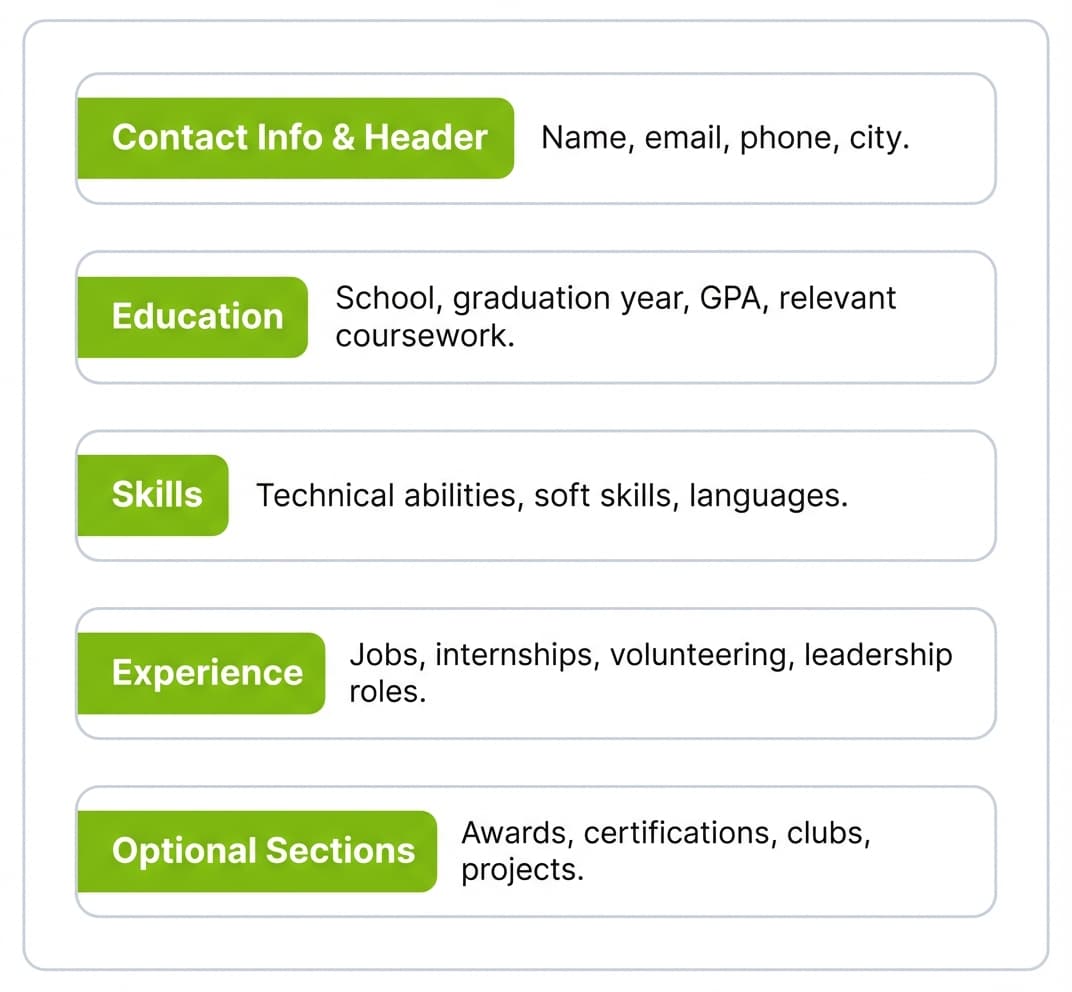
Your high school resume needs five core sections that together paint a complete picture of who you are and what you bring to the table. Getting the structure right matters because every section serves a distinct purpose in convincing an employer to call you back.
Contact Information and Header
Your resume header sits at the top and gives employers a fast, clear way to reach you. Include your full name in a larger or bold font, your phone number with area code, a professional email address, and your city and state. Skip your full mailing address for privacy.
If you have a LinkedIn profile, add the URL and customize it to remove the random numbers LinkedIn assigns by default. A professional email address matters more than you might think. An address like janesmith2026@gmail.com signals professionalism, while partygirl99@gmail.com gives employers a reason to move on before reading a single line.
Before: partygirl99@yahoo.com
After: jane.m.smith@gmail.com
Education Section (GPA, Coursework, and Achievements)
For high school students, education is your strongest section. List your school name, city and state, and expected graduation date. Include your GPA if it is 3.0 or higher. According to MIT's Career Advising & Professional Development office, factual accomplishments and quantitative details help your resume stand out during the few seconds a recruiter spends scanning it.
Place your GPA directly after your school name using the format "GPA: 3.7/4.0." Add relevant coursework that connects to your target role, AP classes, dual enrollment courses, and academic honors like National Honor Society membership or honor roll recognition.
Example Education Section:
Lincoln High School, Portland, OR — Expected Graduation: June 2026 GPA: 3.8/4.0 Relevant Coursework: AP Computer Science, AP English Language, Business Foundations Honors: National Honor Society, Principal's Honor Roll (6 semesters)
Skills Section (Technical and Soft Skills)
Your skills section bridges the gap between what you have done and what an employer needs. Technical skills are measurable abilities like proficiency in Google Workspace, basic coding, video editing, social media management, or data entry. Soft skills cover communication, teamwork, problem-solving, time management, and leadership.
The key is connecting each skill to a real experience. If you volunteered at a summer camp, do not just list "leadership." Instead, note that you organized weekly activities for 20 children, which demonstrates leadership, planning, and communication all at once. You can use a tool like CareerKit's skills generator to identify transferable skills that match common job descriptions.
Before (vague): Good at communication, teamwork, and leadership.
After (specific): Communication: Delivered weekly announcements to 200+ students as student council secretary. Teamwork: Coordinated with 8 cast members to produce school theater performances. Leadership: Organized fundraising events that raised $1,200 for local food bank.
Experience Section (Work, Volunteer, and Extracurriculars)
This section includes paid jobs, volunteer positions, and extracurricular involvement. The format stays the same for all three: organization name, your role or title, dates of involvement, and specific contributions with measurable results whenever possible.
Treat informal work the same way you would a formal job. Babysitting becomes "Child Care Provider" with client management responsibilities. Dog walking becomes "Pet Care Specialist" with scheduling and client communication duties. According to the University of Arizona Career Services, matching the language and keywords from a job posting to your experience descriptions significantly increases your chances of getting noticed.
Example Experience Entry:
Volunteer Tutor, Riverside Community Center — September 2024 to Present Tutored 5 middle school students in math and reading, improving average test scores by 15% Created personalized study plans and tracked weekly progress for each student Coordinated schedules with parents and center staff to ensure consistent sessions
Certifications demonstrate initiative. If you completed a CPR certification, a Google Digital Garage course, or a food handler's permit, list the full certification name, issuing organization, and completion date. Language proficiencies matter especially if you are bilingual or multilingual, as this is a genuine competitive advantage in many entry-level roles.
Hobbies belong at the bottom of your resume and only when they reveal something meaningful about your character. "Gaming" says little, but "competitive chess player ranked in state top 50" tells an employer you are strategic and disciplined.
How to Write a High School Resume Step by Step
Building your first resume takes six structured steps. Each one transforms raw experiences into a professional document that speaks an employer's language.
Step 1: Choose the Right Resume Format
Start with a chronological resume format, which lists your most recent experience first. This is the format that both employers and applicant tracking systems (ATS) prefer. Nearly 99% of Fortune 500 companies use ATS software to filter and manage applications, and chronological formats parse most reliably through these systems.
Use a clean, single-column layout. Set your font to 11 or 12 points in a professional typeface like Arial, Calibri, or Garamond, with margins between 0.5 and 1 inch. You can preview how different fonts look on a resume with CareerKit's font preview tool before committing to one. Avoid multi-column layouts, text boxes, and heavy graphics, as these often confuse ATS software.
Step 2: Write Your Contact Information
Place your full name at the top in a slightly larger font size. Below that, add your phone number, professional email, and city and state. Set up a professional voicemail message that includes your name. If your LinkedIn profile is current and complete, add the URL. Skip your full mailing address.
Before: Tommy B. — call me at 555-1234 — tommyb_rocks@hotmail.com
After: Thomas Brennan — (555) 123-4567 — thomas.brennan@gmail.com — Portland, OR — linkedin.com/in/thomasbrennan
Step 3: Add Your Education Details
Pret a decrocher votre emploi de reve ?
Rejoignez plus de 50 000 chercheurs d'emploi qui ont deja transforme leur carriere avec notre createur de CV propulse par l'IA.