How Long Should a Resume Be? The Expert Guide for Every Career Stage | Careerkit
Accueil/Blog/Guide/How Long Should a Resume Be? The Expert Guide for Every Career Stage
Guide
How Long Should a Resume Be? The Expert Guide for Every Career Stage
How long should a resume be? One page for entry-level, two for mid-career. Learn the right resume length for your career stage with data-backed guidance.
A 2018 eye-tracking study by TheLadders found that recruiters spend an average of just 7.4 seconds on their initial resume scan (HRDive). That is barely enough time to read your name and current job title, let alone your full work history.
So how long should a resume be to survive that first glance? The answer depends on where you are in your career, what industry you work in, and how much relevant experience you need to communicate. A recent graduate padding out two pages will lose a recruiter just as fast as a senior executive cramming 20 years onto one.
This guide breaks down the right resume length for every career stage, backed by recruiter data and hiring research. You will also learn practical strategies to keep your resume concise without cutting the achievements that actually land interviews. If you are building a resume from scratch, CareerKit's free resume builder can help you get the structure and length right from the start.
How Long Should a Resume Be? The General Answer
Resume length is not arbitrary. The number of pages you use sends a signal to recruiters about your judgment, communication skills, and understanding of professional norms. Here is what the data says about getting it right.
The Standard Resume Length Rules
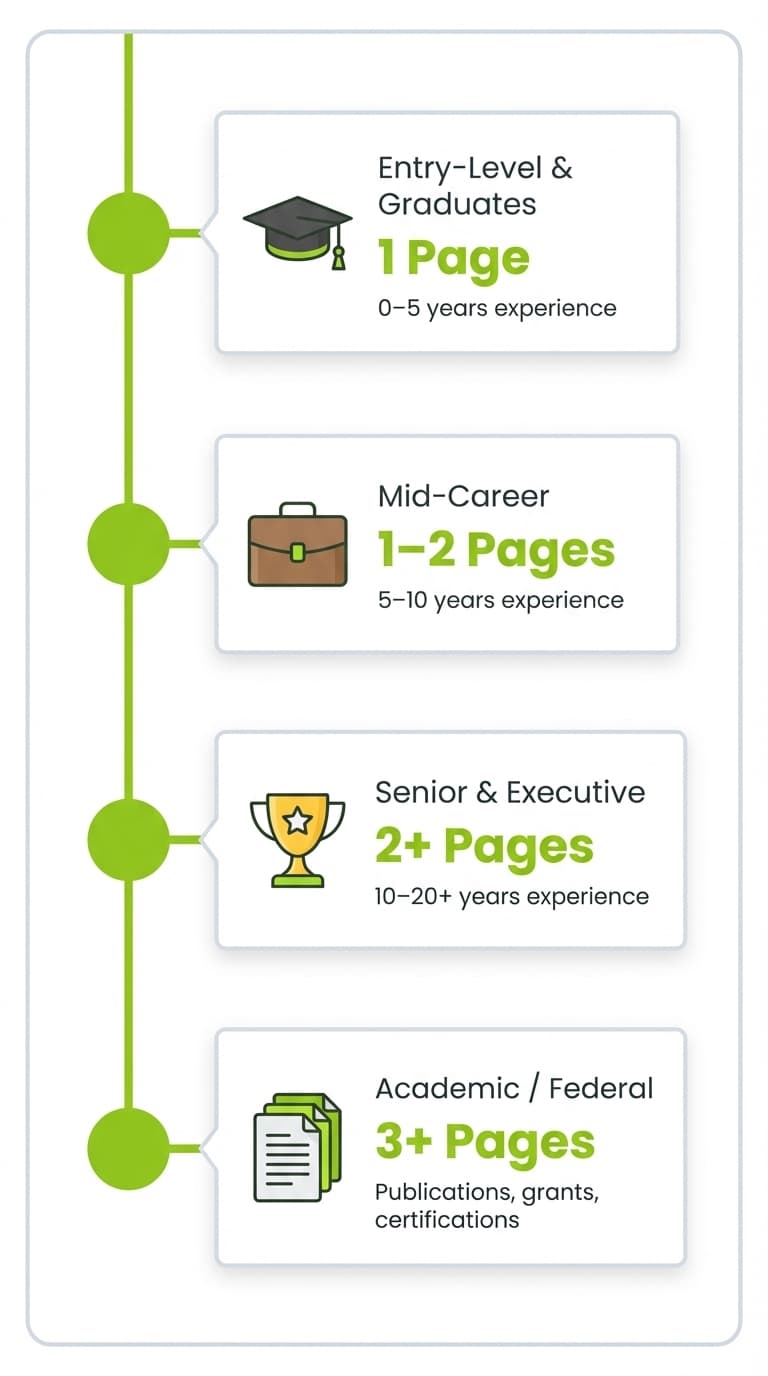
Your resume should be one to two pages in most cases. Recent graduates and professionals with fewer than 10 years of experience should aim for a single page, while mid-to-late career professionals typically need two pages to cover longer tenures and accumulated accomplishments (Indeed).
According to Indeed's career guidance, the standard resume contains between 475 and 600 words. That range gives you enough space to make a compelling case without overwhelming the reader. Anything shorter may leave recruiters questioning your qualifications, while anything significantly longer risks burying your strongest selling points.
There are notable exceptions. Academics, researchers, and scientists who need to list publications, presentations, and grants often require longer documents. Federal government positions frequently demand detailed documentation that pushes well beyond two pages. A curriculum vitae for an academic or scientific role could extend to 10 or even 15 pages, but that is a CV, not a traditional resume.
For the rest of this guide, we are focused on the standard resume used for corporate, private-sector, and non-academic roles. If you are unsure what sections your resume needs, this breakdown of every resume section will help you decide what to include.
Why Resume Length Matters to Recruiters
Hiring managers are working under serious time pressure. According to Indeed, recruiters spend an average of six to seven seconds scanning a resume during their initial review (Indeed). A more recent 2024 survey by ResumeGo found that 47% of hiring professionals spend between 30 seconds and one minute on a resume, though the initial "keep or skip" decision still happens in the first few seconds (ResumeGo).
What this means in practice is that your resume needs to be structured so the most important information is immediately visible. A two-page resume that front-loads achievements on page one can work well for experienced professionals. A bloated two-page resume where the relevant content is buried halfway down page two will get discarded.
Length also affects how recruiters perceive your judgment. An excessively long resume can suggest that you struggle to prioritize or communicate concisely, traits that raise concerns about how you would perform in the role itself. On the flip side, a one-page resume from someone with 15 years of leadership experience may signal that they are underselling their qualifications.
The rise of applicant tracking systems adds another layer. According to SHRM, the average time to fill a position in the U.S. is approximately 44 days, and employers may receive 250 or more applications per corporate job posting (SHRM). Most large employers use ATS software to filter resumes by keyword before a human ever sees them. Overly long resumes stuffed with irrelevant content tend to perform poorly in these automated screens because the relevant keywords get diluted.
Quality Over Quantity in Resume Writing
A tightly written one-page resume will always outperform a two-page document padded with filler. Content quality matters far more than page count. Your resume should showcase the top 10% of your experience that is directly relevant to the role you are applying for.
Think of your resume as a highlight reel, not a biography. Its purpose is to communicate your unique value and open the door to a conversation, not to tell your entire career story. Every word needs to earn its place on the page.
Fewer, well-crafted bullet points tailored to the job description are more impressive to recruiters than a long list of duties. Outcome-driven content that highlights specific results, like revenue growth, cost savings, or efficiency improvements, consistently outperforms generic responsibility statements (Indeed).
Here is what that looks like in practice:
Weak (generic duties): Responsible for managing social media accounts and improving engagement across platforms.
Strong (outcome-driven): Managed 5 social media accounts, growing combined following from 12K to 45K and increasing engagement rate from 2.1% to 4.8% in 8 months.
The weak version tells the recruiter what you did. The strong version tells them what you achieved, and that is the difference between getting an interview and getting skipped.
Resume Length by Career Stage
The right resume length evolves as your career progresses. What works for a fresh graduate would look thin for a director, and what works for a C-suite executive would look absurd for someone two years out of college. Here is the guidance for each stage, from your first job to the boardroom.