Adjectives to Describe Yourself: Strong Words for Your Resume, Interview, and Cover Letter
When someone asks you to describe yourself, the pressure is real. On a resume you have a few seconds to land the right impression, in an interview you have to say it out loud without sounding rehearsed, and in a cover letter you have to prove it in writing. The words you reach for matter, but not in the way most advice suggests. A recruiter spends an average of 7.4 seconds scanning a resume before deciding to keep reading or move on, so a vague adjective like "hard-working" gets you nowhere. The right adjectives to describe yourself are specific, backed by evidence, and matched to the situation. This guide gives you the words that work, the ones to avoid, and how to prove each one so it actually helps you get hired.
Why the Words You Use to Describe Yourself Matter
Self-description is not a personality quiz. It is a hiring signal. When an employer reads "detail-oriented" or hears "I am a collaborative person," they are not scoring your vocabulary; they are trying to predict whether you can do the job and fit the team. According to SHRM, interviewers open with "tell me about yourself" partly to assess your poise, delivery, and communication, not just to gather facts. So the adjective is only half the message. The other half is the proof you attach to it.
An adjective without evidence is just a claim
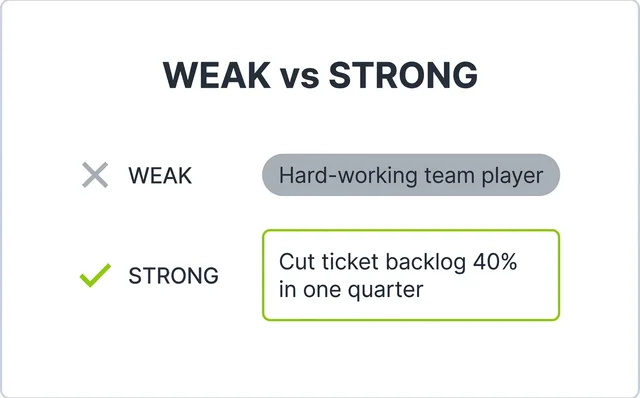
Every strong self-descriptor should be followed, in the same breath or the same bullet, by something a stranger could verify. "Reliable" means nothing on its own. "Reliable: shipped 14 consecutive sprints on schedule" is a fact. This is the single habit that separates a candidate who sounds confident from one who sounds credible. Compare these two versions of the same claim:
Before: "I am a hard-working team player."