
If you have hit Jobscan's paywall after five scans and do not want to pay $49.95 a month to see your full report, you have good options. The short answer: for a genuinely free ATS score with no scan cap and no signup, use Careerkit's ATS checker. If you also want to track applications, Teal's free tier is the strongest. If you want line-by-line writing feedback, Resume Worded goes deepest. Below is an honest breakdown of each, what it is best for, and where the catch is, so you can pick the one that fits how you actually job hunt.
Why people look for a Jobscan alternative
Jobscan does one thing well: it compares your resume to a specific job description and scores the keyword match. The friction is the pricing. As of July 2026, the free plan gives you five scans a month, but the full keyword report, soft-skills analysis, and formatting check are locked behind a paid plan. Paid access is $49.95 a month, or $89.95 billed quarterly (about $29.98 a month). For a job search that lasts a few weeks that adds up fast, and most people find they need the full report to act on anything. That is the gap every tool below is trying to fill, usually on price, on a better free tier, or by also fixing the resume instead of just scoring it.
Before you pay for any scanner, it helps to understand what an ATS actually does, so you know what you are optimizing for. Our guide to the anatomy of a resume walks through the sections these systems parse.
The best Jobscan alternatives in 2026
There is no single winner for everyone. The right pick depends on whether you want a free score, an application tracker, deep writing feedback, or a cheaper version of the same keyword scan.
Careerkit ATS Checker: best free option
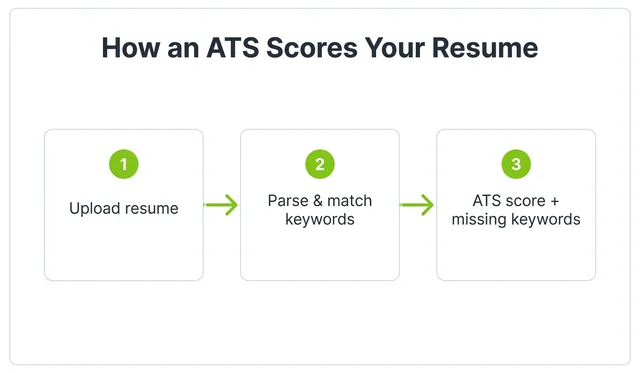
Careerkit's ATS checker is the closest thing to Jobscan without the paywall. You upload a PDF or DOCX, optionally paste the job description, and get an instant ATS score, a keyword match against that job, the specific missing keywords, a structure and formatting check, and concrete fixes. There is no scan limit and no account required to run the check, and your file is processed for analysis only, not stored. The real advantage is what happens next: when the checker flags gaps, you can rebuild the resume directly in Careerkit and re-check it, so scoring and fixing live in one place. The honest catch is that Careerkit is a resume tool, not a full application tracker, so if managing dozens of applications in a pipeline is your priority, you would pair it with something else.