In Switzerland, the Bewerbungsschreiben (cover letter) is the first document a recruiter reads from you, and often the one that decides whether your CV gets opened at all. Yet many treat it as a formality and fill it with sentences that fit every job and therefore none. In this guide I show you, as the founder of Careerkit and a career coach in Zurich, how a Bewerbungsschreiben is structured to Swiss standards, which building blocks belong in it, how to convince with strong wording, and what an adaptable template looks like.
What is a Bewerbungsschreiben?
The Bewerbungsschreiben, also called Anschreiben or Bewerbungsbrief, is the formal cover letter accompanying your application. It comes first in the application dossier and connects you to the advertised role: why you are applying, what you bring, and what value you offer the company. Unlike the CV, which lists facts, the Bewerbungsschreiben makes an argument.
Bewerbungsschreiben, Anschreiben, or Motivationsschreiben?
These three terms cause confusion. Bewerbungsschreiben and Anschreiben mean the same thing: the formal letter that accompanies almost every application for a permanent job. The Motivationsschreiben, by contrast, is a document focused more on personal motivation, required mainly for study places, scholarships, and competitive roles. If you are looking for the strictly DIN 5008-formatted structure common in Germany, our Anschreiben template helps; this guide concentrates on the Swiss conventions.
The structure of a Bewerbungsschreiben
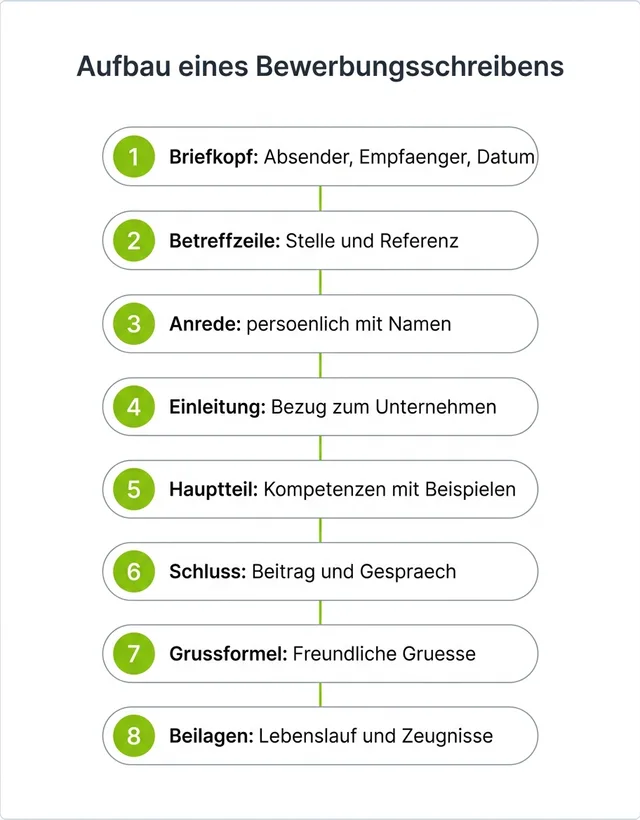
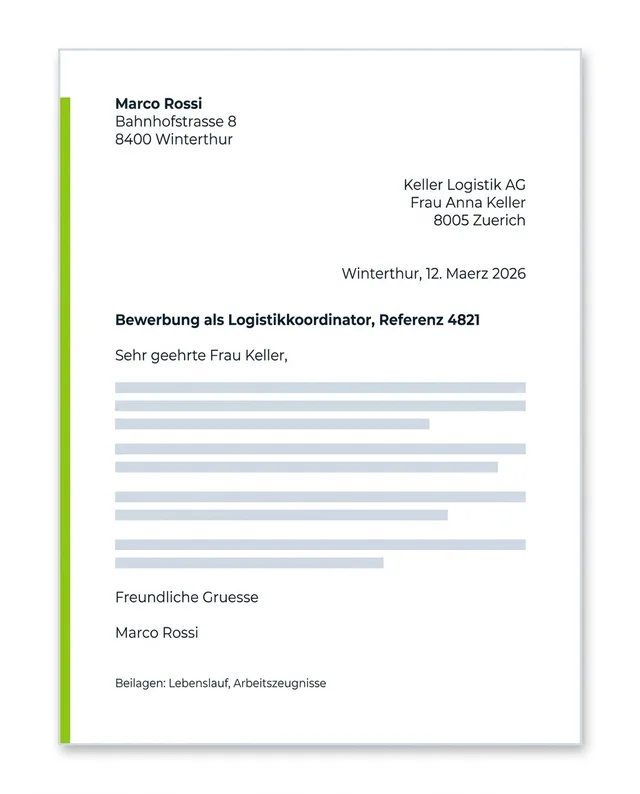
A Bewerbungsschreiben in Switzerland follows a clear, formal letter structure. From the letterhead to the enclosures, every building block has its fixed place. The overview below shows the order you can follow.