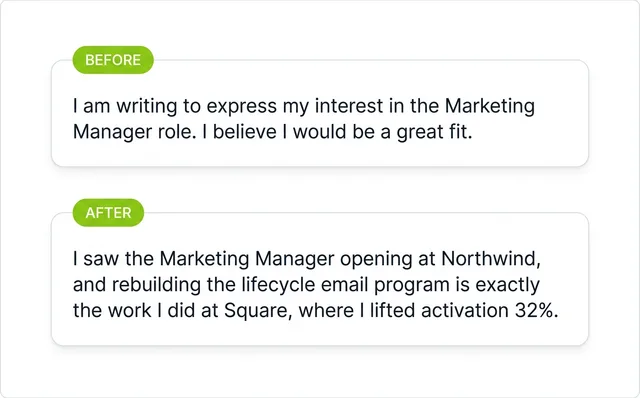
Most cover letters get skimmed in seconds, and the ones that get read all do the same thing: they say something that could only have been written for that one job. That is the whole game. A recruiter can tell in the first two lines whether you wrote to them or to a template, and in 2026, with AI-generated letters flooding every inbox, the specific letter stands out more than it used to, not less.
Here is the part people miss. Cover letters still carry weight. In a ResumeLab survey reported by Human Resources Online, 83% of hiring managers, recruiters, and HR staff said the cover letter is important to their decision, and iHire's survey found roughly 65% of employers still weigh them. Not every employer reads every one, but when the decision is close, a good letter is often the tiebreaker. This guide walks through exactly how to write one, step by step, with examples you can copy the structure from.
What a cover letter is actually for
Your resume lists what you did. Your cover letter explains why it matters for this specific role. It is the one place you get to connect the dots between your experience and their problem in plain sentences, and to say the thing a bullet point cannot: that you understand what they are hiring for and you have done it before.
That means a good cover letter is short, specific, and pointed at one job. If you could send the same letter to five companies by swapping the company name, it is not doing its job. If you want to see finished examples for your role first, browse the cover letter examples library, and if you are weighing how much each document matters, this breakdown of what hiring managers read first is a useful companion.
How to write a cover letter in six steps
Before the steps, one rule that governs all of them: read the job description first and pull out the two or three things they clearly care about, the requirements listed first, mentioned twice, or set apart in a must-have section. Your whole letter is an argument that you match those two or three things.