Can a Resume Be 2 Pages? When Two Pages Wins (and When It Loses)
Yes, a resume can be 2 pages. Here is exactly when two pages helps, when to stay on one, and how to format a two-page resume that recruiters actually read.
Can a resume be 2 pages? Yes, it can, and for a lot of people it should be. The old "one page or you are out" rule was never a real hiring policy. It was advice for new graduates that somehow got applied to everyone, including engineers with a decade of shipped projects. In a controlled study, recruiters were 2.3 times more likely to prefer a two-page resume over a one-page version of the same candidate. The real question is not "one page or two." It is whether every line on your resume earns its place. This guide shows you when two pages wins, when it quietly loses, and how to format a two-page resume so a recruiter reads the whole thing.
The short answer: length follows relevance, not a rule
A resume can be one, two, or in rare cases three pages. What decides the right length is not a page-count rule but the amount of relevant, recent, provable experience you have. A two-page resume that is well organized and full of results beats a cramped one-pager where you shrank the font to 9pt and killed the white space. Recruiters do skim first: a widely cited eye-tracking study found the average first pass lasts about 7.4 seconds. But skimming is how they decide whether to read, not the whole review. In the same length experiment, recruiters spent over four minutes on the two-page resumes they engaged with.
So the decision rule is simple. Add a second page only when the content on it is strong enough to make a recruiter more likely to call you, not just to fill space. If page two is old jobs, hobbies, or a wall of soft skills, it is working against you. Volume is part of why relevance matters: SHRM benchmarks put the typical recruiter workload in the thousands of applications a year, so an extra page of filler simply gives a busy reviewer more to skip. If you want the full breakdown by career stage, our complete guide to resume length goes stage by stage; this article focuses on the two-page decision specifically.

When you should keep it to one page
One page is still the right call for a large share of job seekers, and not because of an arbitrary limit. It is because they genuinely do not have two pages of relevant material, and stretching to fill the space dilutes the strong parts.
You are early in your career (0 to 5 years)
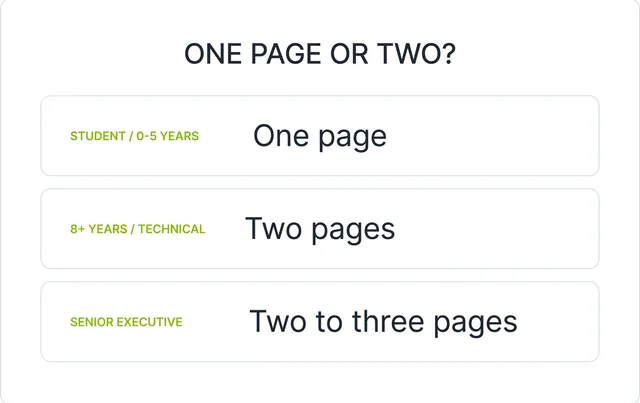
If you are a student, recent graduate, or have under five years of experience, one page is almost always correct. Harvard’s career office calls one page the norm for undergraduate and most graduate candidates. You do not yet have enough relevant, results-driven experience to justify a second page, and padding with unrelated part-time jobs or a long list of coursework signals the opposite of what you intend. The one exception is a graduate with substantial internships, research, or project work that is directly on-target for the role.
This is where trimming matters most. Cut the high-school job, the "references available on request" line, and the generic objective, and you will usually find one focused page is plenty. If you are building your very first resume, our guide to making a first resume walks through exactly what belongs on that single page.
The role or industry expects brevity
Some fields treat a tight one-pager as a signal in itself. Investment banking, management consulting, and many startup roles prize ruthless editing, and a one-page resume there reads as disciplined rather than thin. When in doubt for these fields, one page is the safer default.
Your second page would be filler
The honest test: if the only way you reach page two is by widening margins to nothing, adding a skills section that repeats the job descriptions, or listing every task from a job you held in 2011, you do not have a two-page resume. You have a one-page resume with padding. Keep it to one page and make every line count.
Before and after: cutting filler that pads a first page
Before: "Responsible for various administrative duties. Hardworking team player with excellent communication skills. Objective: to obtain a challenging position where I can grow."
After: "Processed 200+ weekly invoices with 99.8% accuracy and cut month-end close time by two days by rebuilding the reconciliation checklist."
The "before" version eats space and says nothing measurable. The "after" version earns its line. Do that across the whole document and most early-career resumes land comfortably on one page.
When a two-page resume is the right choice
A second page is not a reward for seniority; it is a container for evidence you cannot fit on one. Reach for two pages when you have enough relevant material that cutting it would hide something a hiring manager needs to see.
You have roughly 8 or more years of relevant experience
Once you have close to a decade of on-target experience, one page forces you to strip out accomplishments that actually differentiate you. Purdue’s writing lab is explicit that a two-page resume suits professionals who are above entry level but below the executive tier. The length experiment backs this up by seniority: recruiters were 2.6 times more likely to prefer the two-page version for mid-level roles and 2.9 times more likely for managerial roles, as reported by CNBC.
You are in a technical, scientific, or academic field
Ready to land your dream job?
Join 50,000+ job seekers who have already transformed their careers with our AI-powered resume builder.