A master’s degree or doctorate took years of work, so it is tempting to feature it everywhere on your resume. Used well, it sets you apart in a crowded applicant pool, and in fields from manufacturing to technical consulting that edge can decide who gets the interview. Used carelessly, it looks forced, or makes a hiring manager wonder whether you really want this job.
The degree does little on its own. What helps is putting it where the reader will see it, formatting it the way the job expects, and translating the work behind it into skills an employer can use. This guide covers all three, with examples you can adapt.
Should your degree go in your resume headline?
Take a headline like this one:
“PhD | Senior Researcher | Data Analytics & Artificial Intelligence”
The credential is the first thing a reader sees, whether they skim the page themselves or scan a shortlist in an applicant tracking system. That position matters, because early impressions shape how the rest of a resume gets read. A 2024 study in the Journal of Applied Social Psychology tracked how people form impressions of applicants as they read a resume one snippet at a time. After only three snippets, impressions of majority applicants were significantly more positive than impressions of minority applicants; once readers processed four or more snippets, the gap disappeared. For you, the practical lesson is simple: put your strongest, most relevant evidence where even a quick skim will find it.
That does not mean the degree always belongs at the top. Before you lead with it, ask two questions.
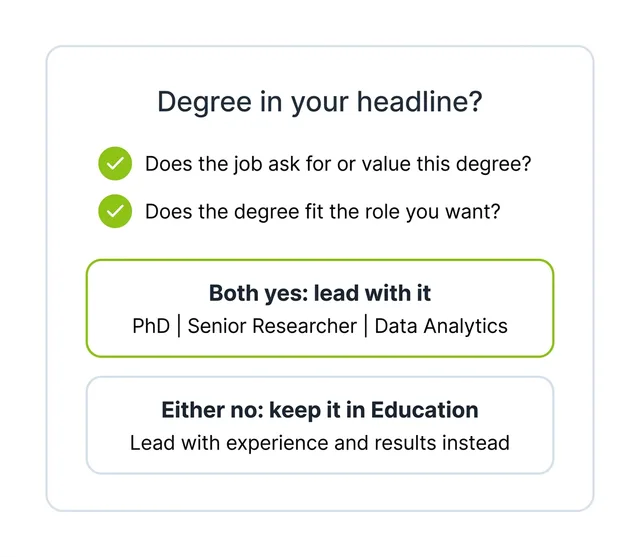
First, does the job ask for or value this degree? Second, does the degree fit the role you want? If the listing emphasizes hands-on industry experience, lead with relevant projects or the companies you have worked for instead. And if the degree does not strengthen your case for this particular job, putting it in the headline reads as overkill.