A CV for Switzerland follows its own rules. Copy a template from Germany, the US or an international website and you often make small mistakes a Swiss recruiter spots at once: no photo, missing personal details, no language levels. This guide walks you step by step through how a convincing Swiss CV (Lebenslauf) is built in 2026, what belongs in each section, and how to write it so it gets you an interview. It applies to the classic tabular CV whether you call it Lebenslauf, CV or curriculum vitae.
As a career coach in Zurich I have seen thousands of application files. The strongest are rarely the most colourful. They are the clearest.
What makes a good Swiss CV
The Swiss CV is tabular, reverse-chronological and usually two to three pages long. Unlike the one-page US resume, more detail is expected here, along with a professional photo and complete personal details. Official Swiss career guidance (berufsberatung.ch) recommends a current colour photo on a neutral background, full contact details and a clear chronological structure. A good CV, then, is not shorter, it is clearer.
Before you start writing, it helps to look at a proven structure. Our Swiss CV template guide shows the layout in detail, and our resume builder produces the layout in minutes.
The structure: which sections belong in a CV
A Swiss CV is made of clearly separated sections in a fixed order, so the recruiter finds each piece of information where they expect it.
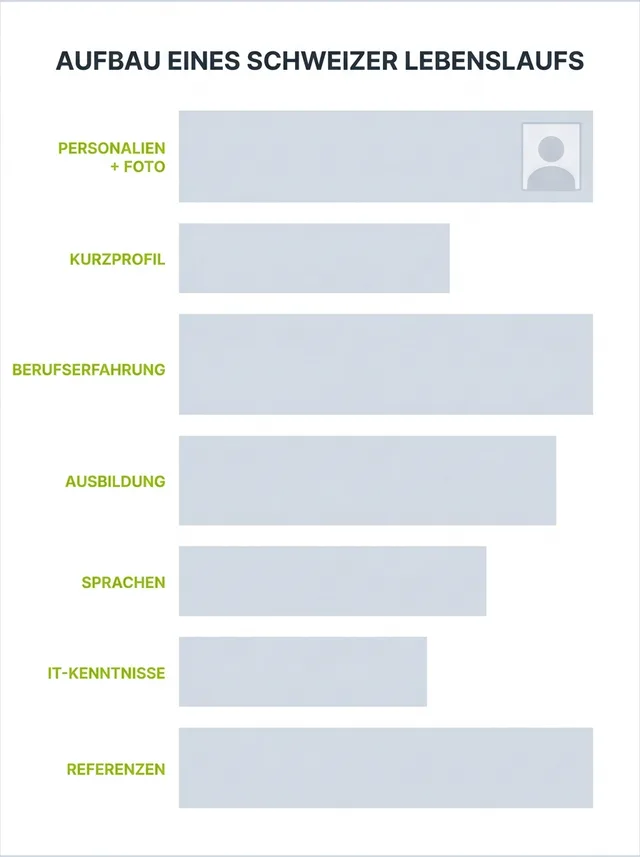
Personal details and photo
Your personal details go at the top: name, address, phone and email. In Switzerland you also include your date of birth and nationality, and for foreign applicants the residence permit (for example permit B or C). That is an important difference from countries where such details are left out for equal-treatment reasons. For more on , see our Swiss checklist, and our guide to the explains how the photo should look.