Resume Summary Examples: 25+ Samples and How to Write One
Resume summary examples by experience level, role, and career change, plus a simple 4-part formula and the difference between a summary and an objective.
A recruiter looks at your resume for about 7.4 seconds before deciding whether to keep reading or move on. Your resume summary is what they read in those seconds. Get it right and the rest of your resume earns a fair look. Get it wrong and the strongest experience in the world can sit unread at the bottom of the page.
This guide gives you more than 25 resume summary examples you can adapt today, grouped by experience level, situation, and role, plus a simple formula for writing your own. You will also see the real difference between a summary, a professional summary, and an objective, so you use the right one for where you are in your career right now.
What is a resume summary?
A resume summary is a short paragraph at the very top of your resume, directly under your name and contact details, that states who you are professionally and the value you bring in two to four sentences. Career services teams like the one at the University of Arizona describe it as your first chance to tell a reviewer why they should keep reading. Think of it as the trailer for your resume: the highlights, not the whole film.
Because it sits at the top, the summary is prime real estate. It is the one place where you get to frame everything that follows in your own words, instead of leaving a busy recruiter to piece your story together from job titles and dates.
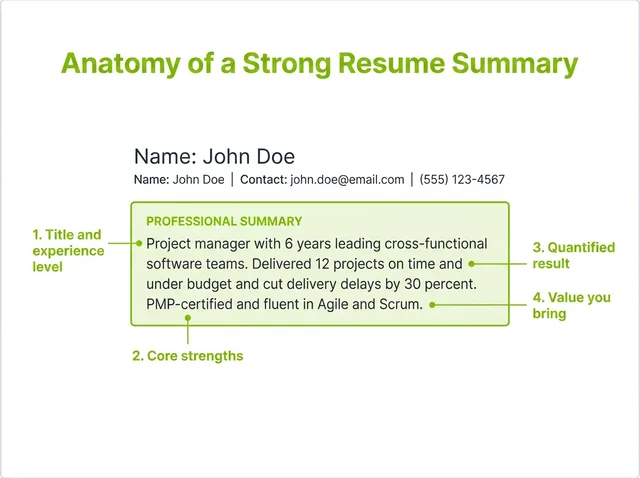
Keep it to three or four lines. Any longer and it stops being a summary. Every strong one names your role or field, your experience level, one or two specific strengths, and at least one quantified result. If you want to see how the summary fits alongside every other section, our guide to the anatomy of a resume breaks the whole document down.
Resume summary vs. professional summary vs. objective
These three terms cause more confusion than almost anything else on a resume, and using the wrong one can date your application instantly.
A resume summary and a professional summary are the same thing. "Professional summary" is simply the more formal label many templates and applicant tracking systems use, and it tends to run slightly longer, three to four sentences, with a little more detail. If a job posting or template asks for a professional summary, write a resume summary and give it one extra sentence of substance.

A resume objective is different. Instead of summarizing what you have done, it states what you want. Objectives read as dated for most candidates, but they still earn their place for career changers and first-time job seekers who need to explain intent. We cover the full trade-off in our guide to resume objectives vs. summaries. You may also see "summary of qualifications," which is the same idea written as three to five short bullet points instead of a paragraph.
How to write a resume summary
The best summaries follow a simple pattern. You can draft one in four steps, then tighten it until every word earns its place.
The four-part formula
Start with your professional title and experience level. Add one or two core strengths that match the job you want. Include at least one achievement with a real number attached. Close with the value you bring to this specific employer. That is the whole formula.
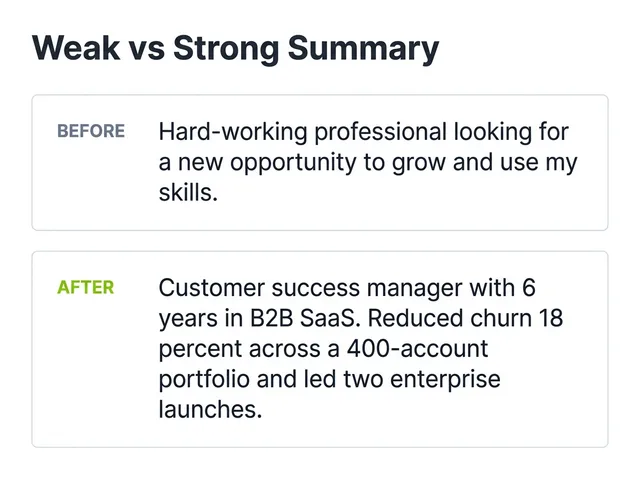
Here is the difference that formula makes. Compare a vague opener with a specific one:
Before: Hard-working professional looking for a new opportunity where I can grow and use my skills.
After: Customer success manager with 6 years in B2B SaaS. Reduced churn by 18% across a 400-account portfolio and led onboarding for two enterprise launches. Looking to bring that retention focus to a scaling product team.
The first could belong to anyone. The second tells the recruiter your role, your level, a measurable win, and where you are headed, all in three sentences.
Tailor it to every job
A generic summary is a wasted summary. Read the job description, note the two or three things the employer clearly cares about most, and make sure your summary speaks to them in the same language. This also helps with keyword matching in applicant tracking systems, which scan for the terms used in the posting. Run your draft through our ATS checker to see how well it matches before you apply.
Before: Experienced marketer skilled in many areas of digital marketing and content.
After: Demand-generation marketer specializing in paid search and lifecycle email. Grew qualified leads 42% year over year on a $50K monthly budget.
Once your summary is sharp, the fastest way to build the rest of the resume around it is with a template that keeps your formatting clean and ATS-safe. You can create a resume in minutes and drop your new summary straight in.
Resume summary examples by experience level
Ready to land your dream job?
Join 50,000+ job seekers who have already transformed their careers with our AI-powered resume builder.