If a job posting asks for a "CV" and you only have a resume, it is easy to freeze. The two documents look similar, the words get used interchangeably in casual conversation, and the answer changes depending on where you live and what field you work in. This guide clears it up. You will learn exactly what a CV is, what belongs in one, how long it should be, where in the world it is expected, and how to write one that actually earns interviews. By the end you will know whether the role in front of you needs a CV or a resume, and how to build the right one fast.
What a CV actually is
CV is short for the Latin term curriculum vitae, which translates to "course of life." A CV is a detailed document that lays out your full professional and academic history, according to Indeed. Where a resume is a tight summary tailored to one job, a CV is a complete record of your credentials that grows over the length of your career.
That single difference in purpose explains almost everything else about the format. A resume answers the question "are you a fit for this specific opening?" A CV answers a broader question: "who are you as a scholar or professional, across everything you have done?" The University of North Carolina Writing Center describes a CV as a "fairly detailed overview of your life's accomplishments, especially those most relevant to the realm of academia," and calls it a living document that you update frequently rather than rewrite for each application, per its CVs versus resumes guide.
There is one more wrinkle that trips people up, and it is geographic. In the United States and Canada, "CV" usually means the long academic document described above. In the United Kingdom, Ireland, and most of Europe, Africa, Asia, and the Middle East, "CV" is simply the everyday word for what Americans call a resume. So the same three letters can mean two very different documents depending on who is reading the job posting. We will map that out in detail below.
What goes in a CV
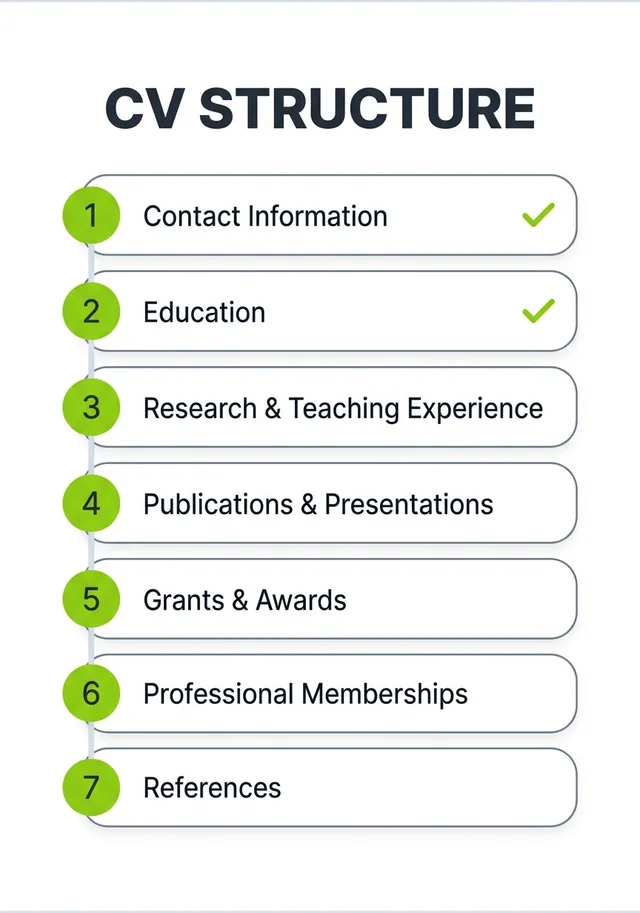
A CV is comprehensive by design, so it carries more sections than a resume and rarely leaves anything out. A full academic or professional CV typically includes your contact information, education (with dissertation or thesis titles), research and teaching experience, grants and fellowships, honors and awards, publications and presentations, professional memberships, licenses and certifications, and references. Indeed's breakdown of CV sections lists all of these plus optional additions like volunteer work and relevant interests.