You found the perfect job, opened the application, and it asks for a "CV." Or maybe it asks for a "resume" and you have only ever built a CV. Same panic, same question: are these the same thing, and if not, which one do you actually send? The short answer is that they are different documents with different purposes, lengths, and audiences, and sending the wrong one can quietly cost you the interview. This guide lays out every real difference between a CV and a resume, shows you which to use based on your field and country, and gives you a simple rule for deciding in seconds.
The short answer
A resume is a brief, targeted summary of your skills and experience for one specific job, usually one page. A CV, short for the Latin curriculum vitae or "course of life," is a comprehensive record of your entire academic and professional history that can run many pages. If you want the full breakdown of the longer document, our guide to what a CV is covers it in depth.
For most corporate jobs in the United States and Canada, you want a resume. For academic, research, medical, or grant roles, or for jobs in the United Kingdom, Europe, and much of the rest of the world, you want a CV. That one sentence resolves the majority of cases. The rest of this guide handles the situations where it is not that simple.
The core differences at a glance
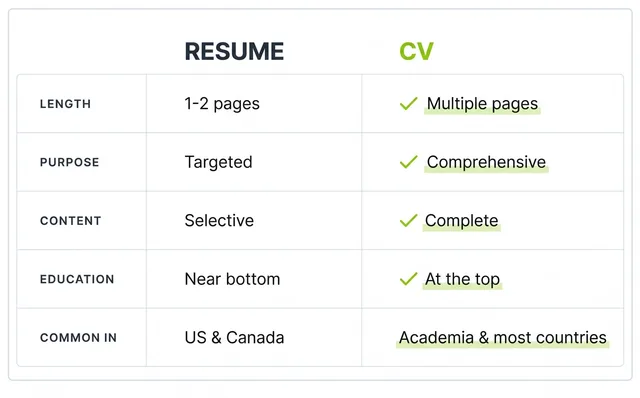
Five differences separate the two documents, and understanding the reasoning behind each one makes it easy to remember which is which.
The first is purpose. A resume is a marketing document tailored to a single opening; you rewrite it for each application to emphasize the most relevant experience. A CV is a complete professional record that you update over time but do not fundamentally reshape for each job. The University of North Carolina Writing Center describes the resume as a "general and concise introduction" to your experience and the CV as a "fairly detailed overview of your life's accomplishments."
The second is length. A resume is held to one or two pages. A CV has no fixed limit and grows with your career, running two to three pages for early-career researchers and into double digits for established scholars, according to UNC. puts the typical CV at two to three pages, longer for senior applicants.