You hit submit, and then nothing happens. Days pass, the inbox stays quiet, and you start wondering whether your application landed in a real person's hands or vanished into an applicant tracking system. A follow-up email after application is how you break that silence professionally, and it is one of the simplest ways to separate yourself from the majority of candidates who never bother.
The hard part is knowing when to send, what to say, and how to sound confident without sounding desperate. Below you get the timing rules, a simple structure you can reuse, and 15 ready-to-adapt templates for almost every scenario, from a routine check-in to a career fair introduction to a senior executive search.
When to Send Your Follow-Up Email After Application
Timing is the difference between looking eager and looking impatient. The right window depends almost entirely on what kind of application you sent and whether you have already spoken to anyone on the team.
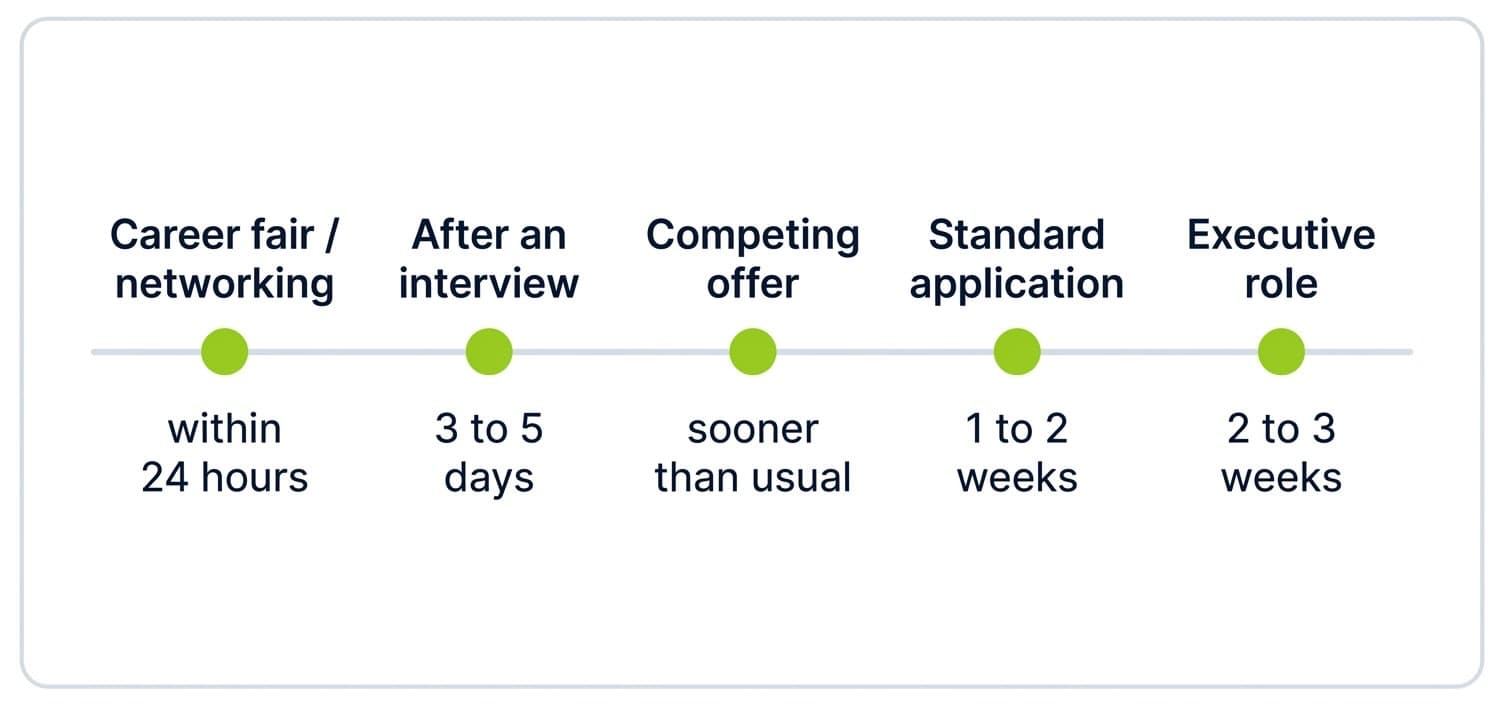
Some scenarios reset the clock. If you have already interviewed, follow up within three to five days rather than waiting two weeks, because the conversation is fresh and the decision may be imminent. After a career fair or a networking event, the window is tighter still: career centers consistently advise sending your note within 24 hours while the recruiter still remembers your face. And if you are holding a competing offer, it is reasonable to reach out sooner than the standard window and say so, since a real deadline can genuinely move your application forward.
When you should wait (or not send at all)
Read the job posting before you write anything. If it asks candidates not to contact the company, respect that completely. If the employer gave a specific decision date during an interview, wait until that date passes before you check in, because following up early looks like you were not listening. Executive and senior roles also run on longer cycles, so two to three weeks is a more realistic first touch for those. When in doubt, give the process a little more room rather than a little less.
How to Write a Follow-Up Email That Gets Read
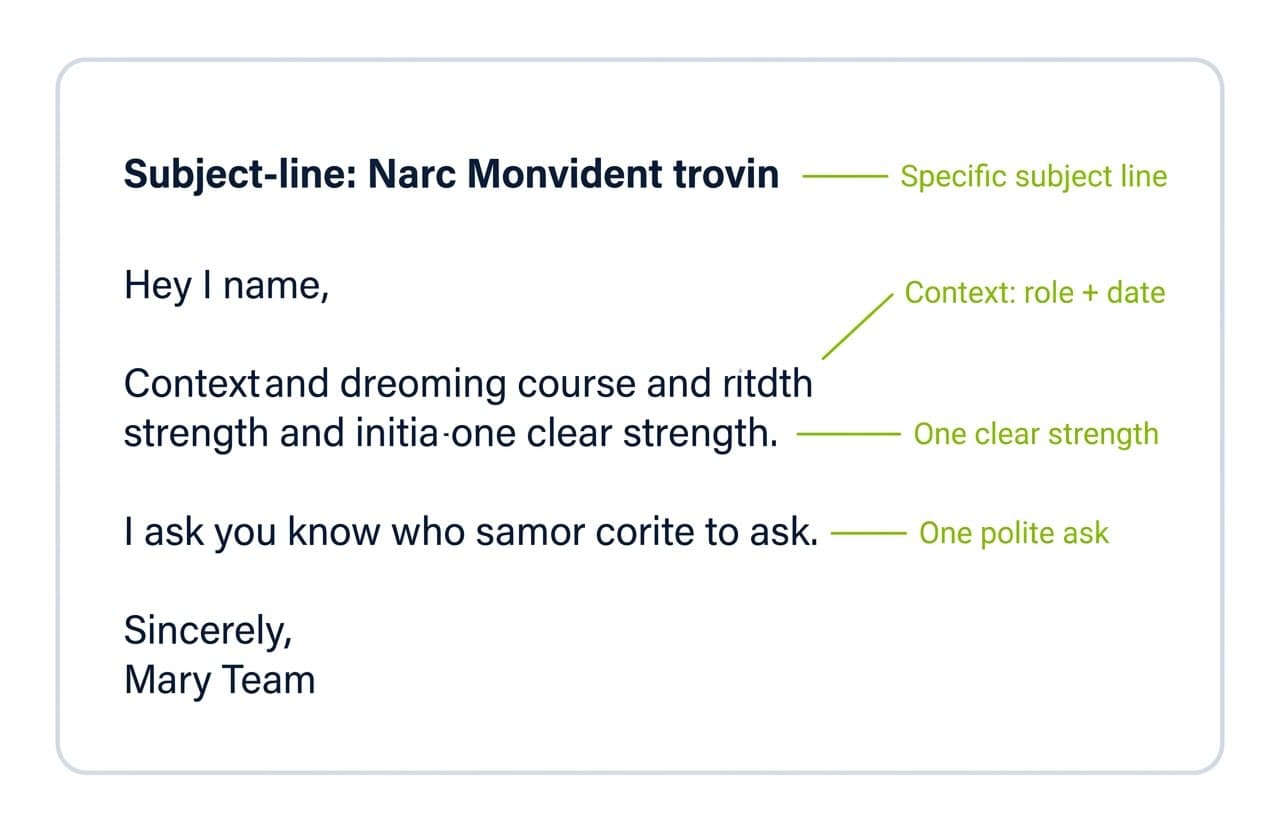
A good follow-up email is short, specific, and easy to answer. The hiring manager should be able to read it in fifteen seconds and know exactly who you are and what you want. Three elements do most of the work.
Nail the subject line
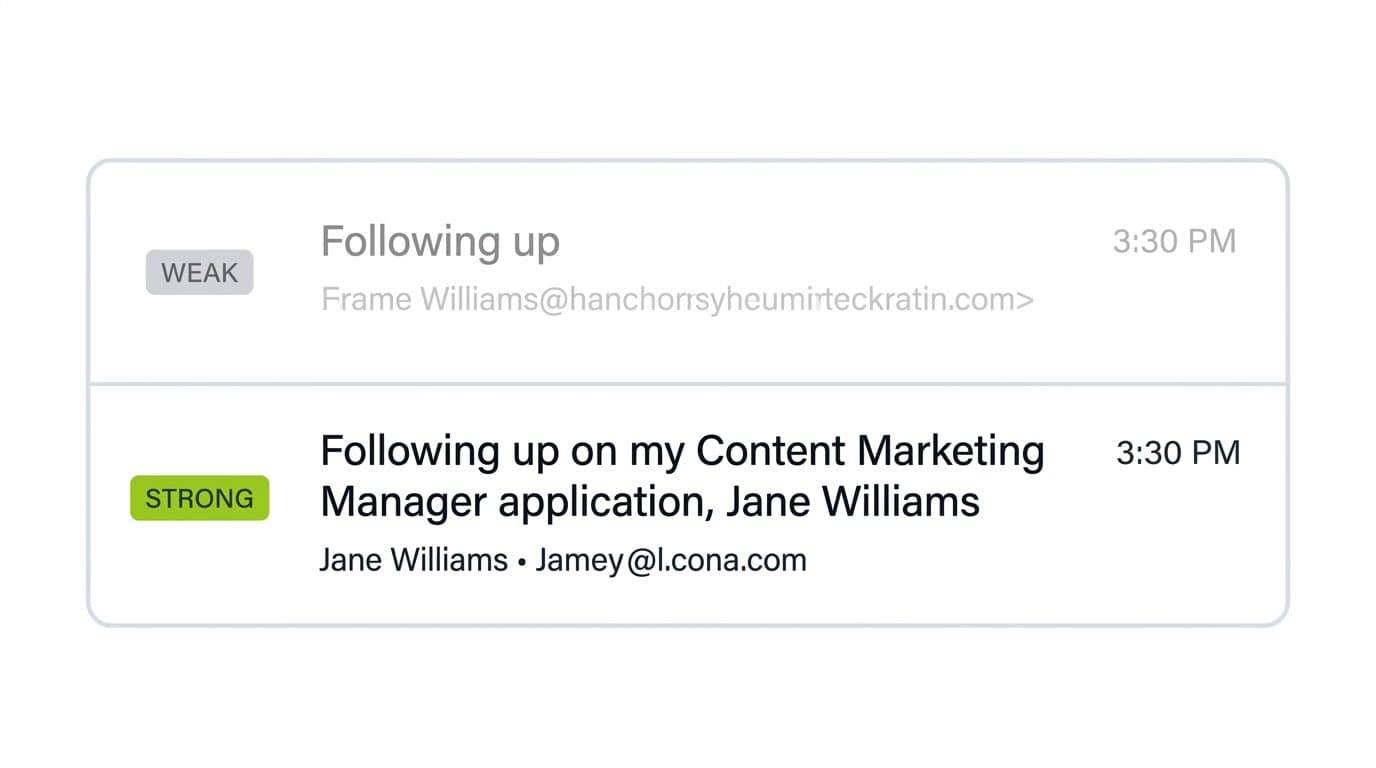
Your subject line should tell the reader what the email is about before they open it, which usually means naming the role and yourself. A generic line gets buried; a specific one gets opened.
Before: Following up
After: Following up on my Content Marketing Manager application, Jane Williams
Open with context, not "just checking in"
The opening line is where most follow-ups go wrong. "I'm just checking in" gives the reader nothing to work with. Instead, anchor your message in a concrete detail: the role, the date you applied, and one specific reason you are a fit.
Before: Hi, I just wanted to check in and see if there are any updates on my application. Thanks!
After: Hi Priya, I applied for the UX Designer role on March 3 and wanted to reaffirm my interest. The work your team is doing on the new onboarding flow is exactly the kind of problem I spent the last three years solving at my current company.
That second version does what your resume cannot do on its own: it connects your specific experience to their specific work. If you want help turning your background into that kind of sharp, role-matched language in the first place, our resume builder is designed to surface your most relevant wins fast.
Make one clear point and one clear ask
Close by reminding the reader of a single relevant strength, then make one polite, specific request. Do not stack three questions or restate your whole cover letter. Your resume already covers your full background, section by section, so the follow-up only needs to add a reason to reply.
Before: I have a lot of relevant experience and I think I'd be great for this role and I was wondering about the timeline and also whether you need references and if there are other roles open too?
After: Given my five years leading paid acquisition, I'd love the chance to discuss the role. Could you let me know where things stand in your timeline? Happy to share anything else that would help.
15 Follow-Up Email After Application Templates
Each of these is built for a specific situation. Adapt the bracketed details, keep your version to two or three short paragraphs, and pick the one that actually fits where you are in the process.
1. The Polite Check-In
The workhorse template. Use it one to two weeks after a standard application when you simply want a status update without any pressure.
Subject: Following up on my [Job Title] application, [Your Name]
Hi [Hiring Manager Name],
I applied for the [Job Title] role on [date] and wanted to reaffirm how interested I am in joining [Company]. My background in [one relevant skill or result] lines up closely with what the role calls for, and I'd welcome the chance to talk it through.
Could you share where the process currently stands? I've attached my resume again for convenience. Thank you for your time.
Best, [Your Name] | [Phone] | [LinkedIn]
2. The Enthusiastic Follow-Up
For startups, creative agencies, and informal cultures where energy and fit matter as much as the resume. Match this only to companies whose tone you have actually checked.
Subject: Still excited about the [Job Title] role at [Company]
Hi [Hiring Manager Name],
Ever since I applied for the [Job Title] position, I've kept coming back to [specific company project or value]. It's rare to find a team tackling [specific problem], and it's exactly where I want to put my [relevant strength] to work.
I'd be thrilled to talk whenever it's useful. Thanks so much for considering me.
Warmly, [Your Name]
Pret a decrocher votre emploi de reve ?
Rejoignez plus de 50 000 chercheurs d'emploi qui ont deja transforme leur carriere avec notre createur de CV propulse par l'IA.