Revenir sur le marché du travail après des années consacrées à la gestion du foyer et à l'éducation des enfants peut sembler intimidant. De nombreuses mères au foyer font face à des défis particuliers au moment de mettre à jour leur CV, sans savoir comment traduire des années de travail non rémunéré en une expérience professionnelle convaincante. La bonne nouvelle ? Les compétences développées durant cette période sont précieuses, transférables et très recherchées par les employeurs, à condition de les présenter de la bonne manière.
Comprendre les défis auxquels font face les mères au foyer
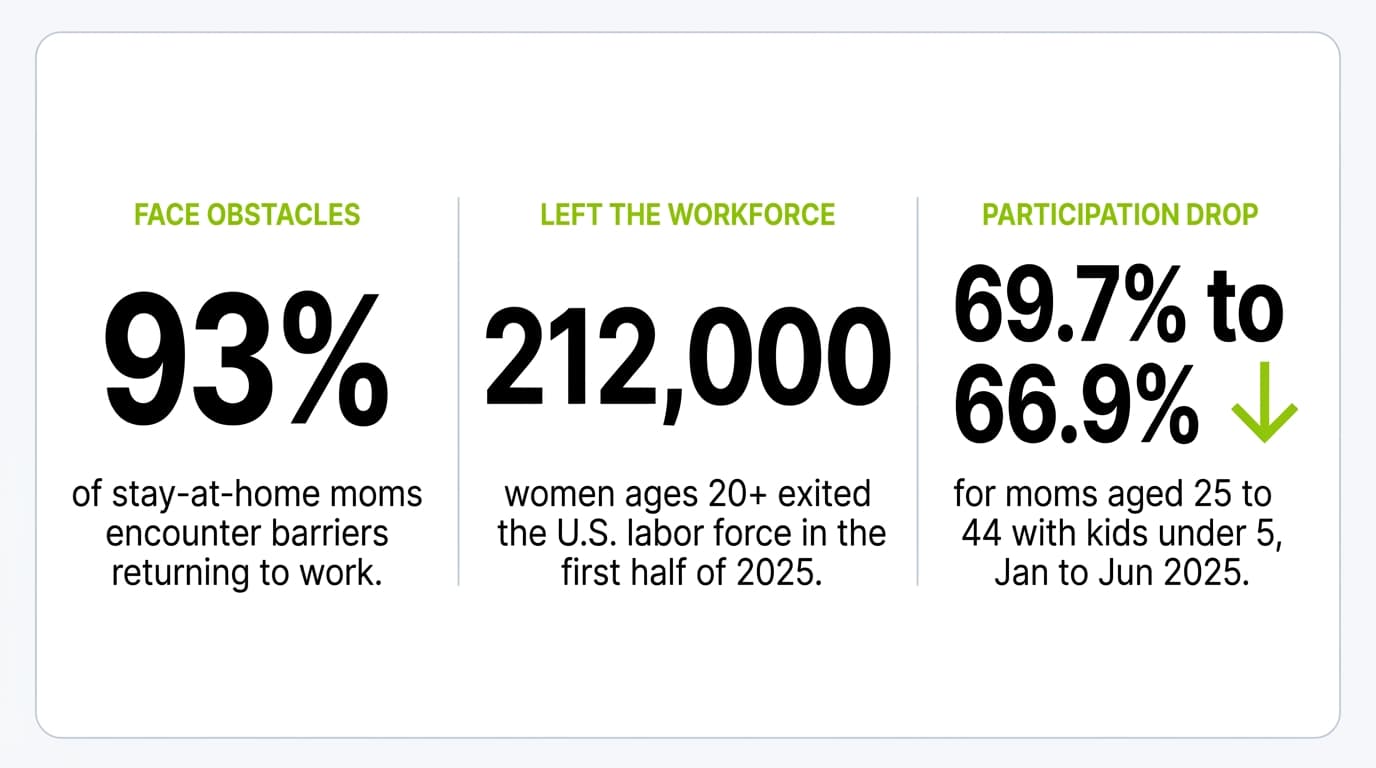
Près de 93 % des mères au foyer déclarent rencontrer des obstacles lorsqu'elles tentent de reprendre le travail, selon une étude d'Indeed sur les mères au foyer. Ce chiffre met en lumière une difficulté répandue : beaucoup de mères sentent que leur temps passé loin de l'emploi classique est perçu comme un trou plutôt que comme un atout. Kristen Shah, experte des tendances de carrière chez Indeed, l'a dit sans détour : "Les trous dans un CV ne sont pas des lacunes de compétences, et les compétences de mère sont des compétences professionnelles."
Ces défis se reflètent dans des tendances plus larges du marché du travail. Entre janvier et juin 2025, le taux d'activité des femmes de 25 à 44 ans ayant des enfants de moins de cinq ans est passé de 69,7 % à 66,9 %, une baisse de près de trois points de pourcentage en six mois. Sur la même période, 212 000 femmes de 20 ans et plus ont quitté le marché du travail américain tandis que 44 000 hommes y entraient, selon les données du Bureau of Labor Statistics. Cela efface des années de progrès, surtout chez les mères de jeunes enfants, et rend un CV solide et ciblé plus urgent que jamais. Un CV de retour à l'emploi doit remplir deux fonctions à la fois : expliquer le trou sans s'en excuser, et traduire le travail non rémunéré dans le langage que reconnaissent les responsables du recrutement.
Outre la perception de leur trou de carrière, les mères au foyer se heurtent souvent à des obstacles personnels lorsqu'elles envisagent un retour au travail. Beaucoup luttent contre le doute de soi et l'anxiété quant à leurs compétences professionnelles, craignant de ne pas pouvoir suivre le rythme effréné du monde du travail moderne. Le poids émotionnel de concilier responsabilités familiales et aspirations professionnelles peut être écrasant, amenant certaines à remettre en question leur propre valeur et leurs capacités. De plus, le manque d'emplois flexibles peut compliquer encore leur retour à l'emploi, car beaucoup de mères recherchent des postes qui leur permettent de préserver un bon équilibre entre vie professionnelle et vie privée.
Par ailleurs, les attentes de la société peuvent peser lourdement sur les mères au foyer, souvent poussées à se conformer aux rôles traditionnels. La stigmatisation entourant leur choix de faire passer la famille avant la carrière peut engendrer des sentiments d'isolement et de frustration. Beaucoup de mères se retrouvent dans une position singulière où elles doivent défendre leur propre valeur professionnelle tout en gérant la complexité de la vie de famille. Cette double responsabilité peut créer un environnement exigeant, d'où l'importance des systèmes de soutien, qu'ils viennent de la famille, des amis ou d'organisations communautaires, pour aider ces femmes à reconquérir leur identité professionnelle et à mener des carrières épanouissantes.
Requalifier l'expérience de mère au foyer en force professionnelle
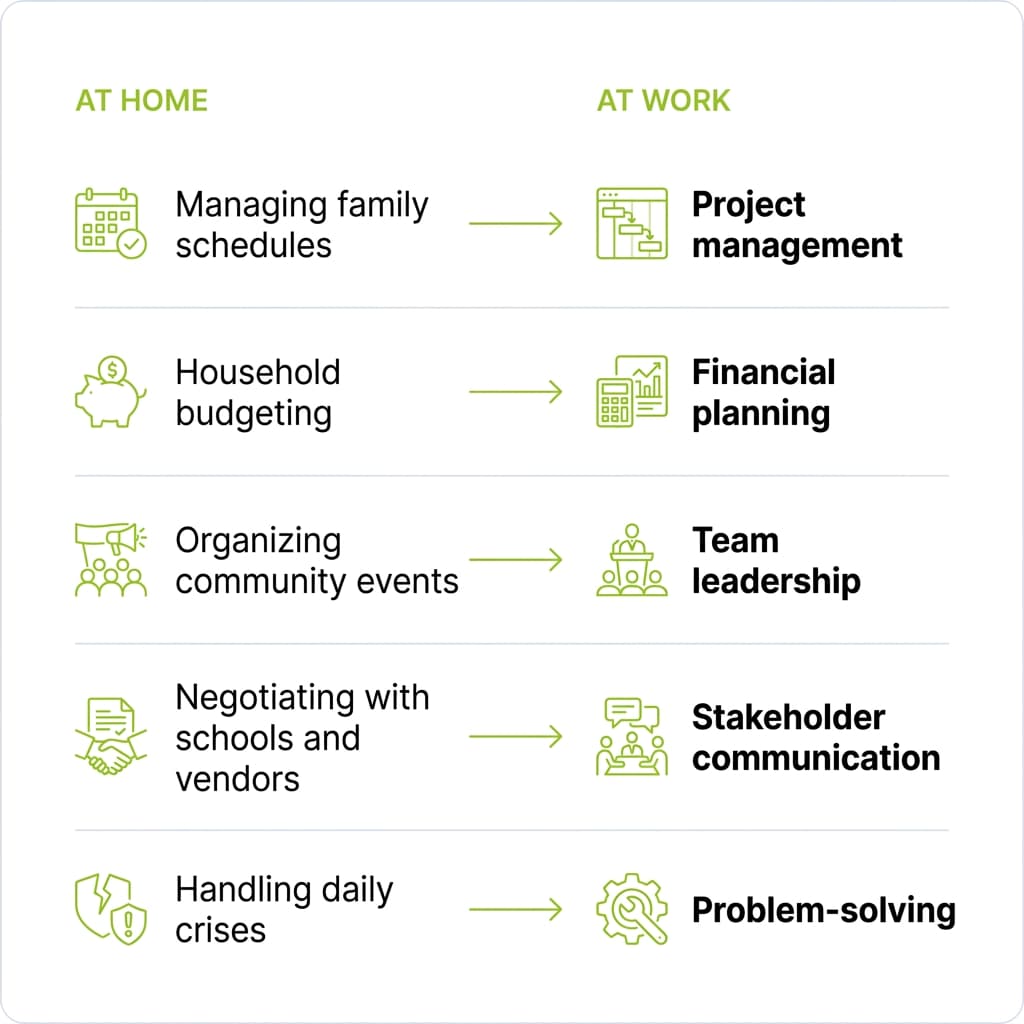
L'un des plus grands obstacles est un changement de regard : cesser de voir le temps passé comme mère au foyer comme un "trou" pour le reconnaître comme une période riche en développement de compétences. Gérer un foyer exige de la gestion de projet, de la gestion budgétaire, de la négociation, de la résolution de conflits, du multitâche et du leadership. Autant de compétences hautement transférables que les employeurs apprécient.
Par exemple, coordonner les emplois du temps de plusieurs membres de la famille s'apparente à gérer des agendas complexes en entreprise. Résoudre les défis du quotidien aiguise l'esprit critique. Négocier avec les écoles, les fournisseurs et les prestataires développe la communication et la persuasion. Ces expériences peuvent se distiller en puces de CV percutantes qui parlent aux recruteurs.
Exemples de compétences transférables que développent les mères au foyer
Cinq domaines de compétences clés se transposent presque directement de la gestion du foyer aux postes de bureau. La gestion du temps se manifeste chaque jour dans l'équilibre entre sorties d'école, rendez-vous et préparation des repas, le même jonglage qu'un chef de projet opère avec les échéances de sprint. La gestion budgétaire et la planification financière couvrent les budgets mensuels du foyer, les négociations de factures et l'épargne à long terme, autant d'éléments qui se transposent clairement aux postes en opérations ou en finance. Le leadership apparaît chaque fois que vous organisez une fête d'anniversaire, coordonnez un covoiturage ou gérez une crise familiale, les mêmes compétences que les chefs d'équipe emploient au travail. La communication se développe en négociant avec les écoles, les fournisseurs, les compagnies d'assurance et les prestataires de santé, ce qui est au fond de la gestion des parties prenantes sous un autre nom. La résolution de problèmes est constante : une gastro en pleine semaine de travail, une journée de neige sans garde d'enfants, un lave-vaisselle en panne la veille d'un dîner. Vous vous adaptez, et cette adaptabilité est exactement ce que les responsables du recrutement entendent quand ils disent "débrouillard".
Si vous avez besoin d'aide pour rattacher ces compétences à une description de poste précise, notre générateur de compétences pour CV extrait les mots-clés exacts que recherche une annonce.
En outre, le rôle de mère au foyer suppose souvent une grande dose d'intelligence émotionnelle. Comprendre les besoins et les émotions des enfants, ainsi que gérer efficacement la dynamique familiale, exige un haut niveau d'empathie et de conscience sociale. Cette intelligence émotionnelle n'est pas seulement cruciale pour créer un foyer bienveillant : c'est aussi une qualité très recherchée en entreprise, où le travail d'équipe et la collaboration sont essentiels. La capacité à décoder les signaux sociaux et à y répondre de façon adaptée peut renforcer la cohésion et la productivité d'une équipe.
De plus, les mères au foyer s'engagent fréquemment dans des activités communautaires, que ce soit par du bénévolat à l'école, l'organisation d'événements de quartier ou la participation à des clubs locaux. Ces expériences élargissent non seulement leur réseau, mais renforcent aussi leurs compétences organisationnelles et leur aptitude à travailler avec des groupes de personnes variés. Un tel engagement peut mener à un solide portfolio de service communautaire, témoignant d'un attachement à la responsabilité sociale et au leadership, des qualités de plus en plus valorisées par les employeurs en quête de candidats capables de contribuer positivement à la culture de leur entreprise.
Rédiger des puces de CV qui mettent en avant l'expérience pertinente
Pour rédiger des puces de CV, la clarté et l'impact sont essentiels. Chaque puce devrait démontrer une compétence ou une réalisation et, quand c'est possible, en chiffrer l'impact. Voici quelques stratégies pour aider les mères au foyer à rédiger des puces convaincantes :
Utilisez un langage orienté vers l'action
Commencez chaque puce par un verbe d'action fort comme "géré", "coordonné", "développé" ou "dirigé". Cela signale aussitôt une démarche proactive et une expérience orientée résultats. En employant un langage dynamique, vous captez l'attention des responsables du recrutement et transmettez un sens de l'appropriation et de l'initiative dans vos rôles. Par exemple, au lieu de dire "chargée d'organiser des événements", vous pourriez dire "orchestré des événements communautaires qui ont réuni plus de 100 familles, favorisant les liens et les réseaux d'entraide".
Chiffrez vos réalisations quand c'est possible
Les chiffres attirent l'œil et fournissent des preuves concrètes de vos capacités. Au lieu de "Géré le budget du foyer", écrivez "Géré un budget mensuel du foyer de CHF 4'500, réduisant les dépenses discrétionnaires de 18 % d'une année sur l'autre". Au lieu de "Coordonné les emplois du temps familiaux", écrivez "Coordonné les emplois du temps hebdomadaires d'un foyer de cinq personnes, jonglant avec trois calendriers scolaires, deux ligues sportives et des rendez-vous médicaux hebdomadaires sans manquer un engagement". Chiffrer vos réalisations fait deux choses à la fois : cela prouve que vous avez opéré à une échelle réelle, et cela montre que vous suivez les résultats, exactement la façon dont les responsables du recrutement pensent leurs employés.
Mettez en avant compétences relationnelles et compétences techniques
Les compétences relationnelles comme la communication, le leadership et l'adaptabilité sont cruciales. Si vous avez acquis des compétences techniques pendant votre pause, comme la maîtrise de logiciels de planification, d'applications de budget ou d'outils de communication en ligne, incluez-les aussi. À l'ère du numérique, être à l'aise avec la technologie peut vous distinguer des autres candidats. Par exemple, mentionner votre expérience des outils de gestion de projet ou des réseaux sociaux illustre votre capacité à évoluer efficacement dans les environnements de travail modernes. De plus, des compétences relationnelles comme l'empathie et la patience, affinées par la parentalité, peuvent être inestimables au sein d'une équipe et dans les interactions avec les clients.
Avant et après : puces faibles vs puces fortes
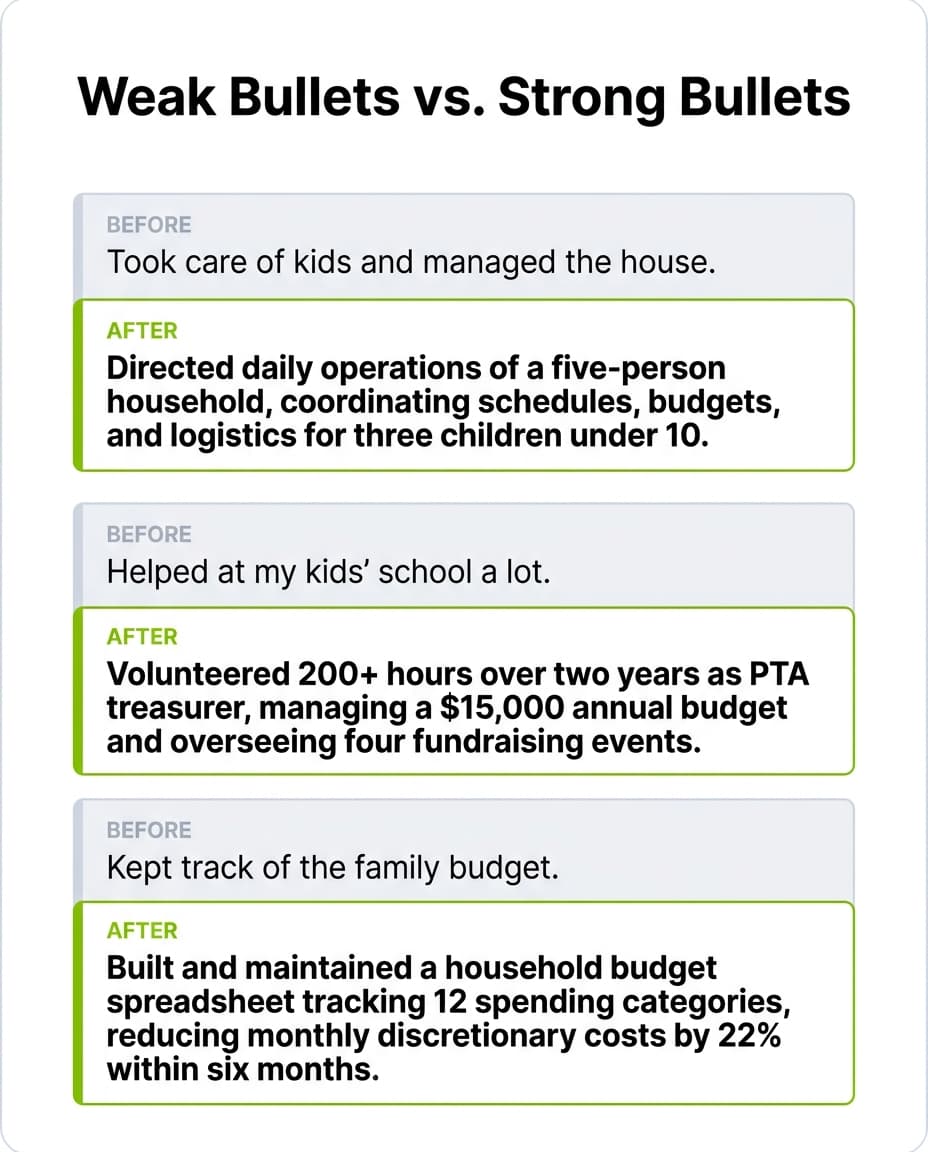
La différence entre une puce que l'on saute et une puce qui décroche un entretien tient généralement à la précision. Voici comment trois puces courantes de mères au foyer se transforment lorsque vous appliquez des verbes d'action, des chiffres et un cadrage professionnel.
Avant : Je me suis occupée des enfants et j'ai géré la maison. Après : Dirigé le fonctionnement quotidien d'un foyer de cinq personnes, en coordonnant emplois du temps, budgets et logistique pour trois enfants de moins de 10 ans.
Avant : J'ai beaucoup aidé à l'école de mes enfants. Après : Effectué plus de 200 heures de bénévolat sur deux ans en tant que trésorière de l'association de parents d'élèves, gérant un budget annuel de CHF 15'000 et supervisant quatre événements de collecte de fonds.
Avant : J'ai suivi le budget familial. Après : Conçu et tenu à jour un tableur de budget du foyer suivant 12 catégories de dépenses, réduisant les coûts discrétionnaires mensuels de 22 % en six mois.
Pret a decrocher votre emploi de reve ?
Rejoignez plus de 50 000 chercheurs d'emploi qui ont deja transforme leur carriere avec notre createur de CV propulse par l'IA.
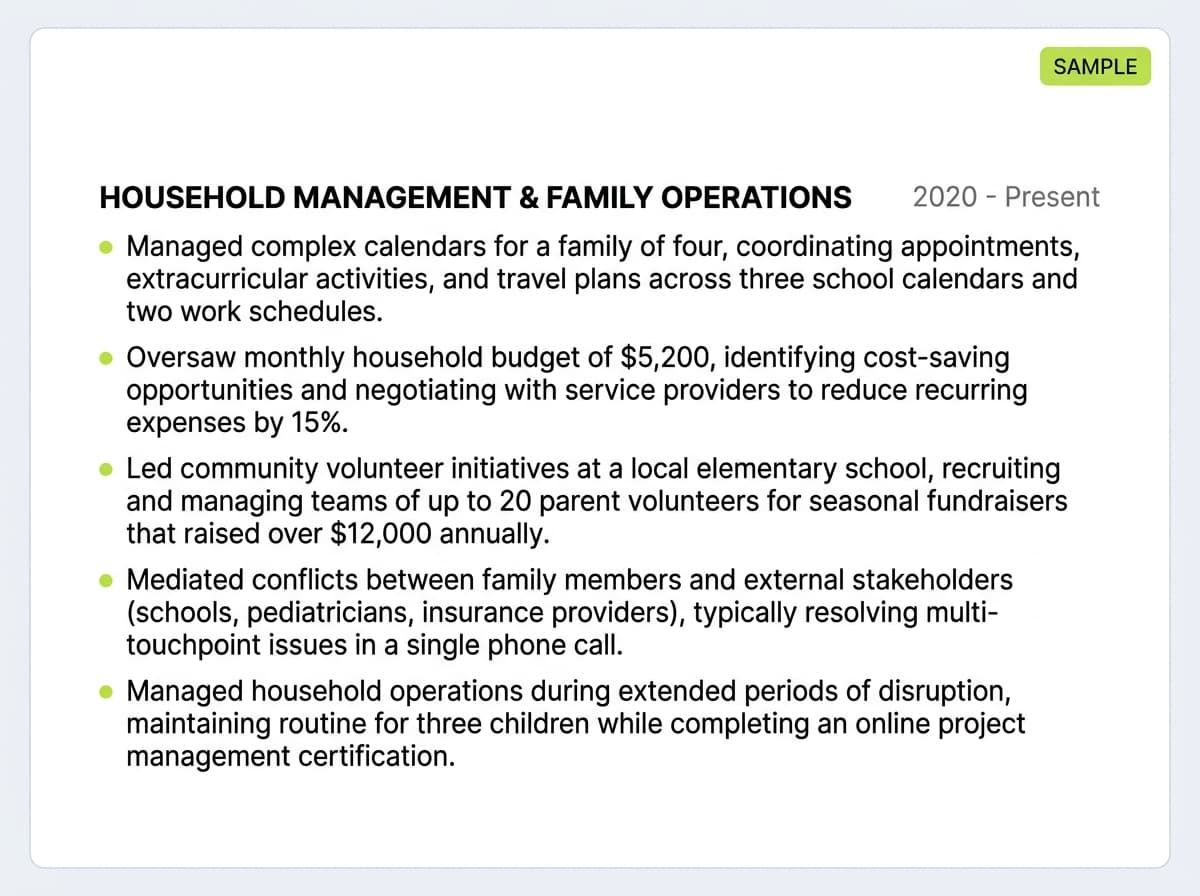
Voici cinq puces que vous pouvez adapter à votre propre expérience. Chacune commence par un verbe fort, comprend un détail chiffrable et présente le travail du foyer dans un langage professionnel.
Géré des agendas complexes pour une famille de quatre personnes, coordonnant rendez-vous, activités extrascolaires et plans de voyage à travers trois calendriers scolaires et deux emplois du temps professionnels.
Supervisé un budget mensuel du foyer de CHF 5'200, identifiant des occasions d'économies et négociant avec les prestataires pour réduire les dépenses récurrentes de 15 %.
Mené des initiatives de bénévolat communautaire dans une école primaire locale, recrutant et encadrant des équipes allant jusqu'à 20 parents bénévoles pour des collectes de fonds saisonnières qui rapportaient plus de CHF 12'000 par an.
Arbitré des conflits entre membres de la famille et interlocuteurs externes (écoles, pédiatres, assureurs), résolvant généralement des problèmes à points de contact multiples en un seul appel téléphonique.
Géré le fonctionnement du foyer lors de périodes prolongées de perturbation (maladie, fermetures d'école, voyages), maintenant la routine de trois enfants tout en obtenant une certification en gestion de projet en ligne.
En complément de ces stratégies, il est important d'adapter vos puces au poste précis auquel vous postulez. Renseignez-vous sur l'entreprise et le rôle pour repérer les compétences et expériences clés qu'ils valorisent. Vous pourrez ainsi aligner vos puces sur leurs besoins et rendre votre candidature plus pertinente et plus convaincante. Par exemple, si la description du poste met l'accent sur le travail d'équipe et la collaboration, vous pourriez mettre en avant votre expérience de l'organisation d'activités de groupe ou de la conduite de projets familiaux exigeant coopération et responsabilité partagée. Pour un déroulé adapté au poste que vous visez, découvrez comment rédiger un CV d'assistant administratif, un CV de vendeur en magasin ou un CV de serveur.
Par ailleurs, pensez à intégrer des mots-clés de l'annonce dans vos puces. De nombreuses entreprises utilisent des systèmes de suivi des candidatures (ATS) pour trier les CV, et inclure des mots-clés pertinents peut aider votre CV à être remarqué. Par exemple, si le poste exige des compétences en "gestion de projet", vous pourriez reformuler une puce pour souligner votre expérience de la conduite de projets familiaux ou d'événements communautaires, démontrant ainsi votre aptitude d'une manière qui répond aux attentes de l'employeur.
Aborder les trous dans le parcours avec assurance
Les trous dans un parcours peuvent être source d'anxiété, mais ils n'ont pas à être un obstacle. La transparence, associée à un cadrage positif de votre expérience de mère au foyer, peut transformer une faiblesse perçue en force. La plupart des responsables du recrutement se soucient moins du trou en lui-même que de votre capacité à être opérationnelle rapidement.
Envisagez d'ajouter une brève explication dans le résumé de votre CV ou dans votre lettre de motivation, en mettant l'accent sur les compétences acquises. Un exemple de phrase de résumé :
Professionnelle des opérations expérimentée, de retour sur le marché du travail après cinq ans consacrés à la gestion familiale, période durant laquelle j'ai développé de solides compétences en organisation, en gestion budgétaire et en leadership. Je souhaite mettre ces aptitudes au service d'un poste de coordinatrice des opérations.
C'est dans la lettre de motivation que vous pouvez approfondir l'histoire derrière le trou. Si vous ne savez pas quel document pèse le plus pour le poste visé, notre décryptage de ce que les responsables du recrutement lisent vraiment en premier explique quand la lettre de motivation l'emporte et quand c'est le CV. Si vous vous réorientez vers un nouveau domaine plutôt que de revenir à l'ancien, notre modèle de CV pour reconversion est conçu spécialement pour des transitions comme la vôtre.
Incluez formations pertinentes ou bénévolat
De nombreuses mères au foyer suivent des cours en ligne, obtiennent des certifications ou s'engagent dans le bénévolat pour garder leurs compétences à jour. Les inclure témoigne d'initiative et d'un développement professionnel continu. Répertoriez-les sous une rubrique dédiée "Développement professionnel" ou "Formation continue", avec des dates, afin que la chronologie de votre trou de carrière ne paraisse plus vide. Un certificat Coursera, un rôle de trésorière d'association de parents d'élèves ou une petite boutique Etsy à temps partiel comptent tous comme un engagement actif, et ont tous leur place sur le CV.
Lorsque vous serez prête à rédiger la lettre de motivation qui l'accompagne, notre créateur de lettres de motivation dopé à l'IA génère un premier jet que vous pouvez modifier en quelques minutes.
Négocier la flexibilité : un facteur clé pour les mères qui reprennent le travail
La flexibilité reste une priorité absolue pour les mères qui reprennent le travail. Une enquête de FlexJobs auprès de mères actives a révélé que 71 % ont quitté ou envisagé de quitter un emploi par manque de flexibilité. Si 56 % ont tenté de négocier des aménagements flexibles avec leur employeur, seules 32 % y sont parvenues, et à peine 13 % se disaient extrêmement confiantes dans leur capacité à négocier.
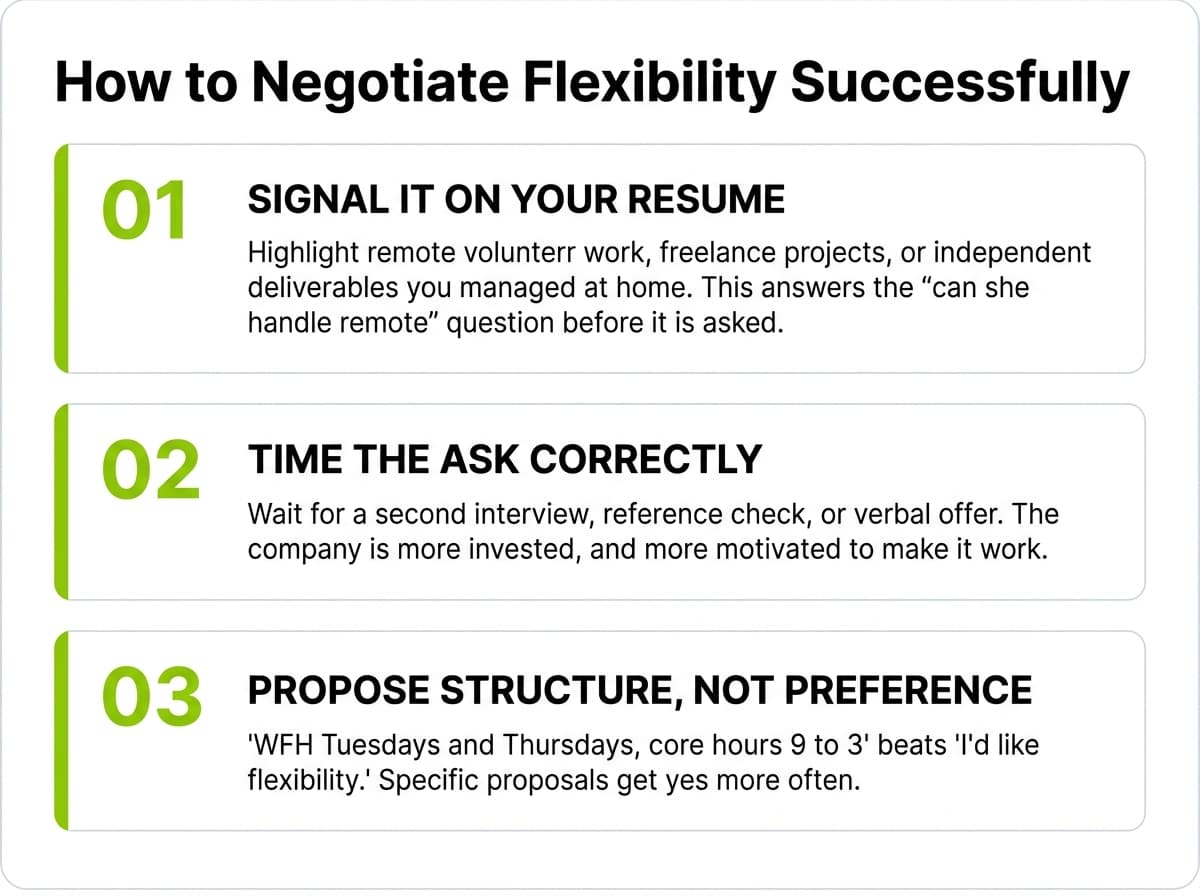
L'écart entre essayer et réussir se résume généralement au cadrage. Voici trois façons concrètes de présenter vos demandes de flexibilité pour qu'elles aboutissent.
Signalez des compétences de flexibilité sur votre CV
La négociation commence sur votre CV, avant tout entretien. Mettez en avant les puces qui prouvent que vous avez réussi dans des configurations non traditionnelles : coordination de bénévoles à distance, projets en freelance, communication asynchrone avec des écoles ou des prestataires, ou tout travail autonome que vous avez géré durant votre temps à la maison. Cela désamorce la crainte du "saura-t-elle gérer le télétravail" avant même qu'elle ne soit formulée à voix haute.
Choisissez le bon moment pour formuler la demande
Ne demandez pas de flexibilité lors du premier entretien. Attendez que l'employeur ait manifesté un intérêt sérieux (un deuxième entretien, une prise de références ou une offre verbale), puis abordez le sujet dans le cadre de la discussion globale sur la rémunération. À ce stade, l'entreprise a déjà investi en vous et est bien plus motivée à faire fonctionner l'aménagement.
Proposez une structure, pas une préférence
"J'aimerais de la flexibilité" est faible. "J'aimerais travailler depuis chez moi les mardis et jeudis, être au bureau les lundis, mercredis et vendredis, et je peux m'engager sur des plages fixes de 9 h à 15 h chaque jour" est fort. Il est plus facile de dire oui à des propositions précises qu'à des demandes ouvertes, et elles montrent que vous avez réfléchi à l'organisation.
Derniers conseils pour un retour à l'emploi réussi
Reprendre le travail après une période de mère au foyer est un parcours qui demande patience, stratégie et confiance. Les cinq actions ci-dessous ont le plus fort effet de levier quand vous débutez.
Personnalisez votre CV pour chaque candidature
Les recruteurs consacrent quelques secondes à un premier survol, et un CV générique perd presque toujours face à un CV sur mesure. Avant de l'envoyer, réécrivez au moins trois puces pour refléter le langage de la description de poste. Si l'annonce parle de "collaboration transversale", assurez-vous que votre CV emploie cette formule exacte partout où elle s'applique honnêtement. Si vous ne savez pas quelles rubriques ajuster, notre décryptage de l'anatomie d'un CV montre où de petits changements font la plus grande différence.
Activez votre réseau tôt
La majorité des postes se pourvoient par le réseau plutôt que par les sites d'emploi. Contactez d'anciens collègues, des parents de votre entourage et d'anciens managers, non pas avec un message formel "je cherche du travail", mais avec une demande précise : "Je reviens dans le marketing après quatre ans à la maison. Connais-tu quelqu'un qui recrute pour des postes juniors ou en contrat ?" La précision suscite des réponses. Les messages vagues, non.
Préparez-vous à parler de votre trou de carrière
Les responsables du recrutement poseront la question. Préparez une réponse de deux phrases qui nomme le trou, nomme ce que vous y avez fait, et enchaîne sur les raisons de votre enthousiasme pour le poste. Exemple : "J'ai consacré les cinq dernières années à gérer mon foyer et à élever deux enfants. J'ai profité de ce temps pour obtenir une certification Google Analytics, et je suis prête à mettre cette rigueur au service d'un poste d'analyste marketing."
Envisagez des postes à temps partiel ou en contrat comme tremplins
Un contrat de six mois avec une entreprise reconnue vaut souvent mieux que d'attendre six mois un poste à temps plein. Il reconstruit un historique de travail récent, vous fournit des références actuelles et débouche fréquemment sur un poste permanent. Beaucoup de personnes qui reprennent le travail rapportent que leur premier poste de retour importe moins que le deuxième, qui profite de tout l'élan bâti dans le premier.
Restez à jour sur les outils et les tendances
Un cours à CHF 50 sur LinkedIn Learning ou Coursera peut combler l'essentiel du "je suis rouillée". Choisissez un ou deux outils pertinents pour le poste visé (Excel, Google Analytics, Figma ou Salesforce selon le domaine) et ajoutez la certification à votre CV. Elle signale davantage l'initiative que l'expertise, et c'est précisément le signal que vous voulez envoyer à ce stade.
Les compétences affinées en tant que mère au foyer sont de puissants atouts, et les présenter avec soin sur votre CV ouvre de vraies portes. Quand vous serez prête, notre créateur de CV gratuit dopé à l'IA vous guide à travers chaque rubrique avec des suggestions adaptées au poste que vous visez.
Passez à l'étape suivante avec Careerkit
Prête à transformer vos compétences de mère au foyer en un CV qui sort du lot ? Careerkit est là pour vous guider dans la création d'un CV qui brille. Avec nos modèles compatibles ATS, notre aide à la rédaction par l'IA et notre lien de profil de carrière unique, vous aurez tout ce qu'il faut pour marquer les recruteurs. Rejoignez les plus de 100 000 chercheurs d'emploi qui ont fait avancer leur carrière avec nos outils. Créez votre CV gratuitement dès aujourd'hui et commencez votre parcours vers un retour à l'emploi réussi.
Expliquez le trou brièvement et sans vous excuser, soit dans le résumé de votre CV, soit dans une entrée dédiée "Pause professionnelle" avec des dates. Concentrez-vous sur ce que vous avez fait pendant ce trou (développement de compétences, bénévolat, freelance, certifications) plutôt que sur ce que vous n'avez pas fait. Une explication d'une phrase suffit amplement. C'est dans la lettre de motivation que vous pouvez approfondir si nécessaire.
Vous le pouvez, mais seulement si vous le traitez comme un vrai rôle, avec des dates, une description du périmètre en une ligne et trois à cinq puces axées sur les réalisations. Si vous ne pouvez pas le remplir de réalisations chiffrables, mieux vaut l'omettre et utiliser plutôt une courte mention "Pause professionnelle" avec les dates. L'essentiel est qu'il n'y ait pas d'espace vide inexpliqué.
Les cinq qui se transposent le plus clairement aux postes professionnels sont la gestion du temps, la gestion budgétaire, le leadership, la communication et la résolution de problèmes. Étayez chacune d'un exemple chiffrable (un montant de budget, une taille d'équipe, des heures de bénévolat) pour qu'elle se lise comme une vraie expérience plutôt que comme un trait générique. Notre générateur de compétences pour CV peut aider à faire correspondre vos compétences à une annonce précise.
Dans l'espace DACH, une à deux pages si votre expérience pertinente totale est inférieure à 10 ans, et deux à trois pages au-delà, car le CV tabulaire de deux pages y est d'usage. La règle stricte d'une page vaut surtout sur le marché américain et anglo-saxon. Un trou de carrière ne modifie pas la longueur idéale, ni à la hausse ni à la baisse. Ce qu'il change, c'est l'accent : placez votre travail professionnel le plus récent, vos certifications et vos compétences transférables en haut, et traitez les rôles plus anciens plus brièvement, plus bas.
Oui. C'est dans la lettre de motivation que vous replacez le trou dans votre propre voix, ce qu'un CV ne peut pas faire. Servez-vous-en pour nommer le trou en une phrase, nommer ce que vous y avez fait, et relier vos compétences au poste précis. Si en rédiger une de zéro vous intimide, notre créateur de lettres de motivation dopé à l'IA génère un premier jet sur mesure en quelques minutes.
Mettez ces conseils en pratique
Vous connaissez la théorie. Le créateur IA de Careerkit la transforme en CV optimisé ATS, adapté au poste que vous visez.
Nishant Modi is the founder of Careerkit.me and a product builder based in Zürich, Switzerland. With a background in product management, marketing & management consulting, he transitioned into AI entrepreneurship after experiencing the frustration of outdated job search tools firsthand. He built Careerkit to give every job seeker access to professional grade resume tools, the platform has helped over 10,000 candidates create ATS optimized resumes. He writes about resume strategy, hiring trends, and what actually gets people hired.