
Thank You Letter After an Interview Example and Template
A thank you letter after an interview is one of the highest-return notes you will ever write, and most candidates skip it.
179 words · Updated July 2026 · Free to read, no account
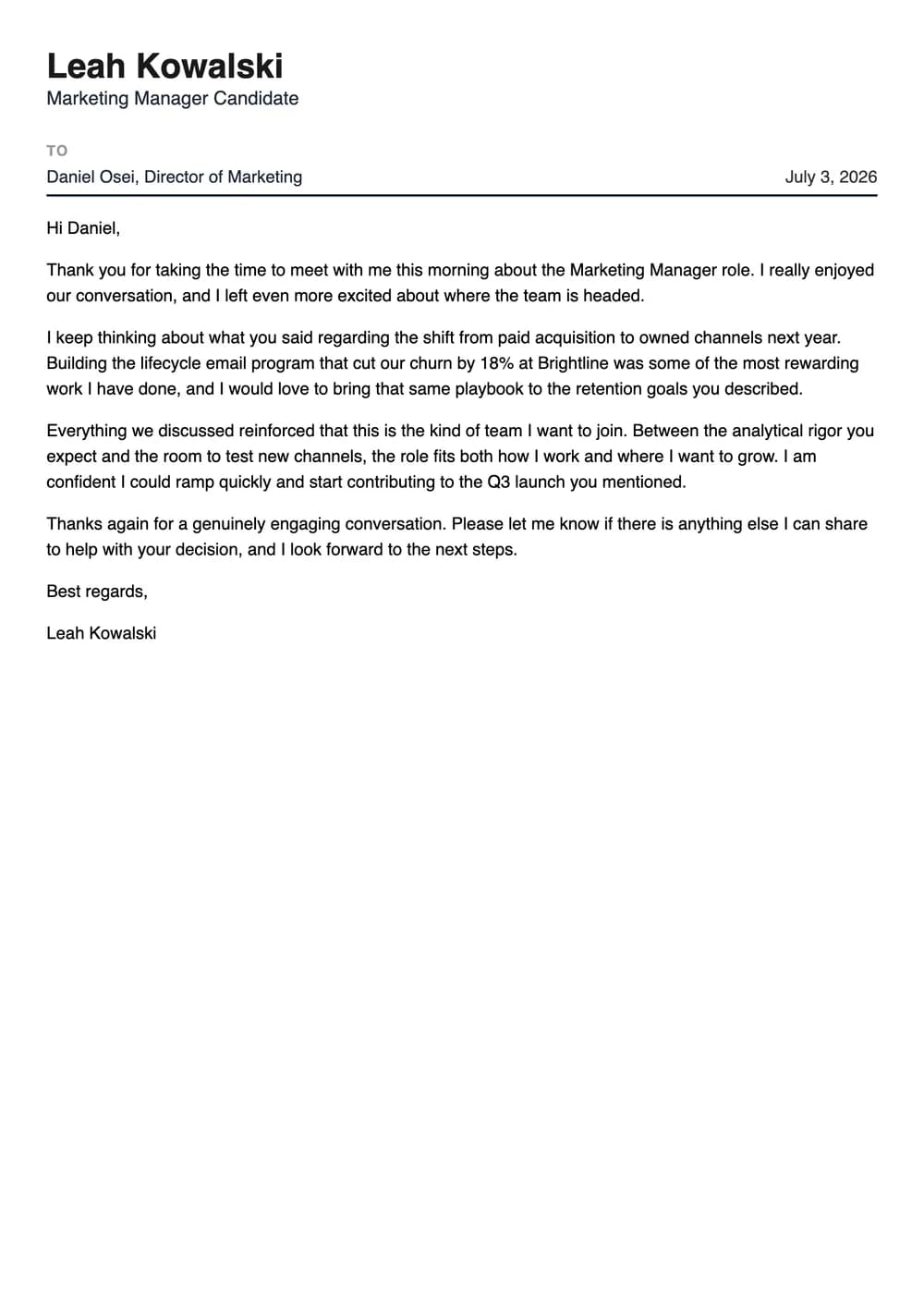
The letter, in words you can take
Leah Kowalski
Marketing Manager Candidate
Daniel Osei, Director of Marketing
Hi Daniel,
Thank you for taking the time to meet with me this morning about the Marketing Manager role. I really enjoyed our conversation, and I left even more excited about where the team is headed.
I keep thinking about what you said regarding the shift from paid acquisition to owned channels next year. Building the lifecycle email program that cut our churn by 18% at Brightline was some of the most rewarding work I have done, and I would love to bring that same playbook to the retention goals you described.
Everything we discussed reinforced that this is the kind of team I want to join. Between the analytical rigor you expect and the room to test new channels, the role fits both how I work and where I want to grow. I am confident I could ramp quickly and start contributing to the Q3 launch you mentioned.
Thanks again for a genuinely engaging conversation. Please let me know if there is anything else I can share to help with your decision, and I look forward to the next steps.
Best regards,
Leah Kowalski
Before you start
Sending one within 24 hours does three things at once: it shows courtesy, it keeps you top of mind while the hiring team compares candidates, and it gives you a last chance to reinforce why you fit. Recruiters routinely say a strong follow-up has tipped a close decision in a candidate's favor. In almost every case, email is the standard now. It arrives while the conversation is still fresh, and it lets a busy interviewer forward your note to the rest of the panel.
The mistake to avoid is a generic template that could have followed any interview. The whole point is specificity. Reference something concrete from the conversation, a problem the team is solving, a project they mentioned, a question you enjoyed digging into, and tie it back to what you would bring. Then reaffirm one key strength and your genuine interest in the role.
Keep it short. Three or four tight paragraphs is plenty, and a shorter note that clearly landed beats a long one that reads like filler. This page gives you a complete thank you email example you can adapt line by line, plus practical tips and answers to the questions candidates ask most.
How to write it
- 01
Send it within 24 hours
Timing is the whole advantage. Send your note the same day, ideally within a few hours while the conversation is fresh for both of you. Waiting two or three days lets the moment cool and can read as an afterthought. If you interviewed late in the day, first thing the next morning is fine.
- 02
Personalize it to the specific conversation
A note that could follow any interview does nothing. Reference something concrete you discussed: a challenge the team is facing, a project they mentioned, a question you enjoyed. That single specific detail proves you were engaged and listening, and it makes your note impossible to mistake for a template.
- 03
Reaffirm one key strength
Do not restate your whole resume. Pick the single most relevant strength for this role, connect it to something the interviewer cares about, and let it stand. One sharp reminder of why you fit lands harder than a paragraph trying to cover everything.
- 04
Keep it short
Three or four short paragraphs, well under a page. The interviewer is busy and skimming, so respect their time. A tight note that clearly took thought beats a long one that reads like filler. If a sentence is not earning its place, cut it.
- 05
Send a separate note to each interviewer
If you met several people, write each of them their own note rather than one group email. Reference something specific to your conversation with that person so the messages do not read as copies. It takes a few extra minutes and shows genuine attention to everyone you met.
What goes in a letter
- Your details and theirs
- Your name and how to reach you, then who this is going to. One line each.
- The subject line
- The role, or what the letter is about. It is the first thing read and the first thing filed.
- The opening
- Why you are writing, in one sentence. No throat-clearing.
- The proof
- One thing you did, with a number attached, that shows the opening was not a claim.
- The ask
- What you want to happen next, said plainly.
- The sign-off
- A closing line and your name. Sincerely is never wrong.
Phrases that carry the tone
These are the phrases that set the register. Pick the ones that sound like you saying them out loud.
Questions people ask
Start from this letter
The editor gives you the same three blocks this letter uses, so you are filling in a shape rather than facing a blank page.
Write my thank you noteFree · No credit card
- Open it in the editor and replace the details
- Write as many letters as you like, free
- Export a PDF with selectable text