If you are reading this, you have probably typed some version of "what career is right for me" into a search bar more than once. Choosing a career as an adult feels heavier than it did at eighteen. You have bills, maybe a family, years already invested in one direction, and a quiet worry that you are too far along to start something new. Here is the good news from someone who coaches people through this every week: being an adult is an advantage, not a handicap. You have real evidence about what you are good at and what drains you, and that evidence is exactly what a good career decision is built on.
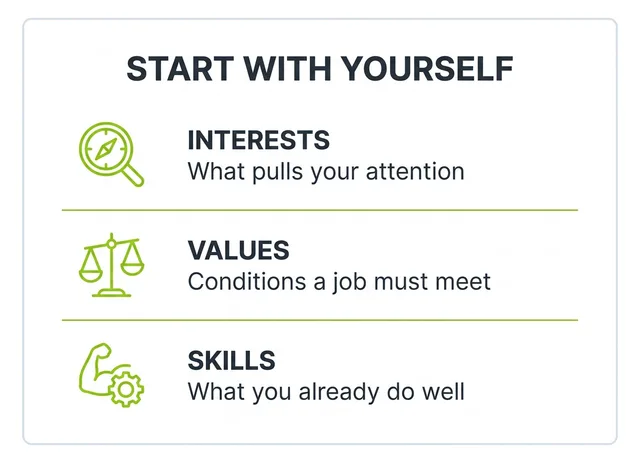
This guide walks through how to choose a career as an adult the way I would talk you through it in a session: start with yourself, turn that self-knowledge into a short list of real options, pressure-test them against your actual life, and then move. If you want a fast starting point before you read, our free career quiz gives you a few directions to react to in about two minutes.
Choosing a career as an adult is not the same as choosing one at 18
At eighteen, you pick a path from theory. You have read about jobs, watched people do them on screens, and guessed at what you might enjoy. As an adult you choose from data. You know which tasks make a day fly and which make you check the clock, which environments leave you energized and which leave you flat. That is a far better foundation than any teenager has, and it is why career changes later in life so often stick.
It also helps to drop one outdated assumption: that a career is a single thing you choose once. The U.S. Bureau of Labor Statistics reports that the median worker had been with their current employer just 3.9 years in 2024, the lowest figure since 2002. Its long-running longitudinal survey found that Americans born in the early 1960s held an average of 12.7 different jobs between ages 18 and 56. The one-employer, gold-watch career is gone. Choosing a career as an adult does not mean locking yourself in forever. It means picking a direction good enough to commit to now, knowing you can adjust later.