Understanding what an ATS resume checker evaluates is crucial for optimizing your application. These tools examine several key areas of your resume, each contributing to your overall score and chances of making it past the initial screening.
Content and keyword relevance
Resume checkers primarily analyze how well your document aligns with specific job descriptions. They scan for industry-specific terms and relevant keywords that match employer expectations. In fact, according to Jobscan's research, 99.7% of recruiters use keyword filters in their ATS to sort applications. The most effective checkers identify whether you've naturally incorporated keywords from job postings throughout your resume, particularly in your skills and experience sections. They evaluate both hard skills (technical abilities) and soft skills relevant to the position.
Formatting and file compatibility
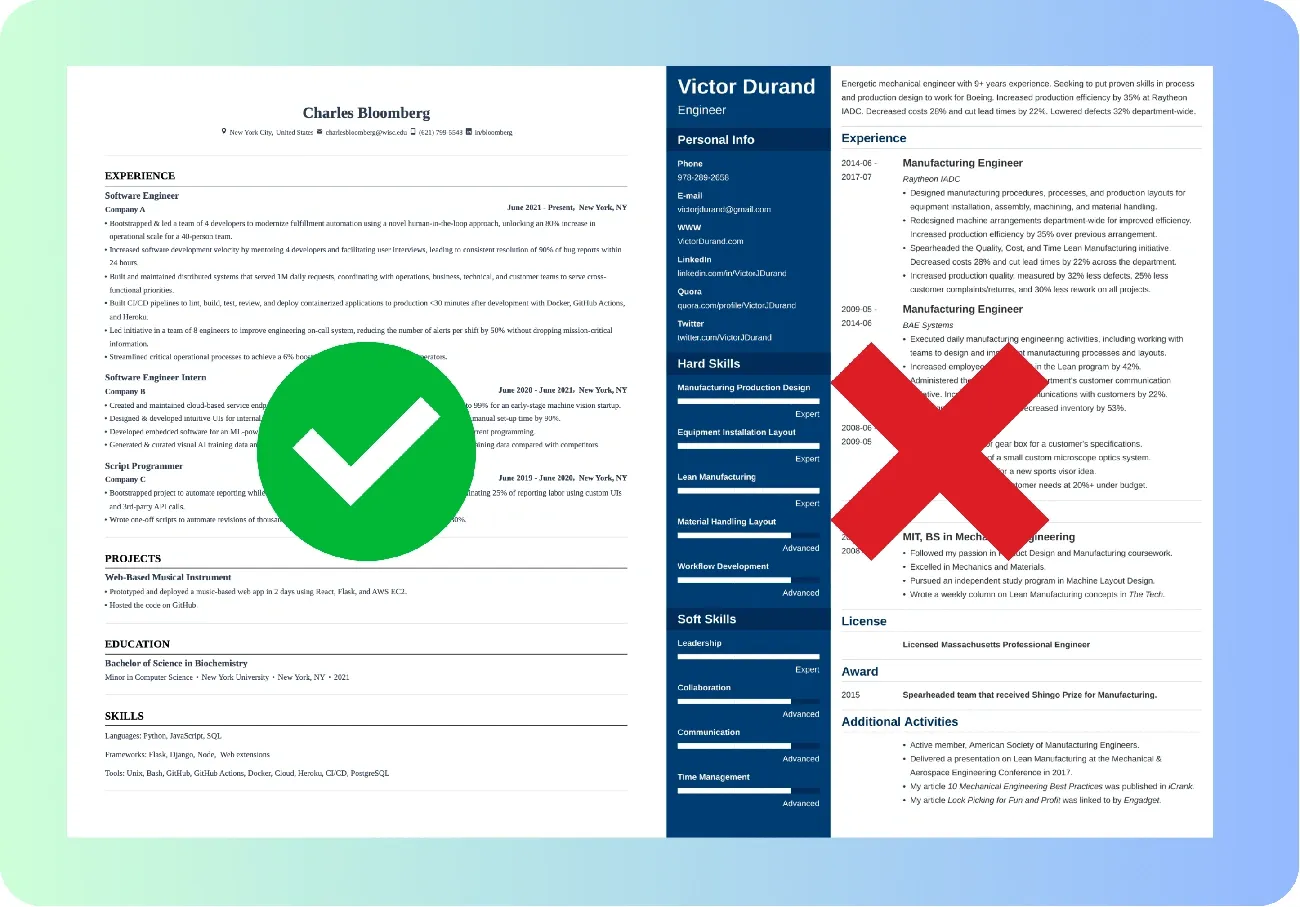
An effective ATS resume checker examines whether your document uses ATS-friendly formatting. This includes verifying you've avoided elements that confuse parsing systems, such as tables, text boxes, columns, headers, footers, and graphics. They also check if you're using standard fonts like Arial, Calibri, or Times New Roman. Regarding file formats, quality checkers verify you've saved your resume as either .docx or .pdf—the two formats most compatible with ATS systems.
Skills section and section labeling
Resume checkers evaluate whether you've included a dedicated "Skills" section with clearly labeled headings. This organization helps ATS software quickly identify your qualifications. The best checkers ensure you've used standard section titles like "Work Experience" and "Education" rather than creative alternatives that might confuse automated systems. They also verify that essential resume sections appear in the main body of the document, as some ATS tools don't scan headers or footers.
Spelling, grammar, and tone
Beyond technical elements, ATS resume checkers assess language quality. They identify spelling errors, grammatical mistakes, and overly wordy sentences that might diminish your professionalism. According to JobHero's research, a professional resume must be completely error-free to pass both ATS and human review. Advanced checkers also evaluate your content's overall tone, ensuring it strikes the right balance between professional and engaging.
Use of active voice and avoiding buzzwords
Quality ATS checkers examine whether you've used active voice throughout your resume. Active verbs demonstrate ownership of actions and make your accomplishments clearer to both ATS systems and hiring managers. Additionally, they flag overused buzzwords and clichés that dilute your message, such as "team player," "hardworking," or "results-driven". Many employers now program their ATS to recognize strong action verbs as they better highlight specific accomplishments.
How to improve your ATS score
Passing the digital gatekeeper requires more than just good qualifications—you need a strategically optimized resume. With 99.7% of recruiters using ATS filters to find qualified candidates, knowing how to improve your score is critical for job search success.
Tailor your resume to the job description
Initially, add the exact job title from the posting to your resume headline. This simple step makes you 10.6 times more likely to get an interview. Customize your resume for each application by identifying keywords in the job description. In view of the fact that 76.4% of recruiters filter by skills, 55.3% by job title, and 50.6% by certifications, incorporating these exact terms is essential. Use both acronyms and full terms (like "ERP" and "Enterprise Resource Planning") to cover all bases.
Use measurable achievements in experience
Achievement-focused resumes stand out among task-oriented applications. Start each bullet point with strong action verbs and quantify your impact with specific numbers whenever possible. For example, instead of "Helped with customer service," write "Resolved 20+ customer complaints daily with a 93% satisfaction rate." These measurable results show employers not just what you did, but how well you performed.
Avoid design elements that confuse ATS
Simplicity is key for ATS compatibility. Avoid tables, columns, graphics, headers/footers, and uncommon fonts. Stick to standard section headings like "Work Experience" and "Education". As opposed to creative formats, use chronological or hybrid resume layouts. Save your file as a Word document (.docx) or PDF to ensure proper parsing.
Optimize resume length and bullet points
Keep your resume to 1-2 pages, as overly lengthy documents challenge ATS processing. Each bullet point should be 1-2 lines long for maximum readability. Sprinkle relevant keywords naturally throughout every section. First thing to remember: bullets should start with action verbs, avoid fillers like "various" or "multiple," and omit personal pronouns. This approach simultaneously improves ATS scoring and human readability.
Top tools to check your resume for ATS
Careerkit's own free ATS checker and resume score checker let you test how your resume parses and see a match score in seconds, and our roundup of the best resume checker tools compares the full field. The tools below each take a slightly different approach.
With countless ATS resume checkers available, finding the right one can feel overwhelming. The following tools stand out for their effectiveness in helping job seekers navigate the complex world of application tracking systems.
1. Careerkit.me
Careerkit.me offers a comprehensive ATS checker integrated into its full career platform. The tool analyzes your resume against real ATS algorithms, checking formatting, keywords, and content structure. What sets Careerkit apart is its holistic approach - beyond just ATS scanning, it provides AI-powered suggestions for improvement, access to ATS-optimized templates, and the ability to tailor resumes for specific job postings. The platform also includes complementary tools like AI headshot generation and job application tracking, making it a one-stop solution for job seekers. Users report that Careerkit's ATS optimization helped them increase their interview rate by up to 3x. Simply upload your pdf resume here.
2. Enhancv Resume Checker
Enhancv offers a two-tier system that evaluates both ATS compatibility and content quality. The tool performs 16 crucial checks across five categories including content, format, skills, resume sections, and style. Enhancv analyzes resume parsability by reverse-engineering popular ATS systems. Naturally, its AI-powered technology goes beyond simple formatting issues to evaluate spelling, grammar, and even the use of active voice. The checker specifically looks for quantified achievements in your experience section, ensuring your resume demonstrates impact.
3. Kickresume ATS Checker
Kickresume's ATS Checker performs over 20 different checks, examining design compatibility, content optimization, and structural integrity. Developed by experienced recruiters and data analysts, it compares your resume against others from people hired at top companies. The tool evaluates whether fonts, templates, and visual elements might interfere with ATS parsing. Additionally, it identifies missing keywords and flags insufficient measurable achievements. Independent testing found resumes using Kickresume's templates achieved a 37% higher ATS pass rate compared to custom-designed resumes.
4. Resume Worded
Resume Worded runs over 20 checks on your resume, analyzing everything from repetition to impact quantification. Importantly, the tool personalizes feedback based on your career level (entry, mid, senior). Resume Worded successfully identifies 92% of hard skills from job descriptions, though it struggles somewhat with contextual soft skills. The platform provides line-by-line analysis with suggested improvements for each issue detected.
5. SkillSyncer
SkillSyncer focuses specifically on matching your resume to target job descriptions. Unlike other tools, it requests the actual job posting for comparison. The platform identifies missing skills and keywords while providing job-specific recommendations. Furthermore, its auto-optimize feature can automatically add relevant keywords to your experience section. Multiple users report significant increases in interview rates after implementing SkillSyncer's recommendations.
6. MyPerfectResume
MyPerfectResume's ATS Checker scans for over 30 criteria, providing instant suggestions to improve your resume score. The tool evaluates customization, content quality, formatting, and style. It extracts essential skills and keywords from job descriptions while analyzing if your summary includes relevant qualifications. A good score on this platform is 80% or higher, typically enough to move your resume to a human recruiter's desk.
Conclusion
The battle against applicant tracking systems might seem daunting at first. After all, knowing your qualifications might never reach human eyes despite your perfect fit for a position feels discouraging. Nevertheless, armed with the right tools and strategies, you can transform your resume from an automatic rejection to an interview invitation.
Remember that most large organizations rely on ATS to filter candidates, making optimization no longer optional but essential for job seekers. Your resume needs proper formatting, relevant keywords, appropriate file types, and standard section headings to pass the initial screening. Therefore, using an ATS resume checker before submitting applications gives you valuable insights into potential issues that might otherwise remain hidden.
Whether you choose a free or paid tool depends on your specific needs and application targets. Paid options generally provide more comprehensive analysis, though free checkers still offer basic optimization guidance. Whichever route you take, focus on tailoring your content to each job description, showcasing measurable achievements, eliminating complex design elements, and keeping your document concise.
Success in today's job market requires adaptation to technological gatekeepers. Though the process may seem mechanical, think of ATS optimization as simply ensuring your qualifications receive fair consideration. The ultimate goal remains connecting your genuine skills with opportunities where you can thrive.
ATS systems won't disappear anytime soon. Consequently, mastering how to work with them rather than against them becomes a crucial career skill. We hope this guide empowers you to navigate these systems confidently and finally stop getting rejected before human eyes ever see your application. Your dream job awaits beyond the digital gatekeeper—now you have the keys to unlock the door.
Key Takeaways
Understanding and optimizing for ATS systems is crucial since 99% of Fortune 500 companies use them to screen resumes before human review.
- Most resumes are filtered for technical reasons, not weak qualifications - poor formatting, missing keywords, or incompatible file types are the usual causes
- Tailor each resume to specific job descriptions - include exact keywords and job titles to increase interview chances by 10.6x
- Use simple formatting with standard sections - avoid tables, graphics, and creative headers that confuse ATS parsing systems
- Quantify achievements with measurable results - replace task descriptions with specific numbers and impact metrics
- Test your resume with ATS checkers before applying - aim for 80+ scores using tools like Enhancv, Kickresume, or Resume Worded
The key to working with ATS systems is not gaming the algorithm, it is ensuring your genuine qualifications are properly formatted and keyword-optimized so they can be accurately parsed and evaluated. Proper optimization gives your application the best chance of being read and ranked by a recruiter instead of being filtered out on a technicality.
FAQs
Q1. How can I ensure my resume passes ATS screening? To pass ATS screening, use a simple format without headers, footers, tables, or graphics. Stick to standard fonts and section headings. Submit your resume as a .docx file, include relevant keywords from the job description, and quantify your achievements with specific metrics.
Q2. What's a good ATS score for a resume? A score above 80% is generally considered good for passing ATS screening. To achieve this, use concise sentences, avoid fluff, stick to a traditional layout, choose readable fonts, and spell out terms where possible. Make sure your resume is tailored to the specific job description.
Q3. How do ATS resume checkers work? ATS resume checkers simulate how employer systems scan applications. They analyze formatting, content relevance, keyword usage, and overall structure. These tools typically provide a score based on multiple checks, evaluating how well your resume might perform in actual ATS systems used by companies.
Q4. What are the key areas that ATS resume checkers evaluate? ATS checkers primarily evaluate content and keyword relevance, formatting and file compatibility, proper section labeling, spelling and grammar, and the use of active voice. They also check for measurable achievements in your experience section and flag overused buzzwords.
Q5. What are some top tools for checking ATS compatibility? Some popular ATS resume checkers include Careerkit.me, Enhancv Resume Checker, Kickresume ATS Checker, Resume Worded, SkillSyncer, and MyPerfectResume. These tools offer various features like keyword analysis, formatting checks, and personalized feedback to help optimize your resume for ATS systems.