Un recruteur passe moins d'une minute sur votre CV avant de décider s'il continue sa lecture. Dans cet instant, la rubrique compétences est souvent la première chose qu'il parcourt, et c'est aussi la première chose qu'un logiciel de suivi des candidatures (ATS) analyse lorsqu'il vous classe par rapport aux autres candidats.
Watch: how to write a resume, section by section (with the data)
Pourtant, la plupart des candidats la traitent comme un détail et jettent une liste de mots-clés au hasard en bas de la page. Cette approche échoue à la fois auprès du lecteur humain et du filtre logiciel.
Ce guide vous montre précisément comment rédiger une rubrique compétences qui fonctionne. Vous apprendrez quels types de compétences inclure, comment extraire les bons mots-clés de n'importe quelle offre d'emploi, où placer les compétences dans votre CV pour un impact maximal et comment tout mettre en forme pour passer le filtrage ATS. Chaque section comprend de vrais exemples de CV que vous pouvez adapter à votre propre création de CV, que vous soyez un professionnel chevronné ou que vous rédigiez votre premier CV.
Pourquoi la rubrique compétences est importante
Une rubrique compétences solide est le cœur d'un CV qui fonctionne. Les candidats n'en mesurent souvent pas la valeur, pourtant ce composant compact peut influencer considérablement leur réussite dans la recherche d'emploi.
La rubrique compétences n'est pas qu'un élément de plus du CV, elle vous offre une excellente occasion de mettre en avant vos qualifications. Cet espace dédié apporte plusieurs avantages qui améliorent vos chances d'obtenir un entretien.
Comment les recruteurs utilisent la rubrique compétences
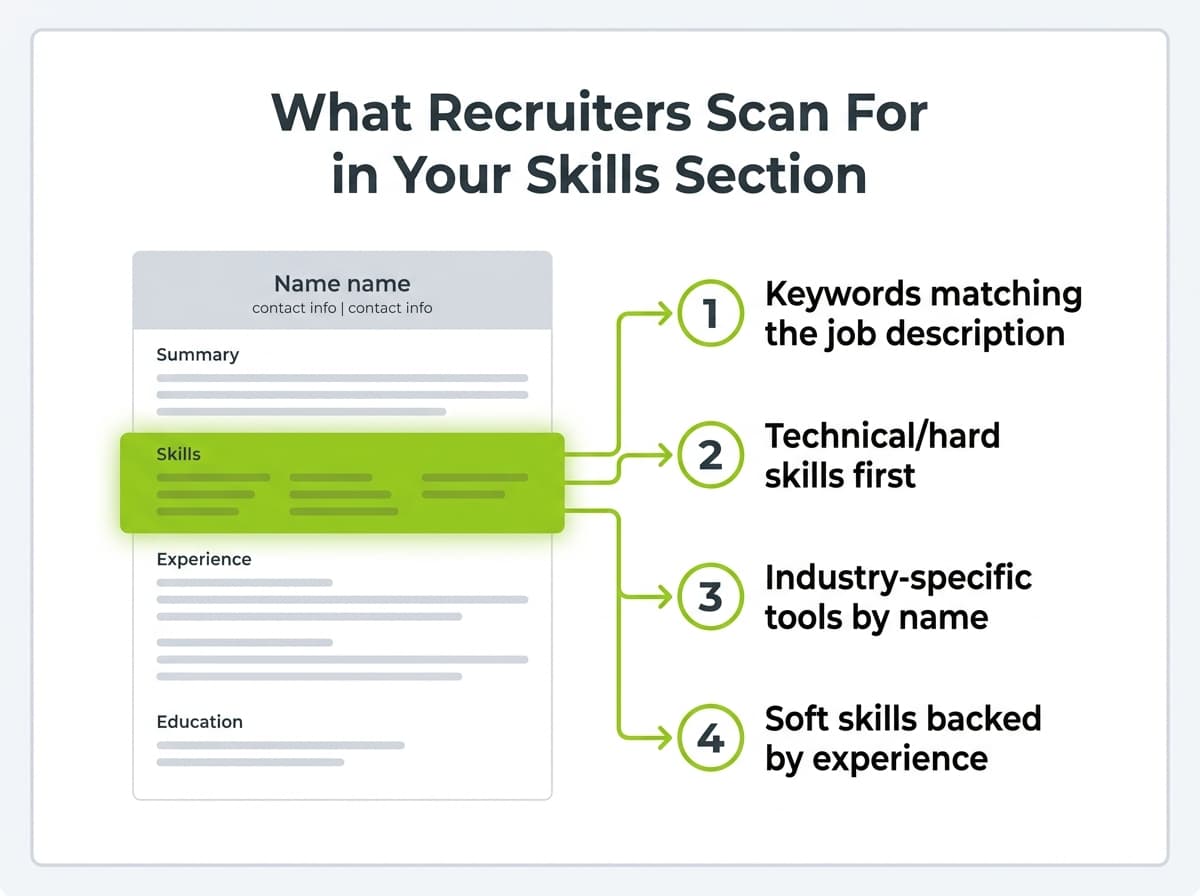
Les recruteurs consacrent remarquablement peu de temps à l'examen de chaque CV avant de prendre une première décision. Pendant ce bref instant, ils cherchent des qualifications précises qui correspondent au poste, et la rubrique compétences est l'endroit où la plupart d'entre eux regardent en premier.
Les recruteurs évaluent à la fois les compétences techniques (hard skills) et les compétences relationnelles (soft skills). Une rubrique compétences bien structurée leur permet d'apprécier votre adéquation d'un coup d'œil, sans avoir à fouiller dans des descriptions détaillées d'expérience professionnelle. Elle vous aide à vous démarquer des autres candidats, montre ce que vous apportez à l'organisation et met en lumière exactement les qualifications que l'entreprise recherche. Lorsque deux candidats ont des niveaux d'expérience et des parcours techniques similaires, les soft skills font souvent la différence.
Pour comprendre la différence, comparez ces deux versions de la même rubrique compétences d'un candidat :
Avant (générique, non adaptée) :
Compétences : Microsoft Office, travail d'équipe, communication, travailleur assidu, résolution de problèmes, leadership
Après (adaptée à un poste de Digital Marketing Manager) :
Compétences clés : stratégie SEO et SEM, Google Analytics 4, marketing de contenu, direction d'équipe transversale, tests A/B, HubSpot CRM, publicité social payante (Meta Ads, LinkedIn Ads)
La première version n'apprend presque rien au recruteur. La seconde reflète le langage qu'un recruteur rechercherait réellement, et elle signale des aptitudes précises et mesurables plutôt que de vaines autoévaluations. La suite de ce guide vous montre comment construire une rubrique compétences comme le second exemple pour n'importe quel poste. Pour une vue plus large de la façon dont chaque section d'un CV s'articule, consultez notre guide sur l'anatomie d'un CV.
Pourquoi cela aide avec l'ATS (logiciels de suivi des candidatures)
Au-delà de séduire les examinateurs humains, votre rubrique compétences joue un rôle essentiel avec les logiciels de suivi des candidatures (ATS), le logiciel qui trie et classe les CV avant même qu'un recruteur ne les voie.
L'ampleur de l'adoption des ATS est difficile à exagérer. Selon Select Software Reviews, près de 99 % des entreprises du Fortune 500 utilisent une plateforme ATS, et 75 % des recruteurs s'appuient sur un ATS ou une technologie de recrutement similaire pour filtrer les candidats. Le logiciel compare votre CV à l'offre d'emploi et classe les candidats selon la qualité de la correspondance de leurs qualifications.
Votre rubrique compétences est l'une des parties les plus compatibles avec les ATS de votre CV, pour trois raisons. Premièrement, les analyseurs ATS cherchent un intitulé de section standard comme "Compétences" ou "Compétences clés" pour localiser vos qualifications, si bien qu'une section clairement nommée garantit que le logiciel trouve ce dont il a besoin. Deuxièmement, la section vous offre un bloc concentré de mots-clés qui correspondent à l'offre d'emploi, ce qui rend ces termes faciles à détecter tant pour l'algorithme que pour l'examinateur humain qui lit votre CV ensuite. Troisièmement, la rubrique compétences est la partie de votre CV la plus facile à personnaliser pour chaque candidature. Au lieu de réécrire toute votre expérience professionnelle, vous pouvez échanger quelques compétences pour vous aligner sur chaque nouvelle offre d'emploi.
Considérez votre rubrique compétences comme un pont de mots-clés : elle satisfait les filtres ATS qui déterminent si votre CV apparaît dans la recherche d'un recruteur, et elle donne au recruteur un aperçu rapide de vos qualifications dès qu'il ouvre le document.
Quels types de compétences inclure
Votre CV gagne en pertinence lorsque vous savez mettre en valeur les bonnes aptitudes. Les employeurs recherchent des candidats qui apportent un mélange équilibré de différents types de compétences. Cette combinaison montre à la fois la capacité technique et l'efficacité au travail.
Hard skills vs. soft skills
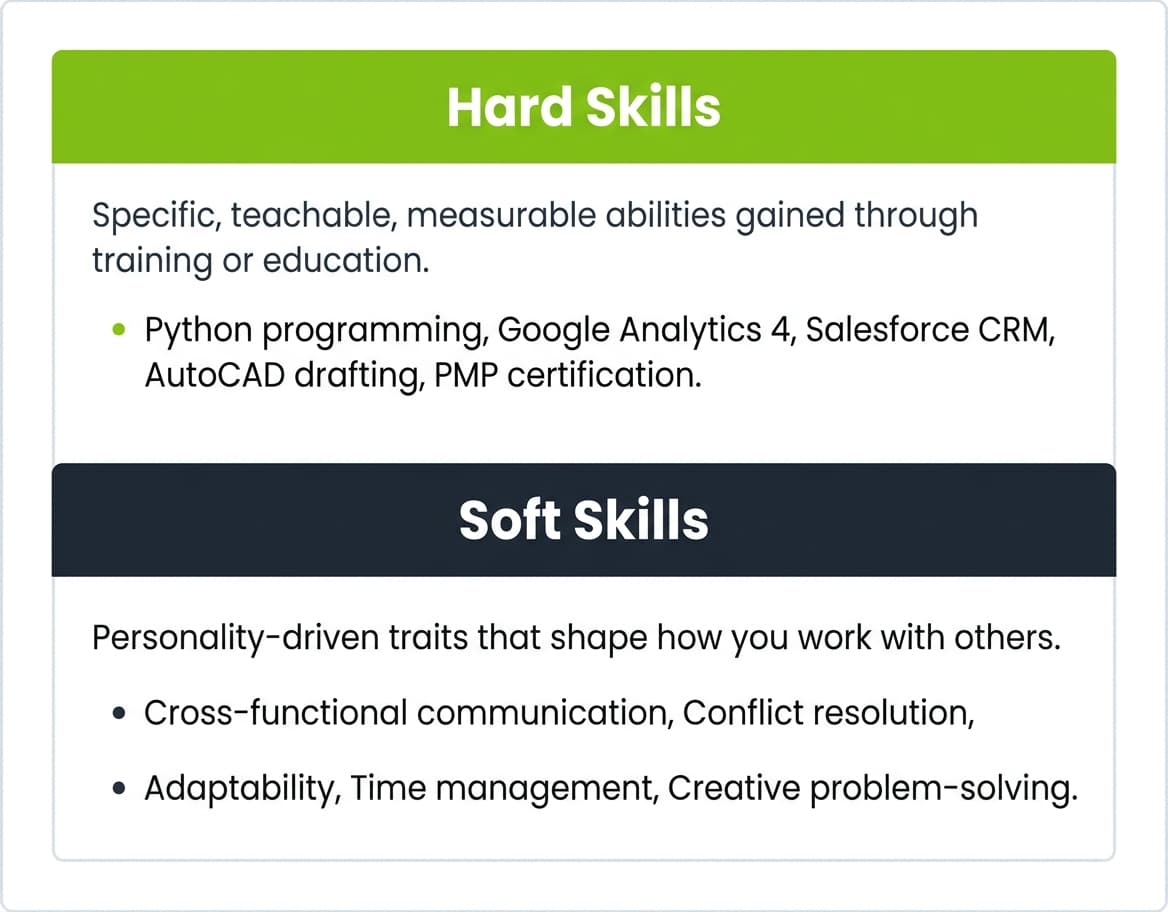
Les hard skills sont des aptitudes précises et enseignables que vous pouvez quantifier et mesurer. Vous les acquérez généralement par une formation formelle, des programmes de perfectionnement ou une expérience pratique. En voici des exemples : des langages de programmation comme Python ou JavaScript, l'analyse de données dans Excel ou Tableau, des certifications comme PMP ou AWS Solutions Architect, et la maîtrise d'outils comme Salesforce ou AutoCAD. Ces aptitudes propres à un métier prouvent votre expertise dans un domaine précis et sont généralement la première chose que recherche un filtre à mots-clés ATS.
Les soft skills reflètent vos traits de personnalité et votre capacité à travailler avec les autres. La communication, le travail d'équipe, l'adaptabilité et la résolution de problèmes entrent toutes dans cette catégorie. Elles prennent plus de temps à se développer, car elles naissent de l'expérience plutôt que d'un cours, et elles sont plus difficiles à mesurer dans un processus de filtrage. Malgré cela, les employeurs les valorisent de plus en plus. Une étude de Wonderlic a révélé que 93 % des responsables du recrutement considèrent les soft skills comme un facteur "essentiel" ou "très important" dans les décisions d'embauche, et beaucoup ont indiqué que les soft skills comptent encore plus que les aptitudes techniques lors de l'évaluation des candidats.
Sur un CV, les hard skills et les soft skills jouent des rôles différents. Les hard skills vous font passer le filtre ATS. Les soft skills convainquent le recruteur humain que vous réussirez réellement dans le poste. Une rubrique compétences solide inclut les deux. Voici à quoi ressemblent les deux catégories en pratique pour un chef de projet :
Hard skills : méthodologie Agile/Scrum, Jira, Microsoft Project, budgétisation et prévision, évaluation des risques
Soft skills : communication avec les parties prenantes, résolution de conflits, direction d'équipe transversale, gestion du temps
Compétences transférables
Les compétences transférables sont des qualifications portables qui restent utiles quel que soit le secteur ou le poste vers lequel vous évoluez. Vous les développez par un mélange d'emplois antérieurs, de bénévolat, de formation et de la vie quotidienne. La résolution de problèmes, la gestion du temps, l'adaptabilité et la communication sont toutes transférables, et elles sont précieuses dans pratiquement tout environnement professionnel.
Prenez un vendeur en commerce de détail qui passe deux ans à résoudre les réclamations des clients, à gérer les retours sous pression et à former les nouveaux venus. Chacune de ces aptitudes se transpose directement dans un poste en contact avec la clientèle dans la technologie, la santé ou les services financiers. Sur un CV, la rubrique compétences est l'endroit où vous rendez ce lien explicite pour le recruteur.
Les données confirment cette importance des aptitudes transférables. Selon l'étude Global Talent Trends de LinkedIn, 57 % des cadres dirigeants valorisent désormais les soft skills plus que les hard skills lors de l'évaluation des candidats. Une recherche menée par le Stanford Research Institute International et la Carnegie Foundation, fondée sur des entretiens avec des PDG du Fortune 500, a établi que 75 % de la réussite professionnelle à long terme dépend des aptitudes humaines, seuls 25 % étant attribuables aux connaissances techniques.
Compétences propres au secteur
L'expertise liée au secteur aide les candidats à se démarquer sur des marchés concurrentiels. Ces aptitudes spécialisées diffèrent d'un domaine à l'autre et montrent votre connaissance particulière d'un secteur précis.
Les professionnels de la santé ont besoin d'aptitudes comme l'évaluation des patients, le codage médical (ICD-10, CPT) et les dossiers médicaux électroniques (Epic, Cerner). Les travailleurs de la technologie doivent démontrer une maîtrise des langages de programmation, de l'infrastructure cloud et des cadres de cybersécurité. Les employeurs de tous les secteurs accordent désormais une plus grande priorité aux aptitudes spécialisées qui correspondent directement à leurs besoins opérationnels ; ainsi, indiquer des compétences propres au secteur sur votre CV signale que vous comprenez les exigences quotidiennes du poste, pas seulement le concept général.
Une rubrique compétences solide équilibre les trois types. Vous pourriez énumérer des aptitudes techniques comme la maîtrise d'un logiciel précis, des qualités relationnelles comme la communication avec les parties prenantes, et des compétences transférables comme la gestion de projet qui montrent votre adaptabilité selon les contextes. Différents postes appellent des accents différents. Un poste en ingénierie logicielle pourrait pondérer 70 % de hard skills et 30 % de soft skills, tandis qu'un poste d'encadrement pourrait inverser ce rapport. Prenez le temps de repérer vos aptitudes les plus fortes dans chaque catégorie avant d'adapter la section pour chaque candidature.
Comment choisir les bonnes compétences
La rubrique compétences de votre CV peut faire ou défaire vos chances de décrocher un entretien. Beaucoup de candidats ne prennent pas le temps de personnaliser cette section essentielle pour chaque candidature. Je peux vous aider à créer une rubrique compétences qui séduit à la fois les recruteurs et les logiciels de suivi des candidatures.
Lisez attentivement l'offre d'emploi
L'offre d'emploi est votre principal guide pour choisir les compétences. Commencez par lire l'annonce du début à la fin, en prêtant une attention particulière aux sections "Exigences" et "Qualifications" où apparaissent les mots-clés les plus importants. Les compétences qui reviennent plusieurs fois, ou qui sont étiquetées "requises" plutôt que "souhaitées", vous disent exactement ce qui compte le plus pour l'équipe de recrutement.
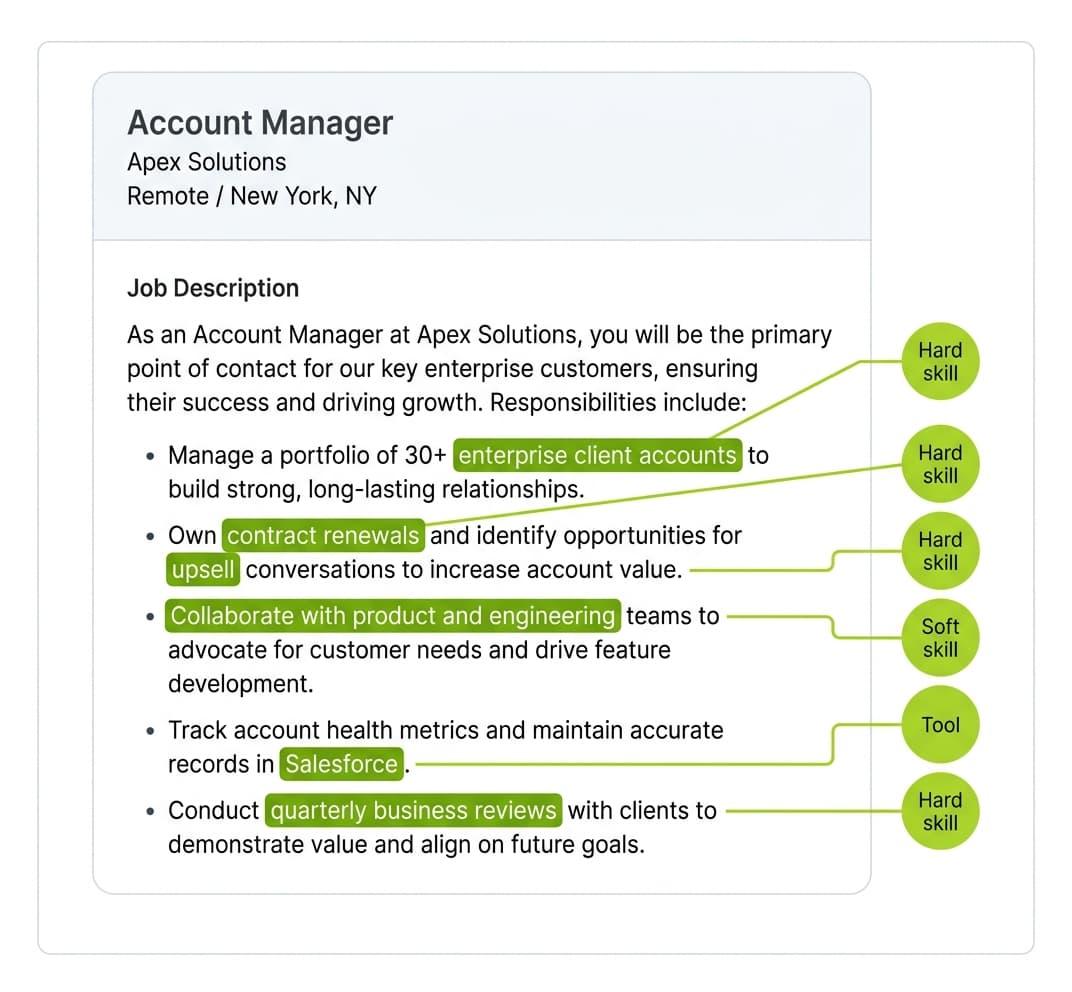
Regardez aussi au-delà des compétences explicitement citées. Chaque phrase décrivant une responsabilité suggère des aptitudes que vous devriez inclure. Voici un exemple concret de la façon d'extraire des compétences d'une offre d'emploi :
Extrait d'une offre d'emploi type (poste d'Account Manager) :
"Gérer un portefeuille de plus de 30 comptes clients grands comptes. Piloter les renouvellements de contrats et les conversations de montée en gamme. Collaborer avec les équipes produit et ingénierie pour résoudre les problèmes des clients. Suivre les indicateurs de santé des comptes dans Salesforce et présenter des revues d'activité trimestrielles aux parties prenantes."
Compétences à extraire de cette annonce :
gestion de comptes, Salesforce CRM, négociation de contrats, montée en gamme, collaboration transversale, gestion de la relation client, reporting fondé sur les données, présentations aux parties prenantes
Remarquez que "collaboration transversale" et "présentations aux parties prenantes" ne figurent explicitement comme compétences nulle part dans l'annonce, mais les responsabilités les exigent clairement. Indiquez toujours à la fois les hard skills (Salesforce, négociation de contrats) et les soft skills (collaboration, gestion de la relation client) que vous trouvez. Cette approche d'extraction détaillée vous donne une correspondance précise avec ce dont l'employeur a réellement besoin, plutôt que de vous forcer à deviner. Pour accélérer ce processus, essayez notre générateur de compétences pour CV qui extrait automatiquement les mots-clés pertinents de n'importe quelle offre d'emploi.
Utilisez les mots-clés de l'offre d'emploi
Pret a decrocher votre emploi de reve ?
Rejoignez plus de 50 000 chercheurs d'emploi qui ont deja transforme leur carriere avec notre createur de CV propulse par l'IA.