Recevoir sa lettre de licenciement est un choc, même quand on le sentait venir. En Suisse, la bonne nouvelle est que la loi encadre précisément ce qui peut et ne peut pas se passer. Le Code des obligations fixe les délais de congé, protège contre certains renvois et vous ouvre un filet de sécurité via l'assurance-chômage. La mauvaise nouvelle, c'est que les délais courent vite et que quelques jours de retard peuvent vous coûter des semaines d'indemnités. Ce guide vous explique vos droits, la différence entre un licenciement ordinaire, abusif et immédiat, et surtout les démarches à faire dès le premier jour pour ne rien perdre. Je suis Nishant Modi, fondateur de Careerkit, basé à Zurich, et j'accompagne des candidats sur le marché suisse depuis des années.
Le cadre légal du licenciement en Suisse
En Suisse, le contrat de travail de durée indéterminée repose sur la liberté de résiliation : chaque partie peut y mettre fin en respectant le délai de congé. L'employeur n'a pas besoin d'un motif valable pour licencier, contrairement à ce que beaucoup croient. Ce qui compte, c'est la forme et le délai. Un renvoi reste valable même sans justification, sauf s'il tombe dans les cas d'abus ou de résiliation en temps inopportun décrits plus bas.
Licenciement ordinaire, abusif ou immédiat
Il existe trois régimes très différents. Le licenciement ordinaire respecte le délai de congé légal ou contractuel. Le licenciement abusif (art. 336 CO) reste valable mais donne droit à une indemnité, car son motif est prohibé. Le licenciement immédiat (art. 337 CO) met fin au contrat sur-le-champ, sans délai, mais uniquement pour de justes motifs graves. Savoir dans quelle catégorie vous vous trouvez détermine vos droits et vos options.
Avant toute chose, relisez votre contrat et votre convention collective éventuelle : elles peuvent prévoir des délais plus longs que le minimum légal. Si vous devez rebondir vite, un CV suisse à jour est votre premier levier, et notre guide du CV suisse détaille les attentes locales.
Les délais de congé (délais de congé) selon le Code des obligations
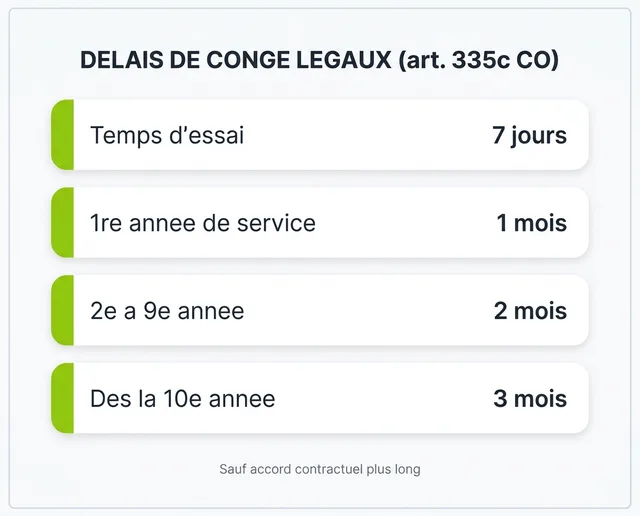
Le délai de congé est la période entre le moment où le congé est notifié et la fin effective des rapports de travail. L'article 335c CO fixe des minimums légaux qui s'appliquent en l'absence d'accord contractuel différent. Ces délais sont le socle de tous vos calculs.