Anschreiben 2026: How to Write a German Cover Letter
How to write a German Anschreiben for jobs in Germany: DIN 5008 structure, phrasing examples, before/after templates and the mistakes to avoid in 2026.
If you are applying for a job in Germany, the Anschreiben (cover letter) is not optional. Even when the job ad calls it "freiwillig" or "optional", most German hiring managers still expect one and use it as a second filter alongside your CV. This guide walks you through the DIN 5008 structure, the phrasing that works, and the mistakes that cost interviews.
If you want to start straight away, you can build your Anschreiben step by step in the CareerKit cover letter editor and match it to the same layout as your CV. First, though, we cover what actually belongs on the page and why.
Why the Anschreiben still decides applications in Germany
In Anglo-Saxon markets, the cover letter is increasingly treated as optional. Germany is different. Here, the Anschreiben remains standard across most industries, and its absence reads as carelessness.
What German recruiters expect from a cover letter
Your CV delivers facts. Your Anschreiben delivers reasoning, motivation, and personality. The University of Zurich Career Services frames it cleanly: by the end of the letter, the reader should know why you are applying, which requirements you fulfil, what distinguishes you from other applicants, and why you fit the company. Four questions, one page, clear answers.
Studies on recruiter behaviour show how little time you have. An eye-tracking study by Ladders, reported by HR Dive, found an average of 7.4 seconds for the initial scan of a CV. Cover letters get a similar quick first read. Recruiters scan the opening line, jump to the closing paragraph, and decide in under a minute whether a closer read is worth their time.
When it is mandatory and when optional
In Germany, the Anschreiben is effectively mandatory. iamexpat.de notes for international applicants that most hiring managers expect a cover letter even when the job posting does not explicitly require one. Applications without an Anschreiben look incomplete and are often screened out by HR teams before a hiring manager sees them.

There are exceptions. Specialised tech recruiters and some start-ups accept applications via LinkedIn Easy Apply without a cover letter. Internal applications often work with a short email. For classical permanent roles, the public sector, manufacturing, and the Mittelstand, the Anschreiben remains expected.
Anschreiben versus Motivationsschreiben
The two documents are often confused but are different. An Anschreiben (also called Bewerbungsschreiben) accompanies job applications and focuses on qualifications, experience, and fit for the specific role. A Motivationsschreiben accompanies university applications, scholarships, and PhD applications, and goes deeper into academic goals, personal drivers, and life choices. Confuse them and the mistake shows immediately.
Structure of an Anschreiben
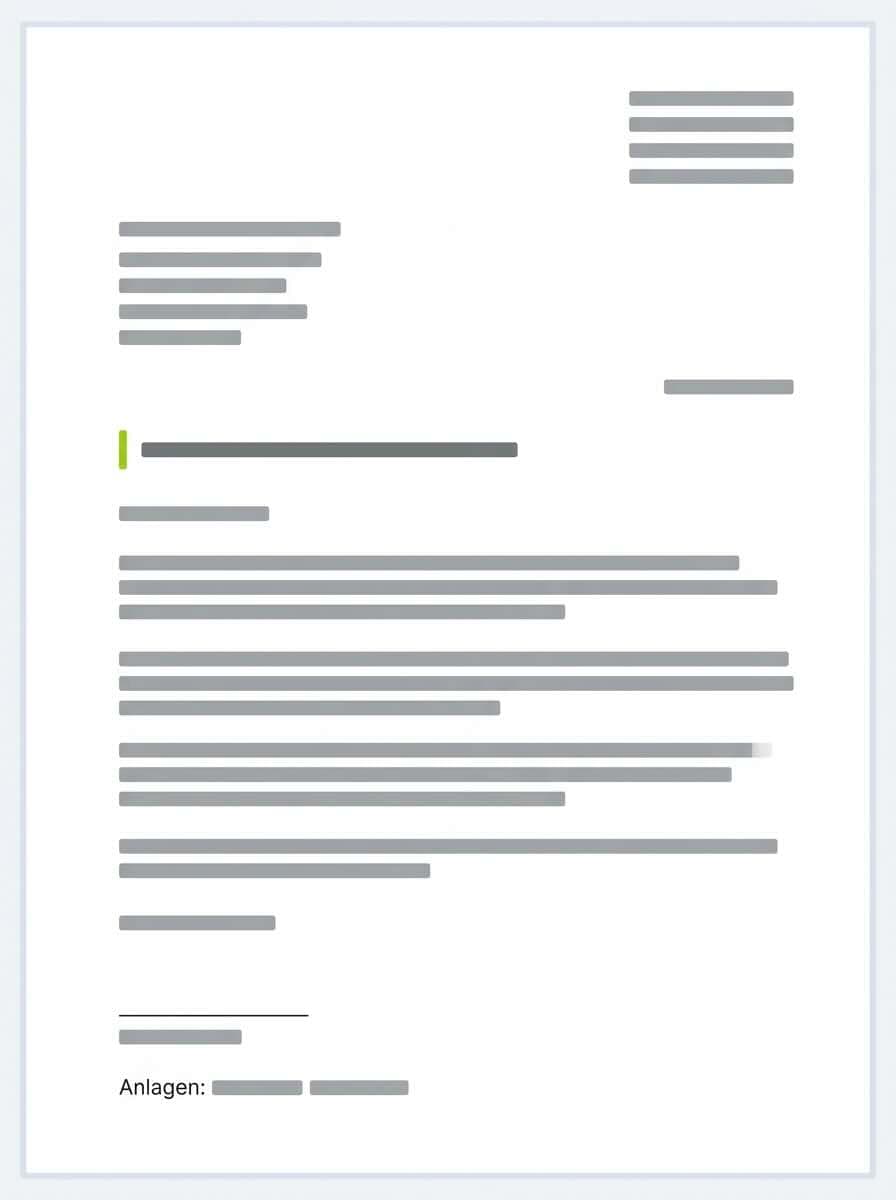
The Anschreiben follows the structure of a German business letter under DIN 5008. This structure is not a matter of taste. Departing from it tells the reader you do not know the local norm.
Sender and recipient block
The header contains your full contact details: first and last name, street and house number, postcode and city, phone number, and a professional email address. Style this block in the same layout as your CV so the application reads as one cohesive package. A full breakdown of the matching CV format is in the anatomy of a resume guide.
Below your contact block, the recipient details sit left-aligned: company name, the specific contact person (if known), department, street, postcode, and city. Right-aligned at the same height: the city you are writing from, plus the current date in DD.MM.YYYY format.
Here is what it looks like in practice:
Anna Berger Hauptstraße 14, 60311 Frankfurt am Main anna.berger@email.de | +49 175 1234567
Müller AG Personalabteilung, Herr Thomas Schmidt Bahnhofstraße 22 10115 Berlin
Frankfurt am Main, 13.05.2026
Date and subject line
The subject line sits two lines below the recipient block, left-aligned and bold. Do not write "Betreff" or "Subject" or "Re:" at the start. That is considered outdated. Instead, state the purpose of your letter directly and, if available, include the job reference number.
A weak subject line looks like this:
Bewerbung
And here is how it reads when it does some work:
Bewerbung als Projektmanagerin im Bereich Digital Transformation, Referenz DT-2026-042
Salutation
Address the letter to a specific person whenever possible. Writing "Sehr geehrte Damen und Herren" (Dear Sir or Madam) signals to the reader that you did not bother to look up who would handle the application. The University of Zurich Career Services explicitly recommends calling the company briefly to ask for the relevant HR contact if it is not in the job ad.
The standard phrasing is "Sehr geehrte Frau Schmidt" (Dear Ms. Schmidt) or "Sehr geehrter Herr Müller" (Dear Mr. Müller). Note the comma after the salutation and the lowercase letter that follows on the next line, which is the German convention. Only fall back to "Sehr geehrte Damen und Herren" when research genuinely turns up nothing.
Opening sentence
The opening sentence decides whether the rest of your Anschreiben gets read. Skip standard phrases like "Hiermit bewerbe ich mich" (I hereby apply) or "Mit großem Interesse habe ich Ihre Stellenanzeige gelesen" (I read your job ad with great interest). These phrases appear in roughly nine of ten cover letters and tell the reader nothing about you.
A weak opening reads:
Hiermit bewerbe ich mich auf die ausgeschriebene Stelle als Projektmanagerin in Ihrem Unternehmen. (I hereby apply for the advertised Project Manager position at your company.)
Ready to land your dream job?
Join 50,000+ job seekers who have already transformed their careers with our AI-powered resume builder.