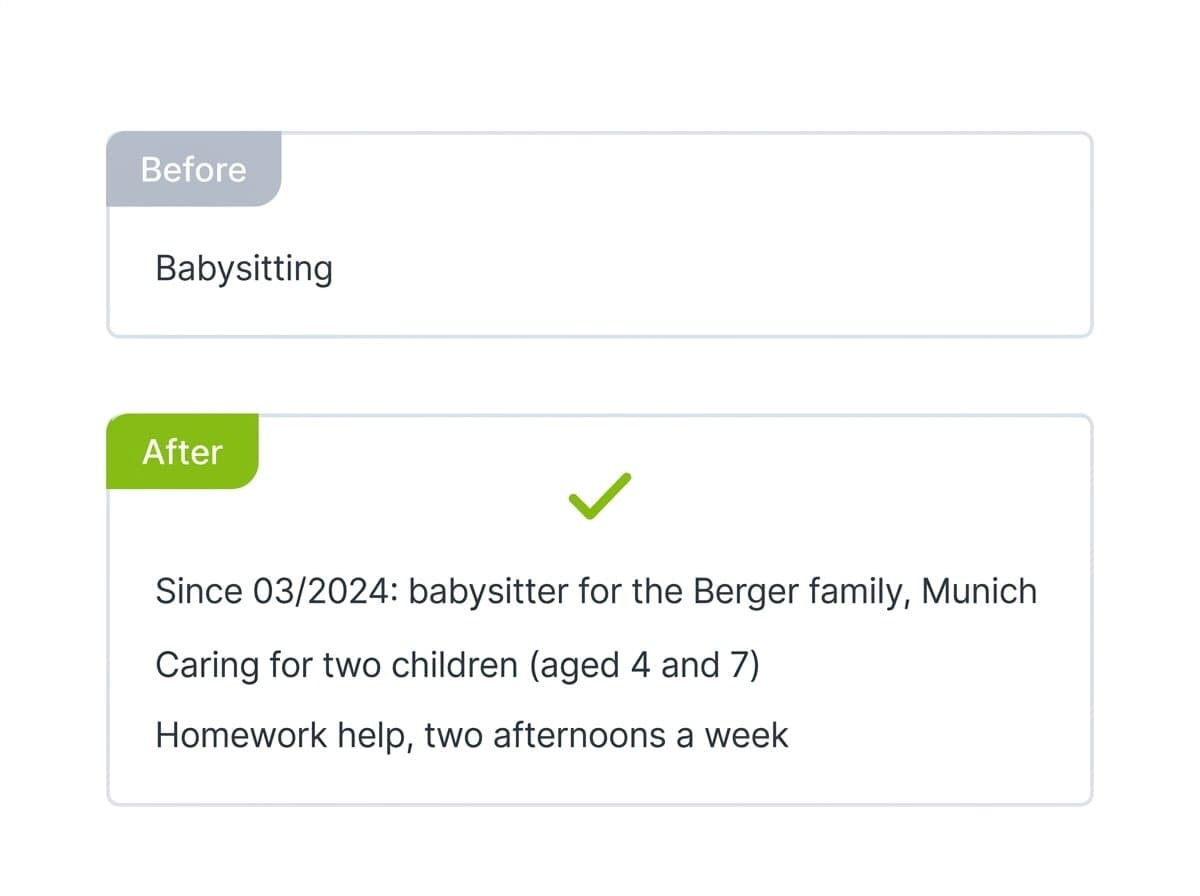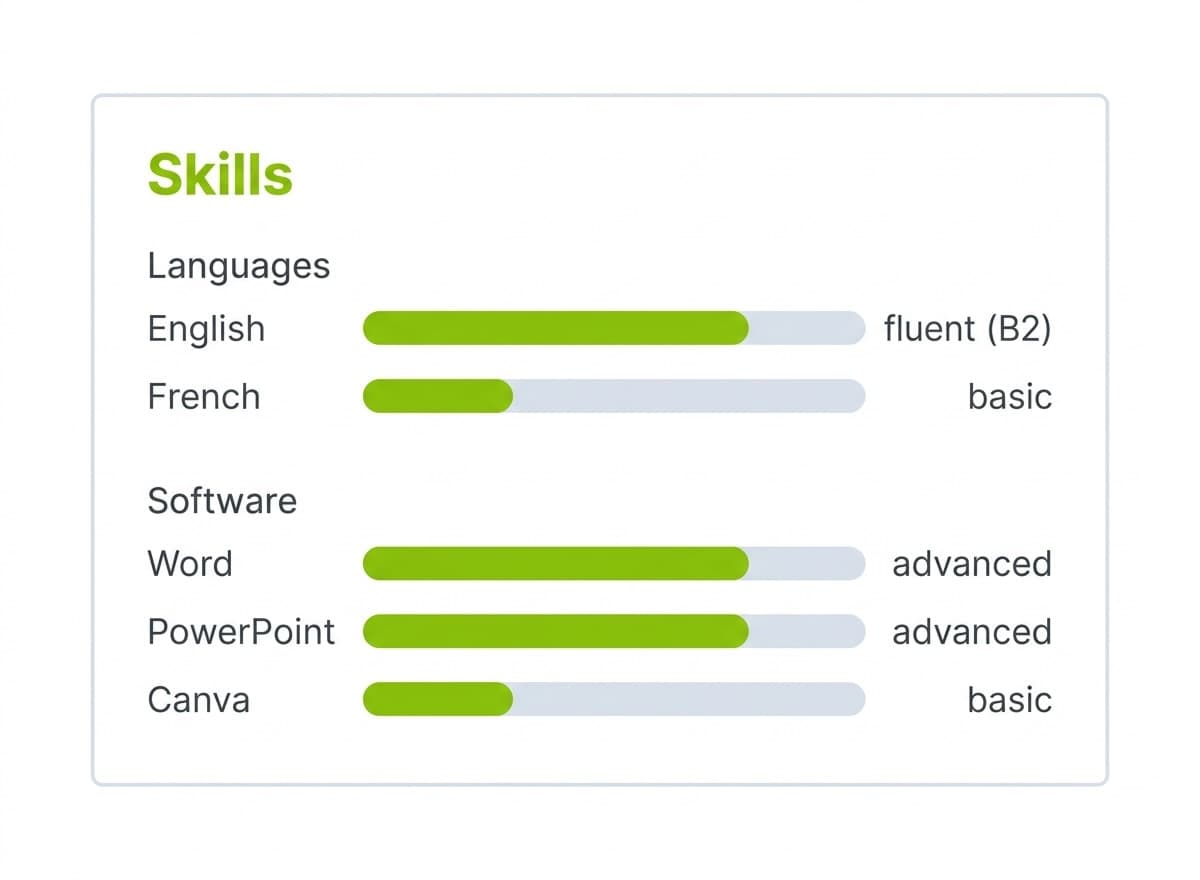
When you apply for a student internship, your CV usually lands on the recruiter's desk first. It is the heart of your application and shows at a glance who you are, what you can do, and what you have done so far. A cleanly built CV also proves, in passing, that you put in effort and genuinely want the internship.
But how do you write a convincing table-format CV when you have hardly any experience yet? That is exactly what we will work through here. You will learn step by step which sections belong in it, how to format them, and how to stand out from the crowd with concrete examples drawn from real before-and-after comparisons.
What Goes Into Your CV for a Student Internship?
A table-format CV consists of several sections that together build a complete picture of you. Each has a clear function, and you build them all in reverse chronological order, with the most recent entry first.
Personal Details and Contact
At the very top go your full first and last name, your address, your phone number with area code, and your email. A professional address built from your first and last name, such as max.mueller@mail.de, matters here. An address like cutie05@mail.com gets you sorted out faster than you would like. Date and place of birth are optional, though still common in applications for student internships.
Education and Current Standing
Education is your most important section, because that is where most of your substance sits. Start with your current school and work backward. For each, give the period, the type of school, and the location. For the current school, add your year, the qualification you are working toward, and, if it is good, your grade average. A bare one-liner says very little.
Before: "Grammar school, since 2019"
After: "Since 09/2019: Max Planck Grammar School, Sample City, currently year 9, target qualification Abitur 2027, grade average 2.1, advanced subjects physics and computer science."
The second version tells the company in a single line where you stand and where your strengths lie.