Compétences en communication sur un CV : exemples | Careerkit
Accueil/Blog/Guide/Compétences en communication sur un CV : exemples
Guide
Compétences en communication sur un CV : exemples
Compétences en communication sur un CV : celles que recherchent les recruteurs, où les indiquer et des exemples de puces qui les prouvent avec des résultats réels.
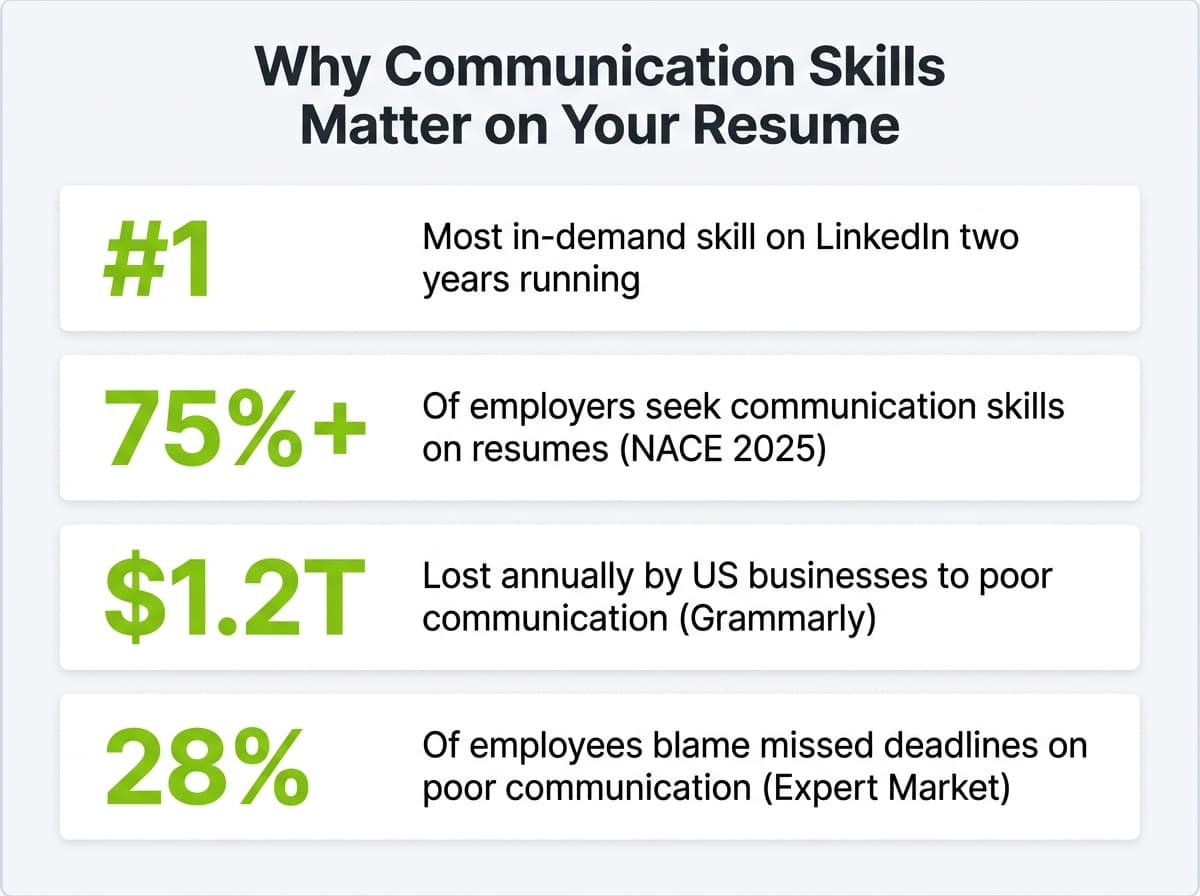
Chaque CV affirme d'« excellentes compétences en communication », mais cette formule à elle seule ne vous décrochera pas d'entretien. Selon le rapport de LinkedIn sur les compétences les plus recherchées, la communication est la compétence numéro un recherchée par les employeurs deux années de suite. Et l'enquête NACE Job Outlook 2025 a révélé que plus de 75 % des employeurs recherchent expressément des compétences en communication sur les CV, les plaçant au même rang que la résolution de problèmes et le travail d'équipe.
Le coût d'une mauvaise communication est vertigineux. Des recherches de Grammarly et The Harris Poll estiment que les entreprises américaines perdent 1 200 milliards de dollars par an à cause d'une communication inefficace au travail, soit environ 12 506 dollars par employé et par an. C'est pourquoi les recruteurs ne veulent pas seulement lire le mot « communicant » sur votre CV. Ils veulent des preuves.
Ce guide détaille les compétences en communication précises que recherchent les recruteurs en 2026, vous montre comment repérer vos plus fortes et vous explique exactement comment les présenter sur votre CV avec de vrais exemples et des résultats mesurables.
Qu'est-ce que les compétences en communication et pourquoi comptent-elles
Les compétences en communication vont bien au-delà du fait de parler clairement en réunion. Elles englobent toutes les manières dont vous partagez et recevez de l'information au travail, de la rédaction d'un e-mail à la lecture du langage corporel lors d'une négociation. Voici un aperçu de ce que ces compétences recouvrent réellement et des données solides qui expliquent pourquoi les employeurs les valorisent autant.
La réussite professionnelle dans le monde du travail actuel repose sur les compétences en communication. Ces compétences aident les personnes à partager des informations avec les autres, dans un cadre personnel comme professionnel. Les compétences en communication ne sont pas une seule compétence : elles forment un ensemble complet d'outils qui permettent de transmettre clairement des idées, des informations et des émotions.
L'National Association of Colleges and Employers (NACE) définit cette compétence d'employabilité comme la capacité à partager des informations de façon claire et efficace avec les personnes à l'intérieur et à l'extérieur d'une organisation, y compris des idées, des faits et des points de vue professionnels. Cette définition montre que ces compétences vont bien au-delà du simple fait de bien parler.
Les composantes d'une communication efficace
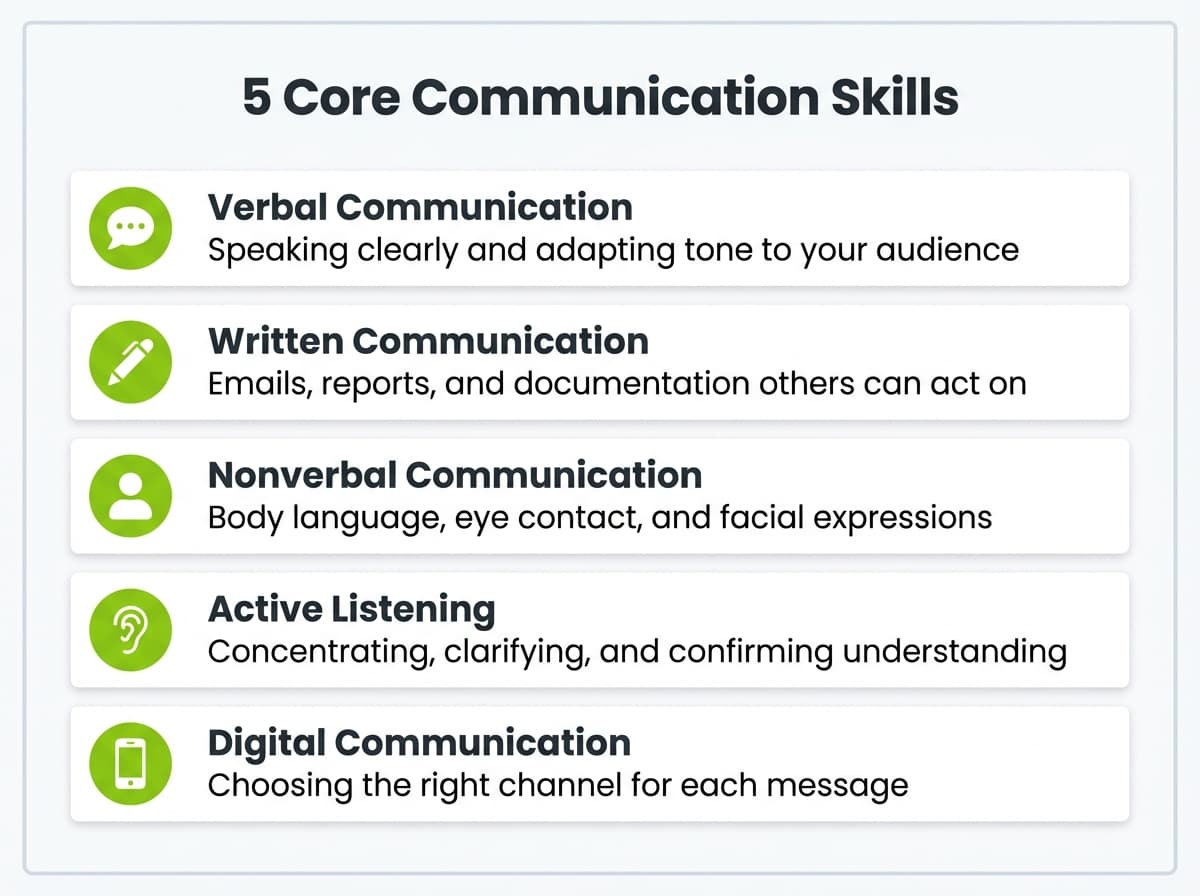
Une bonne communication regroupe plusieurs aptitudes reliées qui fonctionnent ensemble. La communication verbale consiste à parler clairement et à adapter votre ton, votre rythme et votre choix de mots selon les publics, que vous présentiez devant des dirigeants ou expliquiez un processus à une nouvelle recrue. La communication écrite couvre tout, de la rédaction d'e-mails concis à la production de rapports détaillés, de propositions et de documentations que d'autres pourront consulter plus tard.
La communication non verbale joue un rôle d'appui à travers le langage corporel, les expressions du visage, la posture et le contact visuel. Ces signaux peuvent renforcer votre message oral ou, s'ils ne concordent pas, le saper complètement. L'écoute active va au-delà du simple fait d'entendre des mots. Elle exige une concentration totale, des réponses réfléchies et des questions de clarification qui montrent à votre interlocuteur que vous comprenez vraiment son propos.
Enfin, la communication numérique est devenue une catégorie à part entière dans le monde du travail moderne. Choisir le bon canal pour le bon message, qu'il s'agisse d'un message Slack rapide, d'un e-mail formel ou d'un appel vidéo, est une compétence qui distingue les communicants efficaces des autres.
Pourquoi les compétences en communication comptent
Ces compétences vont bien au-delà de simples interactions au travail. L'enquête NACE Job Outlook 2024 a révélé que près de 90 % des employeurs attendent des candidats des capacités de résolution de problèmes, et qu'environ 80 % recherchent de solides aptitudes au travail d'équipe. Au moins deux tiers des employeurs recherchent aussi des candidats dotés de compétences écrites et orales, plaçant ces qualités parmi les principaux critères de toute grille de recrutement.
Une mauvaise communication nuit à l'efficacité au travail. Une enquête d'Expert Market a révélé que 28 % des salariés citent une mauvaise communication comme la raison pour laquelle ils n'ont pas pu livrer leur travail à temps. Selon le rapport State of Business Communication de Grammarly, les entreprises américaines perdent environ 1 200 milliards de dollars par an à cause d'une communication inefficace.
Une communication solide crée un effet d'entraînement dans tous les aspects de votre vie professionnelle. Les équipes qui communiquent bien collaborent plus efficacement, car les malentendus diminuent et chacun reste aligné sur des objectifs communs. Sur le plan individuel, une communication claire instaure la confiance et des liens sincères avec les collègues, ce qui crée le type d'environnement de travail positif dans lequel les gens ont envie de rester.
La clarté des objectifs est un autre avantage direct. Lorsque les salariés comprennent exactement ce que l'on attend d'eux, ils obtiennent de meilleurs résultats, et cette clarté renforce à la fois la satisfaction au travail et le moral de l'équipe. Votre style de communication a aussi un impact direct sur votre évolution de carrière. Que vous présentiez un rapport trimestriel à la direction, négociiez une promotion ou développiez votre réseau lors d'un événement professionnel, votre manière de communiquer façonne la perception que les autres ont de votre compétence et de votre potentiel.
Plus important encore, la communication est au cœur de la résolution de problèmes. L'écoute active vous aide à comprendre la cause d'un problème, et une formulation claire des idées vous aide à rallier une équipe autour d'une solution. Une cheffe de projet capable de transformer la frustration vague d'un client en un plan d'action concret pour l'équipe technique vaut bien plus que quelqu'un qui se contente de transmettre des messages.
Voici ce que cela donne en pratique. Imaginez deux chefs de projet gérant un lancement de produit retardé. Le premier envoie un e-mail d'une ligne : « Le lancement est retardé, nouvelle date à venir. » Le second rédige une brève mise à jour expliquant la raison du retard, le calendrier révisé et les prochaines étapes précises pour chaque membre de l'équipe. L'équipe du second chef de projet sait exactement quoi faire, reste motivée et respecte le nouveau délai. L'équipe du premier passe les deux jours suivants à poser des questions et perd son élan. Même situation, communication différente, résultat totalement différent.
Les chercheurs d'emploi doivent démontrer ces compétences, et savoir où placer chaque section de votre CV est la première étape pour y parvenir efficacement. NACE cite la communication parmi les principales compétences d'employabilité dont les futurs salariés ont besoin pendant leur recherche d'emploi. Bien communiquer aide les autres à percevoir clairement votre valeur et votre potentiel.
Les organisations profitent elles aussi de salariés dotés de bonnes compétences en communication. Un meilleur partage de l'information améliore la collaboration. Cela aide à prendre des décisions plus judicieuses, favorables aux résultats de l'entreprise.
Les principaux types de compétences en communication pour un CV
Selon une étude d'oculométrie menée par Ladders en 2018, les recruteurs consacrent en moyenne 7,4 secondes à une première lecture rapide d'un CV avant de décider s'ils poursuivent. Ces quelques secondes sont votre fenêtre pour mettre en avant les bonnes compétences en communication. Voici les types précis qui pèsent le plus auprès des recruteurs, ainsi que des conseils pour formuler chacun d'eux à l'aide du générateur de compétences Careerkit afin d'adapter votre expérience au poste.
Communication verbale
La communication verbale consiste à exprimer des idées de façon claire et assurée à l'oral. Cette compétence fondamentale englobe la manière dont vous exprimez vos pensées, présentez des informations et interagissez oralement avec les autres.
Les personnes qui excellent en communication verbale s'expriment avec clarté et précision. Elles rendent des informations complexes accessibles à différents publics et adaptent leur style selon la situation et l'auditoire. Sur un CV, cela se traduit par des compétences comme la prise de parole en public et la présentation, la communication interpersonnelle, la persuasion et la négociation, ainsi que l'assurance de partager clairement des idées dans des situations à fort enjeu.
Voici ce que cela donne sous forme de puce sur un CV :
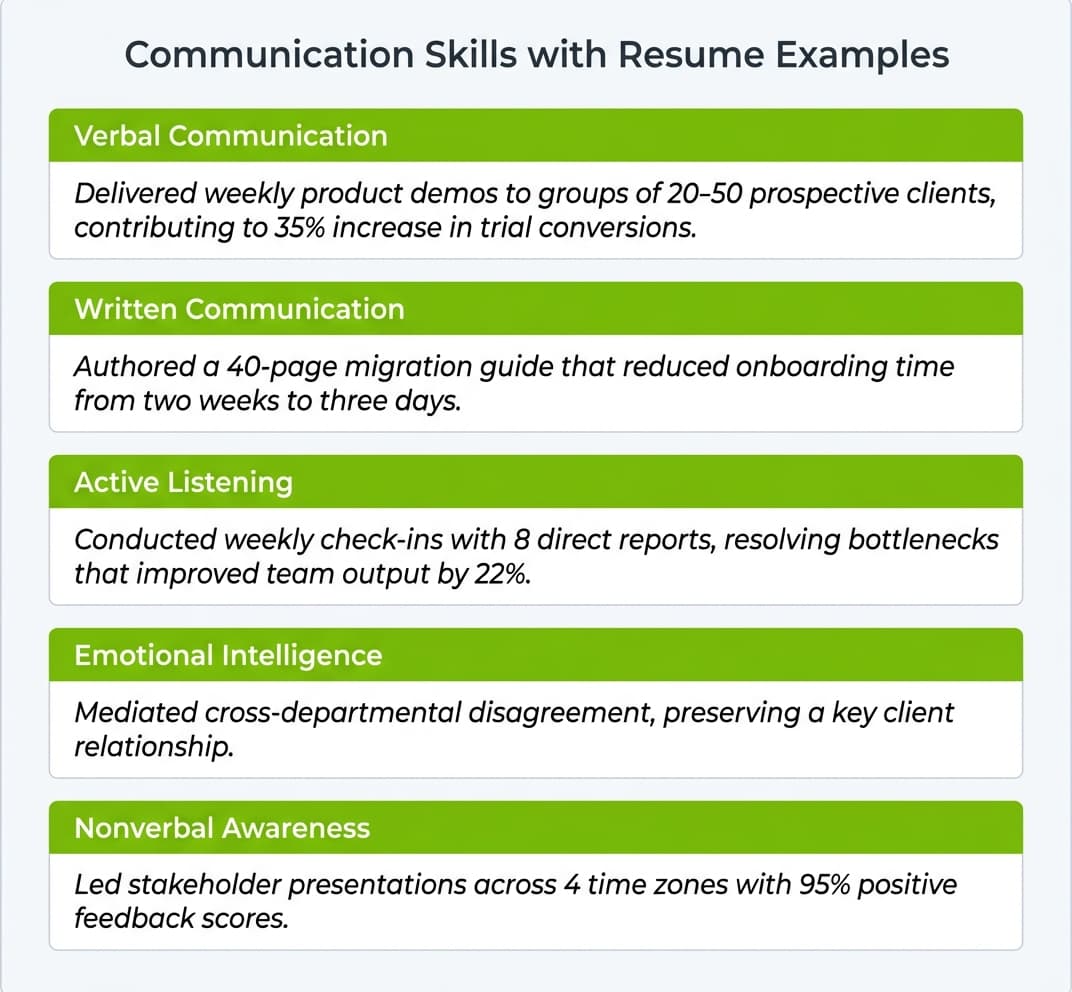
« Animé des démonstrations produit hebdomadaires auprès de groupes de 20 à 50 clients potentiels, contribuant à une hausse de 35 % de la conversion de l'essai vers l'abonnement payant sur six mois. »
Comparez cela au simple fait d'écrire « bonne communication orale ». La première version montre la compétence en action avec un résultat mesurable.
Communication écrite
Les compétences écrites vous aident à partager de l'information par le texte, des e-mails et rapports aux présentations formelles. La communication écrite laisse une trace durable que l'on peut consulter plus tard.
Une solide communication écrite sur votre CV montre que vous savez écrire de façon claire et directe, relire et corriger la grammaire et la clarté, adapter votre style selon les publics et produire des documents bien structurés que l'on utilise réellement. De nombreux environnements professionnels ont besoin de personnes capables de transformer des informations techniques complexes en un langage simple, compréhensible tant par les membres techniques que non techniques de l'équipe.
Voici un bon exemple pour un CV :
« Rédigé un guide de migration technique de 40 pages qui a réduit le temps d'intégration des nouveaux développeurs de deux semaines à trois jours. »
Et voici une version faible de la même expérience :
« Rédigé de la documentation pour l'équipe. »
La différence tient à la précision. La première version indique au recruteur exactement ce que vous avez écrit, à qui cela a servi et ce qui a changé grâce à cela.
Communication non verbale
La communication non verbale joue un rôle important dans la façon dont votre message est reçu. L'affirmation souvent citée selon laquelle « 93 % de la communication est non verbale » est en réalité une mauvaise interprétation des recherches d'Albert Mehrabian de 1967, qui ne s'appliquait qu'aux situations où les mots et les expressions du visage se contredisaient. Dans les vraies conversations au travail, les mots comptent évidemment beaucoup. Mais les signaux non verbaux comme la posture, le contact visuel et le ton de la voix façonnent tout de même la façon dont les collègues et les recruteurs perçoivent votre assurance et votre crédibilité.
La communication non verbale comprend le langage corporel, les expressions du visage, le contact visuel, la posture et les gestes. Ces éléments peuvent appuyer ou contredire votre message oral, ce qui les rend essentiels à une communication efficace.
Parmi les compétences non verbales les plus importantes dans un cadre professionnel figurent le maintien d'un contact visuel approprié pendant les échanges, l'usage de gestes intentionnels qui renforcent votre message plutôt que d'en détourner, une posture assurée, une lecture juste du langage corporel des autres et une conscience des normes d'espace personnel selon les contextes culturels. Vous ne pouvez pas indiquer « bon contact visuel » sur votre CV, mais vous pouvez démontrer votre aisance non verbale à travers des réussites comme des présentations client réussies, la gestion des parties prenantes ou la collaboration interculturelle.
Écoute active
L'écoute active, c'est bien plus que simplement entendre des mots. Vous devez vous concentrer pleinement, comprendre, répondre et retenir ce que dit une personne. Cette compétence montre que vous savez créer un lien avec les autres et instaurer la confiance.
Pour ne citer qu'un exemple, l'écoute active vous aide à comprendre les préoccupations des clients, à faire preuve d'empathie et à proposer des solutions ciblées. Cela renforce les relations professionnelles et améliore la résolution de problèmes.
Parmi les compétences d'écoute active à mettre en avant figurent une attention totale sans interrompre, des questions de clarification pour confirmer votre compréhension, la reformulation et la synthèse des points clés, des réponses réfléchies plutôt que réactives et l'attention aux signaux non verbaux qui accompagnent les messages oraux. Sur un CV, l'écoute active se manifeste par des résultats comme de meilleurs scores de satisfaction client, une résolution des conflits plus rapide ou un meilleur alignement de l'équipe après des réunions que vous avez animées.
Voici un exemple :
« Mené des points individuels hebdomadaires avec huit collaborateurs directs, repérant et résolvant les blocages du flux de travail, ce qui a amélioré la production de l'équipe de 22 %. »
Empathie et intelligence émotionnelle
L'empathie est le cœur de l'intelligence émotionnelle. Elle consiste à comprendre les points de vue et les émotions des autres. Les responsables empathiques inspirent loyauté et motivation en témoignant un intérêt sincère pour les membres de leur équipe.
L'intelligence émotionnelle vous aide à gérer vos propres émotions tout en reconnaissant et en influençant les sentiments des autres. Une étude Catalyst portant sur près de 900 salariés américains a révélé que 76 % des personnes ayant des dirigeants très empathiques se disaient engagées au travail, contre seulement 32 % pour celles ayant des dirigeants moins empathiques. Votre CV devrait montrer votre intelligence émotionnelle à travers des situations concrètes où vous avez compris et respecté des points de vue différents, géré des conflits de façon constructive, tissé des liens au sein d'équipes diverses, maîtrisé vos propres réactions sous pression ou transmis un retour difficile avec tact. L'essentiel est de présenter cela comme des résultats et non comme des traits de personnalité.
Voici un exemple :
« Arbitré un désaccord interservices sur l'allocation des ressources et favorisé un compromis qui a maintenu les deux équipes dans les délais et préservé une relation client clé. »
Comment repérer vos meilleures compétences en communication
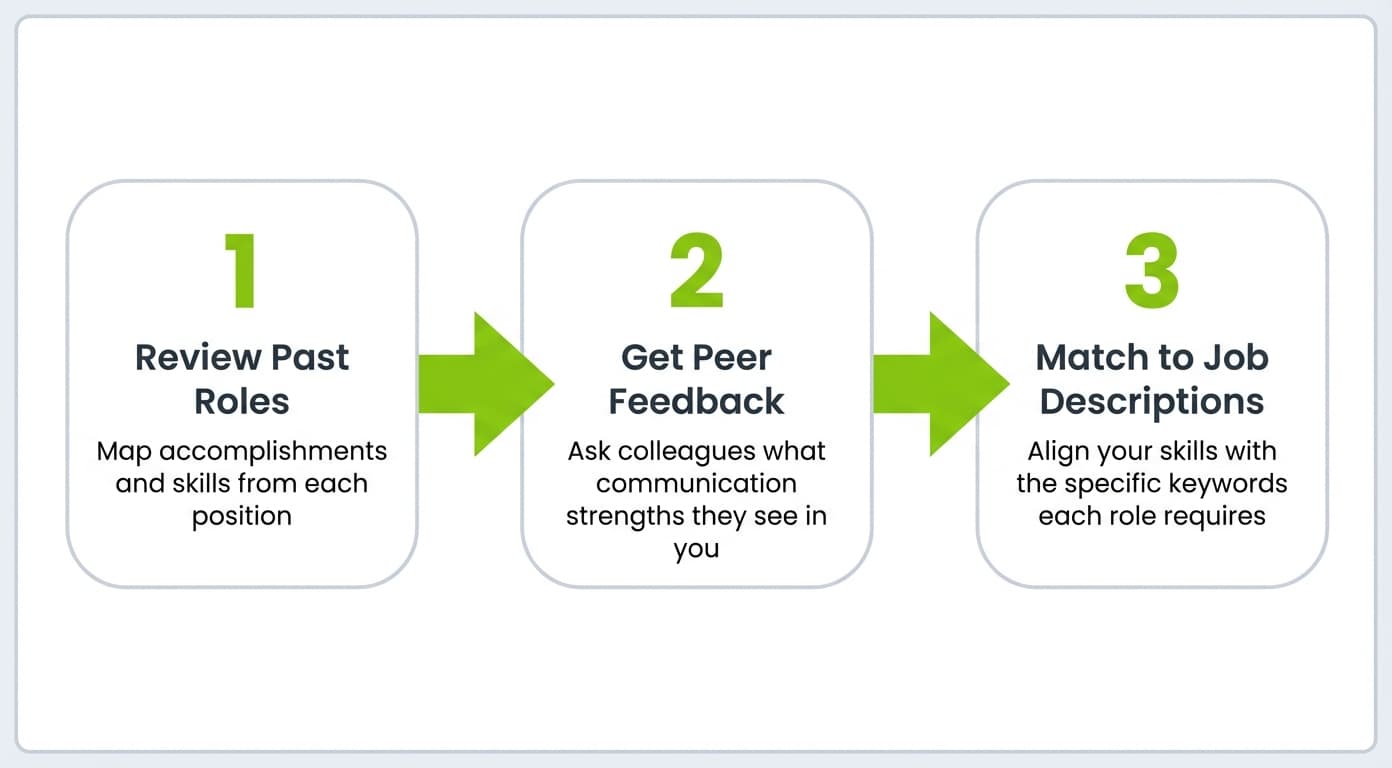
Pour repérer vos meilleures compétences en communication, vous avez besoin d'une autoévaluation honnête et d'un regard extérieur. Les aptitudes techniques se mesurent par des tests ou des certifications, mais les forces en communication se révèlent à travers l'expérience et les retours. Voici quelques moyens concrets de repérer vos atouts en communication.
Passez en revue vos rôles et responsabilités passés
Votre parcours professionnel en dit long sur vos forces en communication. Commencez par créer une chronologie de carrière qui recense vos principales réussites, en notant les compétences techniques et humaines mobilisées à chaque étape. Tenez un journal de travail où vous consignez vos tâches quotidiennes ou hebdomadaires et les compétences en communication que chacune a exigées. Examinez ensuite les différents rôles que vous avez occupés, que ce soit comme chercheuse, chef d'équipe, formatrice ou représentant en relation avec la clientèle, et dressez la liste des tâches de communication précises que chaque poste demandait.
Une fois vos compétences en communication les plus fortes identifiées, un modèle structuré facilite leur présentation. Le créateur de CV Careerkit vous permet d'organiser vos compétences, votre expérience et votre résumé dans un format déjà optimisé pour l'analyse par les ATS. Peut-être avez-vous expliqué quelque chose de complexe de façon claire, résolu un conflit ou rédigé une documentation qui a aidé les autres.
Ne vous contentez pas d'énumérer des tâches, mettez l'accent sur les compétences. Plutôt que d'écrire « animé des réunions d'équipe », valorisez la compétence : « coordonné des discussions qui ont accru l'efficacité de l'équipe de 30 % ». Cela transforme de simples descriptions en preuves solides de ce dont vous êtes capable.
Sollicitez des retours de vos pairs ou de vos managers
Les autres perçoivent souvent en nous des forces qui nous échappent. Les recherches montrent que des avis honnêtes de sources de confiance peuvent révéler les domaines où vous excellez :
Commencez par demander un retour honnête à des personnes qui vous ont vu communiquer dans différentes situations : des clients de longue date, des collègues rencontrés en réunion et des proches qui savent comment vous gérez la pression. Filmez-vous en train de parler afin de revoir à la fois vos mots et votre langage corporel. La vidéo est particulièrement utile, car elle vous permet de voir l'ensemble de votre style de communication du point de vue de l'auditoire.
Pret a decrocher votre emploi de reve ?
Rejoignez plus de 50 000 chercheurs d'emploi qui ont deja transforme leur carriere avec notre createur de CV propulse par l'IA.
Posez des questions précises plutôt que des questions générales sur les « compétences en communication ». Essayez des questions comme : « Est-ce que j'explique bien les concepts techniques ? » ou « Mes instructions écrites sont-elles assez claires ? » Vous obtiendrez ainsi des réponses plus concrètes.
Lorsque des personnes vous font un retour, ne vous expliquez pas et ne vous justifiez pas. Dites simplement : « Merci. Je vais y réfléchir. » Cela montre du respect pour leur avis et vous laisse le temps de l'assimiler.
Faites correspondre vos compétences aux descriptions de poste
Les offres d'emploi montrent quelles compétences en communication les employeurs recherchent le plus. Lire ces descriptions vous aide à voir où vos forces répondent aux besoins du marché :
Lisez attentivement les offres et repérez les mots-clés liés à la communication au-delà des formules génériques comme « excellent communicant ». Prêtez attention aux compétences précises que le poste exige, comme présenter à des parties prenantes, influencer des équipes transverses, rédiger de la documentation technique ou gérer des relations client. Adaptez ensuite environ 20 % de votre CV aux exigences de communication de chaque poste, en gardant les 80 % restants identiques d'une candidature à l'autre.
Les employeurs veulent plus que de « bonnes compétences en communication ». Ils recherchent des personnes qui travaillent bien avec leurs collègues et leurs clients, mènent des conversations difficiles, résolvent les conflits et s'adaptent à des contextes de travail précis, qu'il s'agisse d'équipes, de télétravail ou de présentations formelles.
Nouveau sur le marché du travail ou en pleine reconversion ? Aucun problème. Vos projets personnels, vos travaux universitaires et vos activités en dehors du travail peuvent démontrer de solides compétences en communication. Notre guide pour rédiger votre premier CV vous explique comment relier ces expériences à des situations professionnelles, même sans années d'expérience.
Une image claire de vos forces en communication se dégage lorsque vous passez en revue vos expériences, recueillez des retours honnêtes et faites correspondre vos compétences aux exigences des postes. Cette connaissance vous aide à présenter ces aptitudes efficacement sur votre CV.
Comment montrer vos compétences en communication sur votre CV
Un bon CV montre vos compétences en communication aux employeurs potentiels. Votre manière de présenter ces aptitudes peut influencer les décisions de recrutement. Une présentation médiocre peut vous coûter des occasions d'entretien. Voyons des méthodes éprouvées pour mettre en valeur ces compétences essentielles.
Utilisez des verbes d'action et des résultats mesurables
Des verbes d'action forts attirent l'attention et montrent votre aisance en communication sans le dire directement. Commencez chaque puce par des verbes percutants qui traduisent vos capacités de communication :
Parmi les verbes d'action forts axés sur la communication figurent traité, arbitré, rédigé, collaboré, correspondu, ébauché, animé, influencé, interprété, arbitré, négocié, persuadé, présenté et promu. Des mots comme « coordonné », « dirigé » et « négocié » signalent immédiatement une aptitude à la communication et pèsent bien plus que des formules génériques comme « responsable de » que les recruteurs voient des centaines de fois par jour.
Des mots comme « coordonné », « dirigé » et « négocié » montrent de solides aptitudes à la communication. Ils fonctionnent mieux que des termes génériques comme « responsable de » que les recruteurs voient souvent. Ces verbes percutants dressent un portrait clair de ce dont vous êtes capable.
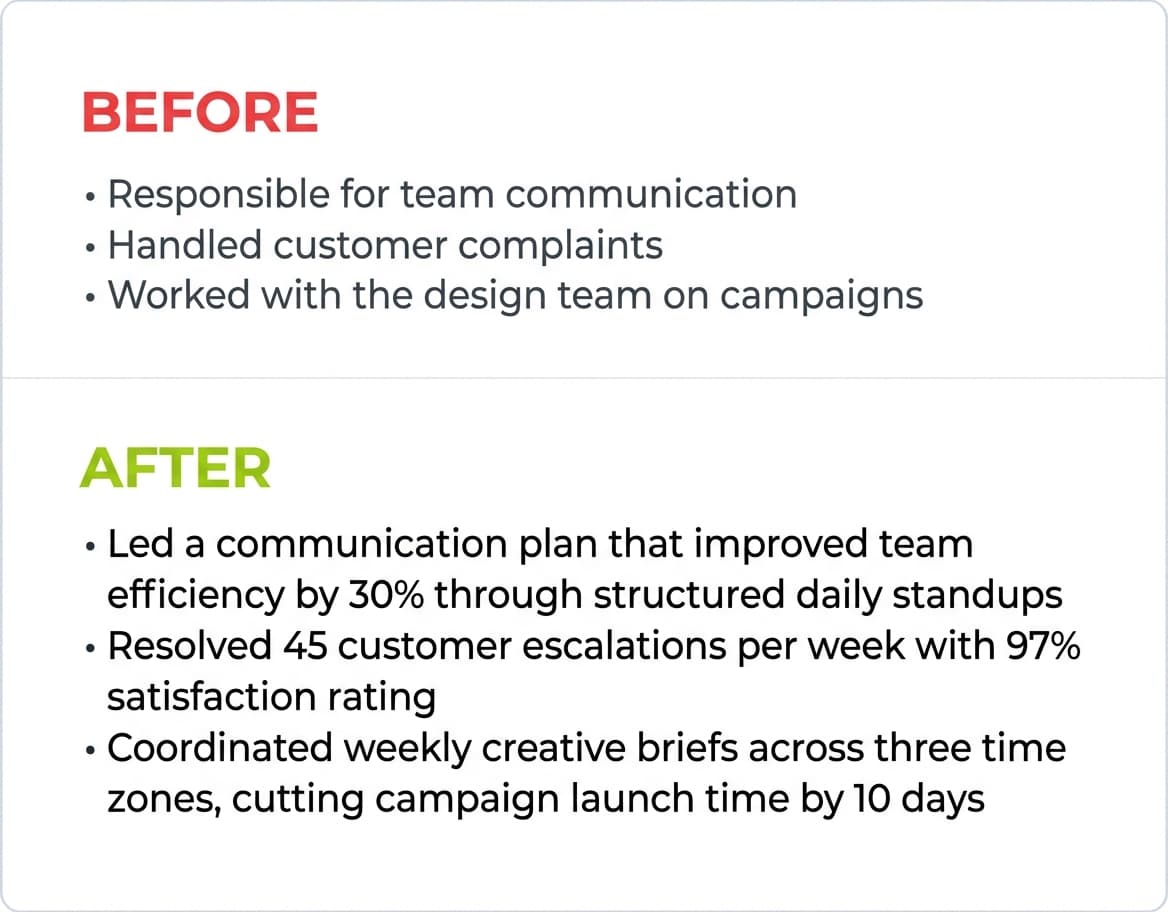
Cela dit, les verbes seuls ne suffisent pas. Ajouter des chiffres à vos réussites transforme des affirmations vagues en preuves solides. Pour ne citer qu'un exemple, observez ce changement :
Faible : « Responsable de la communication d'équipe. »Fort : « Piloté un dispositif qui a amélioré l'efficacité de l'équipe de 30 % grâce à des points quotidiens structurés et à des rapports d'avancement hebdomadaires. »
Cela montre à la fois comment vous communiquez et ce que cela a produit. Ajoutez des chiffres dès que possible pour illustrer l'ampleur (taille de l'auditoire, fréquence), l'efficacité (temps gagné) ou la qualité (scores de satisfaction).
Voici deux autres exemples avant/après pour différents postes :
Faible (service client) : « Traité les réclamations clients. »
Fort : « Résolu en moyenne 45 remontées clients par semaine grâce à l'écoute active et à des techniques de désamorçage, atteignant un taux de satisfaction de 97 % dans les enquêtes après appel. »
Faible (marketing) : « Travaillé avec l'équipe de design sur des campagnes. »
Fort : « Coordonné des briefs créatifs hebdomadaires entre les équipes marketing et design sur trois fuseaux horaires, réduisant les cycles de révision de quatre à deux et raccourcissant le délai de lancement des campagnes de 10 jours. »
Adaptez vos exemples à la description de poste
Avant de rédiger votre CV, analysez la description de poste pour repérer les mots-clés liés à la communication. Déterminez quelles compétences précises le poste requiert : présenter, influencer, gérer ou rédiger. Notez ces exigences et ajoutez des exemples pertinents.
Évitez les affirmations génériques comme « excellent communicant ». Les employeurs veulent des personnes capables de bien collaborer avec leurs collègues et leurs clients, de parler de performance, de résoudre les conflits et de communiquer dans des situations de travail précises.
Mettez donc en avant des expériences qui montrent exactement comment vous avez utilisé ces compétences :
« Géré des parties prenantes internationales en Inde, au Royaume-Uni et à Hong Kong au moyen de points quotidiens et de rapports d'avancement hebdomadaires. »
Cet exemple montre que vous savez communiquer entre différentes cultures et fuseaux horaires, un atout pour les organisations internationales.
Intégrez à la fois des compétences humaines et techniques de communication
Le bon équilibre entre expertise technique et compétences humaines est essentiel pour montrer que vous êtes un candidat complet. Les employeurs recherchent des personnes capables d'accomplir des tâches précises tout en travaillant bien avec les autres.
Montrez comment vous avez utilisé des compétences techniques de communication dans des situations réelles plutôt que de les énumérer. Au lieu d'écrire « bonne communication écrite », dites : « Rédigé la documentation technique du projet de migration de l'API, réduisant le temps d'intégration des nouveaux développeurs de deux semaines à trois jours. »
Intégrez des compétences humaines de communication en décrivant vos réussites. Au lieu d'écrire « esprit d'équipe » ou « excellent communicant », montrez ces qualités à travers des réalisations :
« Négocié avec des équipes transverses pour mener à bien un projet client complexe. Nous avons résolu des priorités contradictoires et livré deux semaines en avance. »
Oui, il est vrai que votre CV lui-même reflète vos compétences en communication écrite. Conservez une structure professionnelle sans fautes d'orthographe ni de grammaire. Si vous êtes en train de créer votre CV de A à Z, utilisez un modèle épuré qui laisse votre contenu s'exprimer clairement. Rendez chaque section limpide pour montrer que vous communiquez bien et restez organisé.
Vos aptitudes en communication doivent être reliées à des résultats concrets. Notez qu'une communication sans résultats n'est que du bavardage. Même dans un espace limité, chaque point devrait relier votre manière de communiquer à un résultat positif. Cela montre que vous savez qu'une bonne communication produit des résultats et ne se contente pas de transmettre de l'information.
La meilleure preuve de vos compétences en communication vient du fait de les montrer, non de les affirmer. Utilisez des puces rédigées avec soin, centrées sur les réalisations, qui démontrent vos aptitudes avérées.
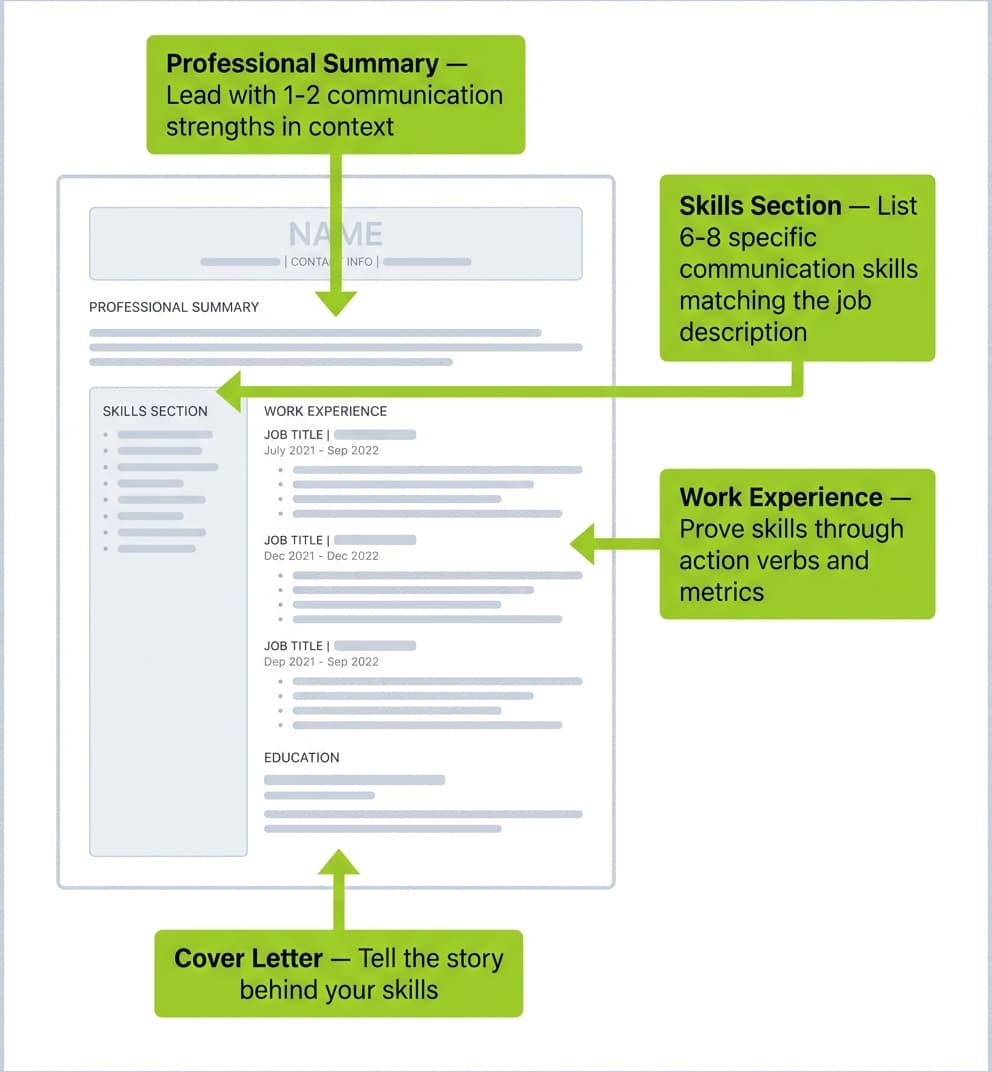
Où placer vos compétences en communication dans votre CV
Un placement judicieux de vos compétences en communication tout au long de votre CV augmente vos chances de franchir les systèmes de tri automatique et les recruteurs humains. Les bons endroits pour valoriser ces aptitudes font la différence entre être remarqué ou passer inaperçu.
Résumé professionnel
Votre résumé professionnel figure en haut de votre CV. Cet emplacement de choix aide à mettre en avant vos meilleures aptitudes en communication. Cette section doit être brève tout en ayant du poids : 3 à 4 lignes qui accrochent immédiatement l'attention.
Cette introduction doit présenter 1 à 2 forces principales en communication avec un contexte rapide plutôt que des compétences génériques. Au lieu d'écrire « excellent communicant », vous pourriez écrire :
« Spécialiste de la communication très motivée, forte de cinq ans d'expérience en communication et relations publiques. Professionnelle à l'aise avec les outils numériques, à la recherche d'un poste stimulant de responsable de la communication digitale au sein d'une organisation porteuse de sens. »
Cette approche montre votre expertise tout en prouvant vos compétences en communication écrite par un langage clair et direct.
Voici un deuxième exemple pour un poste hors communication :
« Chef de projet senior avec sept ans d'expérience à la tête d'équipes transverses de 15 personnes ou plus réparties sur plusieurs sites. Reconnu pour traduire des exigences techniques complexes en mises à jour claires destinées aux parties prenantes, qui maintiennent les projets alignés et dans les délais. »
Cela fonctionne parce que le texte ne dit pas « excellent communicant ». Il démontre la communication à travers les actions concrètes décrites.
Section Compétences
La section Compétences est un excellent moyen de faire figurer 6 à 8 aptitudes en communication pertinentes qui correspondent à la description de poste. Cette section doit être facile à parcourir pour que les recruteurs repèrent vite vos capacités.
Vous pouvez inclure des aptitudes précises comme la prise de parole en public assurée, l'écoute empathique, l'écriture persuasive, la présentation aux parties prenantes, la négociation, la communication interculturelle ou la documentation technique. L'essentiel est de choisir six à huit compétences qui correspondent directement au vocabulaire de la description de poste plutôt que d'énumérer des termes génériques.
L'essentiel est d'éviter d'énumérer des « compétences en communication » sans contexte. Reliez ces aptitudes à des résultats : vos présentations ont-elles orienté des décisions ? Votre communication écrite a-t-elle réduit les erreurs ? Votre écoute a-t-elle amélioré la satisfaction client ?
Section Expérience professionnelle
La section Expérience professionnelle prouve votre expertise en communication à travers de vrais exemples. Chaque responsabilité appelle des formulations concises qui commencent par des verbes forts.
Chaque poste devrait montrer comment vous avez utilisé vos compétences en communication. Pour ne citer qu'un exemple, si vous avez travaillé dans le service client, expliquez comment vous avez aidé les clients à comprendre et à satisfaire leurs besoins.
Transformez des affirmations vagues en preuves solides à l'aide de chiffres :
« Animé des réunions d'équipe hebdomadaires pour fixer les objectifs des projets, aboutissant à 95 % de projets livrés dans les délais. »
« Résolu des réclamations clients avec un taux de satisfaction de 95 % grâce à des techniques d'écoute active. »
« Présenté des rapports trimestriels à la direction et obtenu l'approbation de trois nouvelles initiatives. »
Vos exemples devraient montrer à la fois vos aptitudes en communication écrite et orale. Ajoutez des situations où vous avez conclu des accords ou collaboré avec des équipes pour mener des projets à terme.
Lettre de motivation (astuce bonus)
Votre lettre de motivation vous permet de montrer les compétences en communication requises pour la plupart des postes. Le document lui-même reflète vos aptitudes en communication écrite, d'où l'importance d'une rédaction et d'une relecture soignées.
Contrairement à votre CV, votre lettre de motivation doit raconter vos qualifications et votre motivation à travers un récit convaincant. Construisez-la avec une introduction claire, des paragraphes ciblés dans le corps et une brève conclusion.
Une lettre de motivation bien rédigée vous aide à montrer vos compétences, à laisser une impression durable et à décrocher un entretien. Si vous ne savez pas trop en quoi une lettre de motivation diffère d'un CV, la réponse courte est que votre CV énumère les preuves tandis que votre lettre raconte l'histoire qui les sous-tend. Utilisez cet espace pour tisser vos expériences en un récit qui montre pourquoi vous êtes la bonne personne pour le poste. Vous pouvez créer votre lettre de motivation ici à l'aide d'un modèle assorti à votre CV.
Voici un court exemple de la façon d'intégrer des compétences en communication dans l'ouverture d'une lettre de motivation :
« Dans mon poste actuel chez Meridian Solutions, j'anime une réunion transverse hebdomadaire entre l'ingénierie, le design et le produit, une réunion qui débutait comme une mêlée de 90 minutes et se déroule aujourd'hui en moins de 30 minutes, avec des points d'action clairs. Cette capacité à apporter structure et clarté à des échanges complexes est précisément ce qui m'a attiré vers ce poste. »
Exemples de compétences en communication dans les puces d'un CV
Des puces bien rédigées peuvent transformer un CV ordinaire en une vitrine convaincante de vos aptitudes en communication. Ces exemples concrets vous montrent comment mettre en valeur vos compétences en communication de manière à toucher les recruteurs.
Animé des réunions d'équipe hebdomadaires pour définir les objectifs des projets
Les responsables ont besoin de compétences en communication exceptionnelles pour faire avancer les projets tout en favorisant la collaboration au sein de l'équipe. Ces exemples parlants montrent pourquoi :
« Dirigé une équipe de 12 personnes et atteint une croissance du chiffre d'affaires de 30 % grâce à des réunions hebdomadaires structurées alignant les contributions individuelles sur les objectifs stratégiques »
« Facilité la communication interservices, ce qui a réduit de 50 % le délai de résolution des cas complexes »
« Orchestré des réunions d'équipe pour rechercher et imaginer des solutions, créant un esprit de camaraderie qui a amélioré l'efficacité de l'équipe »
Ces puces fonctionnent parce qu'elles sont précises. Vous démontrez la valeur commerciale de vos compétences en communication en indiquant à la fois la méthode (animer des réunions) et les résultats (croissance du chiffre d'affaires, délais de résolution raccourcis).
Résolu des réclamations clients avec un taux de satisfaction de 95 %
Les postes du service client vous offrent d'excellentes occasions de mettre en avant votre expertise en communication à travers la résolution de conflits et de problèmes :
« Résolu plus de 500 réclamations clients par mois, atteignant un taux de satisfaction de 98 % grâce à une communication efficace et à des techniques de résolution »
« Géré en moyenne 120 demandes clients par jour, respectant systématiquement les objectifs de résolution des appels et réduisant les appels répétés de 20 % »
« Désamorcé des confrontations tendues entre clients, aboutissant à des résolutions apaisées et préservant la réputation de l'entreprise pour son service exceptionnel »
Mesurer vos réussites transforme des affirmations générales en preuves solides. Chaque exemple relie des méthodes de communication à des résultats ou des indicateurs précis, ce qui les rend plus convaincants qu'un simple « doué pour résoudre les conflits ».
Présenté des rapports trimestriels à la direction
Vos compétences de présentation montrent à quel point vous communiquez des informations complexes à différents publics avec clarté et conviction : exemples de communication par secteur
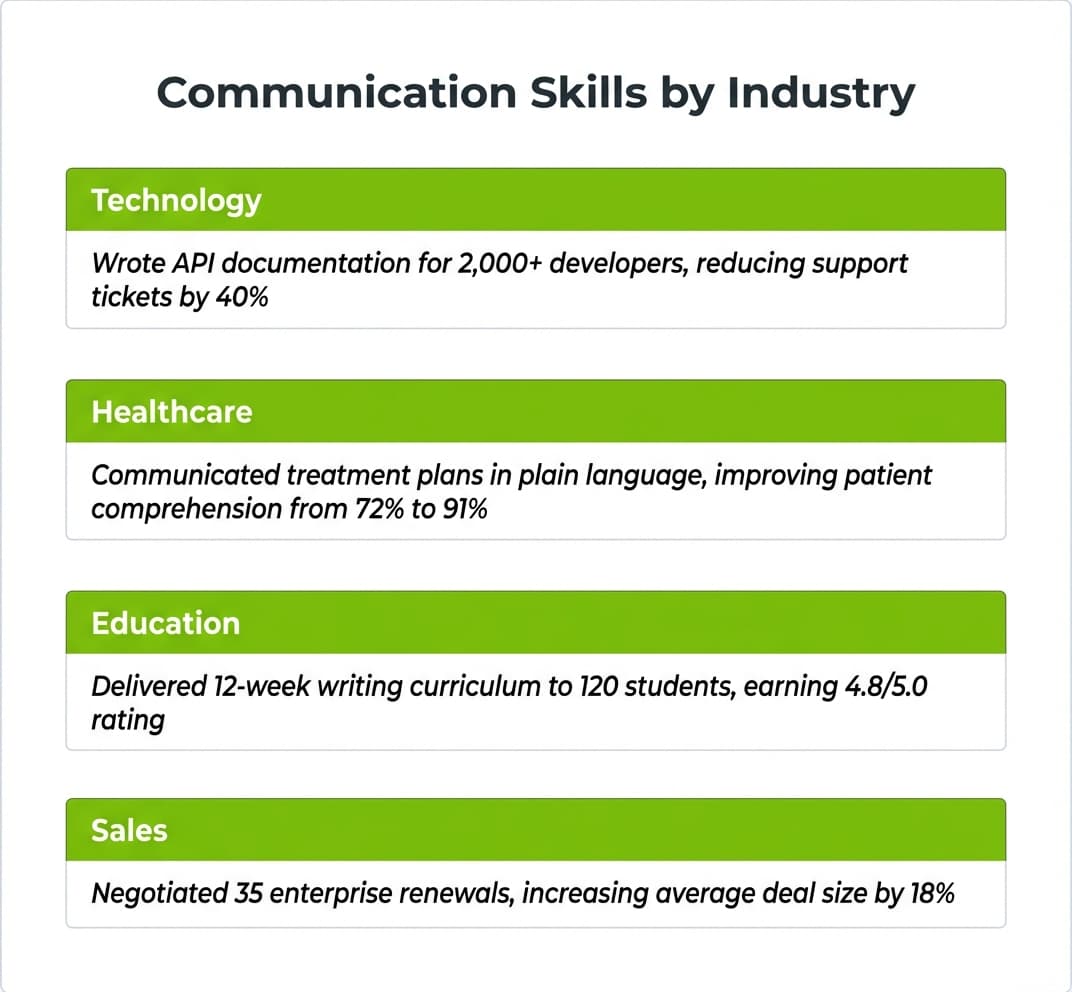
Chaque secteur valorise des compétences en communication différentes. Voici d'autres exemples que vous pouvez adapter à votre propre CV :
Technologie :
« Rédigé des notes de version et la documentation de l'API pour un public de plus de 2 000 développeurs, réduisant de 40 % les tickets de support liés aux nouvelles fonctionnalités. »
Santé :
« Expliqué les plans de traitement aux patients et à leurs proches en langage simple, faisant passer les scores de compréhension des patients de 72 % à 91 % selon les enquêtes après consultation. »
Éducation :
« Conçu et dispensé un programme de 12 semaines sur l'écriture professionnelle pour 120 étudiants de licence, obtenant une note d'enseignant de 4,8 sur 5,0. »
Vente :
« Négocié le renouvellement de contrats avec 35 comptes grands comptes, en recourant à une communication consultative pour augmenter le montant moyen des accords de 18 % d'une année sur l'autre. »
Les chiffres rendent vos présentations plus marquantes. Mentionnez la taille de votre auditoire, la fréquence de vos présentations ou, mieux encore, les résultats obtenus grâce à vos efforts de communication.
Des exemples précis prouvent vos compétences en communication mieux que la simple affirmation d'être « un excellent communicant ». Ces puces mettent en valeur vos aptitudes avérées et donnent aux employeurs de bonnes raisons de croire que vous serez précieux pour leur organisation.
Faites de vos compétences en communication un atout
Les compétences en communication ne sont pas une case à cocher sur un CV. Elles sont le fil conducteur qui traverse chaque section, de votre résumé professionnel à votre lettre de motivation. La différence entre les candidats qui décrochent des entretiens et ceux qui sont écartés tient souvent à une chose : montrer plutôt que dire.
Au lieu d'écrire « excellent communicant », montrez que vous avez animé des réunions qui ont fait avancer des projets, rédigé une documentation qui a fait gagner des heures à votre équipe ou résolu des conflits qui ont préservé des relations client. Chaque puce de votre CV est une occasion de prouver vos compétences en communication par des actions concrètes et des résultats mesurables.
Parmi les compétences en communication les plus fortes pour un CV figurent la communication verbale comme la prise de parole en public et les présentations, la communication écrite comme les rapports et la documentation, l'écoute active, la négociation, la résolution de conflits et la communication interculturelle. Adaptez toujours votre liste au vocabulaire précis de la description de poste plutôt que d'employer des termes génériques.
Utilisez les puces de votre expérience professionnelle pour montrer la communication en action. Commencez chaque puce par un verbe d'action fort comme « présenté », « négocié » ou « rédigé », puis indiquez ce que vous avez fait, qui était impliqué et le résultat mesurable. Par exemple, « Présenté des rapports de performance trimestriels à une équipe de direction de 12 personnes, obtenant l'approbation de trois nouvelles initiatives » est bien plus convaincant que « solides compétences en communication ».
Les deux. Indiquez six à huit compétences en communication précises dans votre section Compétences en reprenant des mots-clés de l'offre, comme « communication avec les parties prenantes » ou « rédaction technique ». Étayez-les ensuite avec des exemples concrets dans les puces de votre expérience professionnelle. Cette combinaison satisfait à la fois l'analyse des mots-clés par les ATS et les lecteurs humains.
La communication verbale recouvre les compétences orales comme les présentations, les réunions, les appels téléphoniques et les négociations. La communication écrite recouvre les compétences textuelles comme les e-mails, les rapports, les propositions et la documentation. La plupart des postes exigent les deux, mais l'équilibre varie selon le poste. Un rôle commercial s'appuie davantage sur l'oral, tandis qu'un rôle de contenu ou technique s'appuie sur l'écrit.
Appuyez-vous sur des projets universitaires, du bénévolat, des associations étudiantes et des projets personnels. Animer une présentation de groupe, écrire pour une publication étudiante, organiser un événement ou accompagner des camarades démontrent tous des compétences en communication. Présentez-les de la même manière qu'une expérience professionnelle : décrivez la situation, votre rôle en communication et le résultat.
Oui. Les systèmes de suivi des candidatures recherchent des correspondances exactes de mots-clés issus de la description de poste. Si l'offre indique « gestion des parties prenantes » et que votre CV dit « travail avec les parties prenantes », l'ATS risque de ne pas faire le lien. Reprenez la formulation exacte de l'annonce à la fois dans votre section Compétences et dans les puces de votre expérience.
Mettez ces conseils en pratique
Vous connaissez la théorie. Le créateur IA de Careerkit la transforme en CV optimisé ATS, adapté au poste que vous visez.
Nishant Modi is the founder of Careerkit.me and a product builder based in Zürich, Switzerland. With a background in product management, marketing & management consulting, he transitioned into AI entrepreneurship after experiencing the frustration of outdated job search tools firsthand. He built Careerkit to give every job seeker access to professional grade resume tools, the platform has helped over 10,000 candidates create ATS optimized resumes. He writes about resume strategy, hiring trends, and what actually gets people hired.